
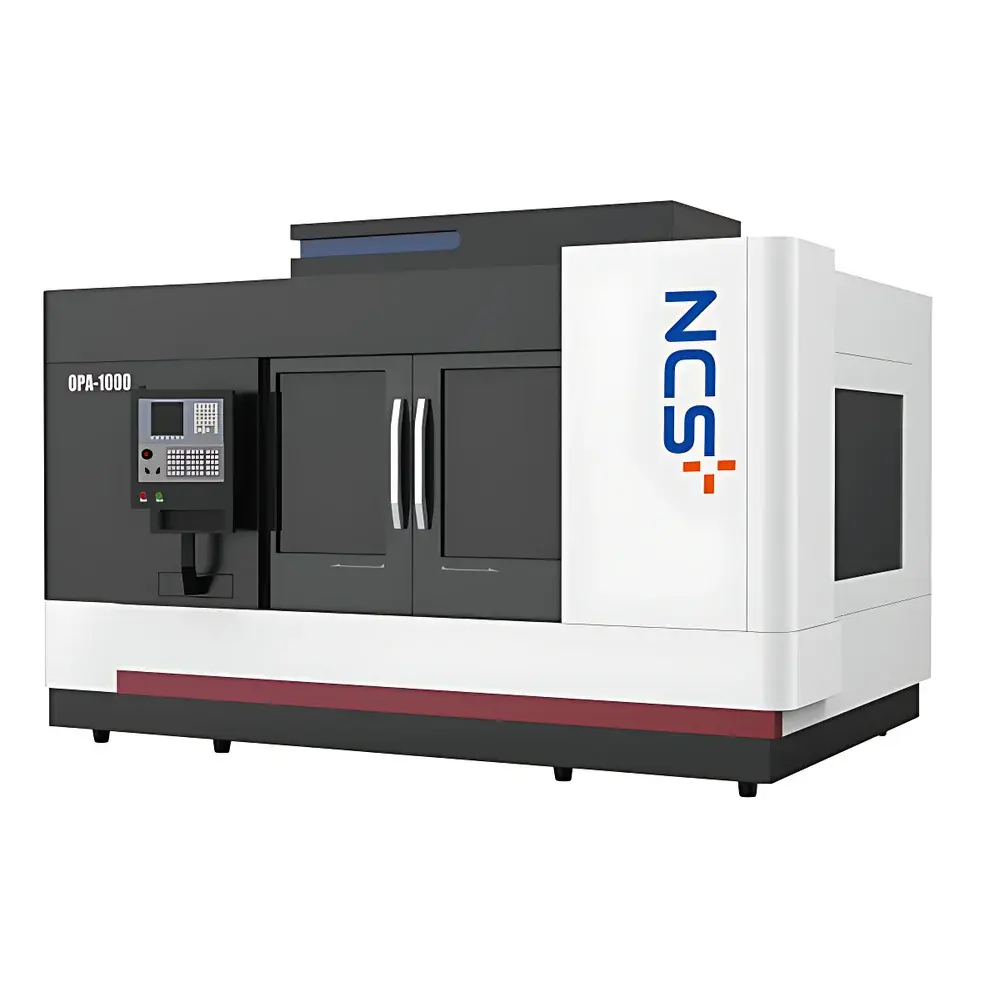
NCS OPA-1000 Fully Automated In-Situ Statistical Distribution Analyzer for Ultra-Large Metallic Components
| Brand | NCS |
|---|---|
| Origin | Beijing, China |
| Manufacturer Type | Original Equipment Manufacturer (OEM) |
| Country of Origin | China |
| Model | OPA-1000 |
| Pricing | Upon Request |
Overview
The NCS OPA-1000 is a fully automated, large-area in-situ statistical distribution analyzer engineered for quantitative elemental and microstructural characterization of ultra-large metallic components—up to 1000 mm × 510 mm in planar dimension. Developed under China’s National Major Scientific Instrument Program, it implements the proprietary Original Position Analysis (OPA) methodology—a novel spark-based optical emission spectroscopy (OES) paradigm that eliminates pre-burn requirements and enables continuous, high-speed spatial scanning with direct signal acquisition from single-discharge events. Unlike conventional bulk or micro-spot analysis instruments, the OPA-1000 operates on statistically representative surface mapping principles: it acquires >10⁶ discrete spectral data points per sample via synchronized spark excitation and real-time spectral digitization, then applies multivariate mathematical models to reconstruct position-resolved elemental concentrations, segregation indices, inclusion distributions, and structural heterogeneity metrics across macroscopic scales. Its core innovation lies in bridging metallurgical process validation with materials genomics workflows—providing traceable, high-throughput, non-destructive (surface-level) compositional mapping compliant with ASTM E407, ISO 11885, and GB/T 4336 standards for metallic material analysis.
Key Features
- Fully integrated metrology-grade machining–scanning–analysis platform: Combines 4-axis CNC milling (X/Y/Z/W), sub-10 µm bidirectional positioning repeatability, and adaptive contour-following scan path generation for irregular geometries.
- High-stability continuous spark source: Adjustable frequency (300–800 Hz), optimized for low-noise, high-SNR emission spectra across 130–800 nm range; equipped with 500-mm focal length, 2700-line/mm grating yielding 0.74 nm/mm linear dispersion.
- Real-time parallel data acquisition: Ethernet-linked CCD/CMOS detection system with up to 64 spectral channels; supports concurrent analysis of up to 20 segregation-sensitive elements and 8 inclusion-specific spectral bands.
- Statistical distribution modeling engine: Implements frequency-based histogram analysis, directional anisotropy quantification (1D line scans, 2D cross-sections, 3D volumetric interpolation), and multi-scale segregation descriptors—including statistical segregation degree (SSD), conformity index (CI), and porosity density mapping.
- Automated inclusion characterization module: Leverages boundary-diffusion discharge signatures to classify inclusions by chemical composition (e.g., Al₂O₃, MnS, TiN), quantify size distribution (0.5–200 µm), and map spatial clustering patterns using kernel density estimation.
Sample Compatibility & Compliance
The OPA-1000 accommodates flat or moderately curved metallic specimens (ferrous and non-ferrous alloys) up to 900 kg mass and 1200 mm × 510 mm footprint. Surface preparation is performed in situ via integrated CNC machining (Ra ≤ 3.2 µm, flatness ≤ 0.04 mm/m), ensuring analytical reproducibility without manual intervention. All measurement protocols adhere to GLP-aligned data integrity frameworks: full audit trail logging (user actions, instrument parameters, calibration history), timestamped raw spectral files (HDF5 format), and configurable electronic signatures compliant with FDA 21 CFR Part 11 requirements. The system supports ISO/IEC 17025 method validation documentation packages and is routinely deployed in third-party certified laboratories for aerospace-grade turbine disk and nuclear pressure vessel qualification.
Software & Data Management
Controlled by NCS proprietary OPA-Suite v4.x software, the platform delivers unified workflow management—from toolpath planning and spark parameter optimization to multilayer statistical visualization. Data processing leverages GPU-accelerated parallel computing (max. 5 GB/sample), enabling near-real-time generation of frequency histograms, 2D heatmaps, 3D topographic concentration surfaces, and directional anisotropy vector fields. Export formats include CSV, TIFF, HDF5, and XML-compliant reports compatible with LIMS integration. Software architecture includes role-based access control, versioned method templates, and built-in uncertainty propagation modules aligned with GUM (JCGM 100:2012) guidelines.
Applications
- Quantitative segregation assessment of large-scale castings and forgings (e.g., Ni-based superalloy turbine blades, Ti-6Al-4V airframe components).
- Anisotropy mapping for additive manufacturing parts—correlating build direction with elemental partitioning and phase distribution.
- Materials genome initiative (MGI) campaigns requiring high-throughput, position-resolved composition libraries for CALPHAD model training.
- Root-cause analysis of service-induced failures via inclusion cluster localization and compositional fingerprinting (e.g., sulfide stringers in pipeline steels).
- Process validation for hot isostatic pressing (HIP), diffusion bonding, and friction stir welding—evaluating interfacial homogeneity at cm-scale resolution.
FAQ
What sample preparation is required prior to analysis?
No external preparation is needed—the OPA-1000 performs in-situ surface conditioning via its integrated CNC system, including leveling, roughing, and finishing passes to achieve Ra ≤ 3.2 µm.
Can the system analyze coated or plated components?
Yes, provided the coating thickness is ≤ 50 µm and chemically distinct from the substrate; depth profiling is achieved through controlled spark ablation rate modulation.
Is remote operation and monitoring supported?
Yes—OPA-Suite supports secure VPN-based remote access with live scan visualization, alarm notifications, and diagnostic telemetry.
How is calibration traceability maintained?
Calibration uses NIST-traceable certified reference materials (CRMs) such as IRMM-016, BCS-CRM 301, and custom alloy standards; all calibrations are stored with metadata including uncertainty budgets and drift correction coefficients.
Does the system support automated report generation for regulatory submissions?
Yes—templates conform to ASTM E2925, ISO 17025, and ICH M10 requirements, including raw data annexes, statistical confidence intervals, and instrument qualification records (IQ/OQ/PQ).




