
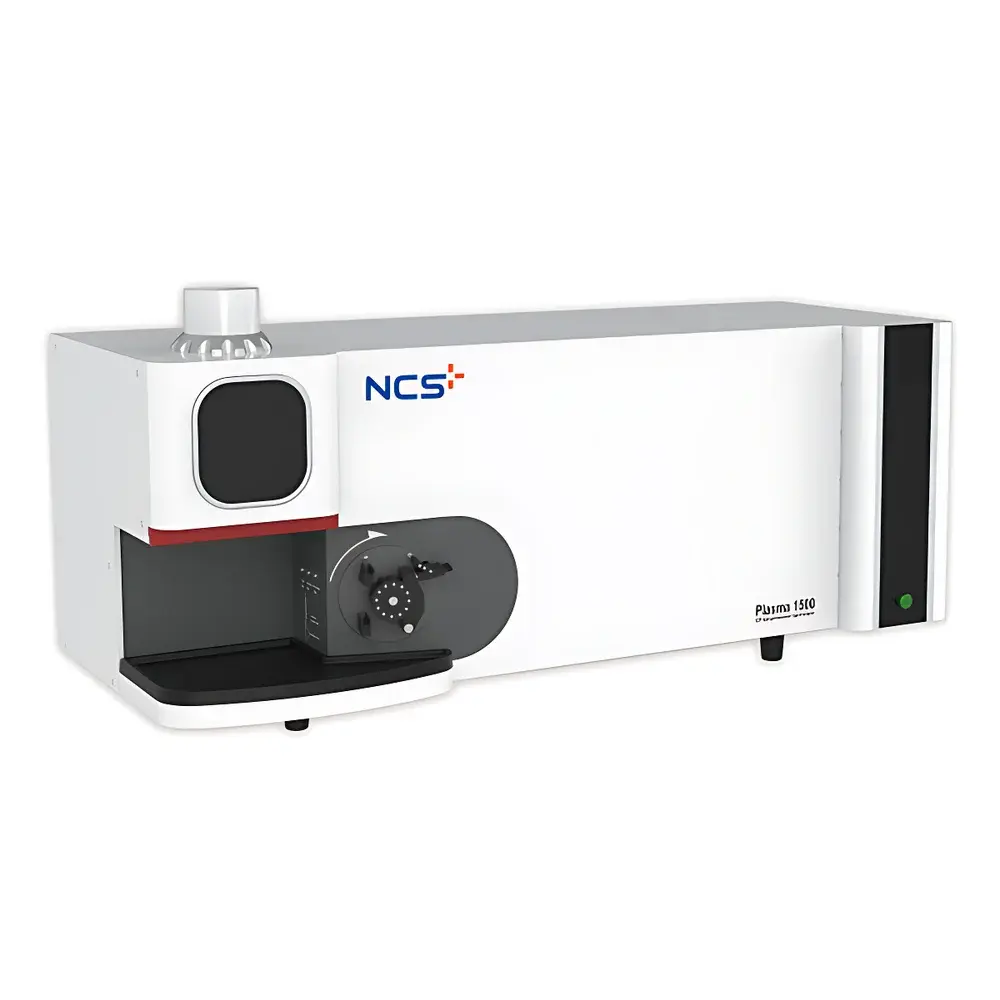
NCS Plasma 1500 Inductively Coupled Plasma Optical Emission Spectrometer
| Brand | NCS |
|---|---|
| Origin | Jiangsu, China |
| Manufacturer Type | Original Equipment Manufacturer (OEM) |
| Instrument Type | Sequential Scanning ICP-OES |
| Detection Limit (Zn at 213.856 nm) | ≤0.003 µg/L |
| Precision (RSD) | ≤0.5% at 1 mg/L (n=10) |
| Short-term Stability (RSD) | ≤0.75% (500×LOD) |
| Long-term Stability (RSD) | ≤1.25% (500×LOD) |
| Wavelength Range | 165–800 nm (2400 g/mm grating) |
| Optical Resolution | ≤0.012 nm (2400 g/mm) |
Overview
The NCS Plasma 1500 is a high-performance sequential scanning inductively coupled plasma optical emission spectrometer (ICP-OES) engineered for trace elemental analysis across diverse sample matrices. Based on the fundamental principle of atomic emission spectroscopy—where analyte atoms and ions, atomized and excited in a high-temperature argon plasma (~6,000–10,000 K), emit characteristic photons upon relaxation—the Plasma 1500 delivers quantitative multi-element data with sub-part-per-trillion detection capability in optimized configurations. Designed and manufactured by NCS (National Center for Iron and Steel Research Co., Ltd.), a state-owned enterprise and publicly listed company in China, the instrument reflects over 35 years of method development expertise and direct contribution to national and industry standards—including GB/T 36244–2018 for ICP-OES instrumentation and multiple ASTM- and ISO-aligned test protocols used in metallurgy, environmental monitoring, and geochemical laboratories.
Key Features
- High-efficiency all-solid-state RF generator (500–1600 W, 1-W resolution), featuring automatic impedance matching, <0.1% power stability, and <0.01% frequency stability—eliminating vacuum tube dependency and enabling robust operation with volatile organic solvents and high-salt matrices.
- Czerny-Turner optical architecture with large-format, high-line-density holographic plane gratings (2400/3600/4320 g/mm), offering selectable spectral resolution down to ≤0.006 nm (at 4320 g/mm) and extended wavelength coverage from 165 nm to 800 nm.
- Dual-grating option (4320 + 2400 g/mm) ensures uniform high resolution across the full UV–VIS–NIR spectral range without mechanical reconfiguration.
- Vertical torch configuration with interchangeable quartz or ceramic monolithic torches (center tube ID: 0.8/1.5/2.0 mm), enhancing matrix tolerance and reducing maintenance frequency.
- Optimized sample introduction system: four-channel, 12-roller peristaltic pump (continuously adjustable speed); vortex or dual-chamber spray chamber; HF-resistant nebulizers and chambers; precision mass flow controllers for plasma gas regulation.
- Thermally stabilized optical chamber maintained at 35.0 ± 0.1 °C via multi-point active cooling; optional nitrogen or argon purge for enhanced UV transmission and reduced ozone-related signal drift.
Sample Compatibility & Compliance
The Plasma 1500 supports liquid samples—including aqueous standards, digested geological/metallic matrices, environmental waters, food extracts, pharmaceutical leachates, and petrochemical distillates—with proven performance under high-dissolved-solid (up to 25% TDS) and hydrofluoric acid-containing conditions. Its vertical-view plasma geometry minimizes self-absorption and polyatomic interferences common in axial-view systems, improving accuracy for major and minor elements (e.g., Al, Fe, Ca, Mg) alongside trace analytes (e.g., As, Cd, Pb, U). The system complies with key regulatory frameworks governing analytical instrumentation: it supports audit trails, electronic signatures, and secure user access control aligned with FDA 21 CFR Part 11 requirements; its calibration and validation workflows are compatible with ISO/IEC 17025 and GLP/GMP laboratory practices. Method documentation adheres to ASTM D1976, ISO 11885, USP <232>, and EN 14802 standards.
Software & Data Management
The proprietary NCS ICP Analysis Suite provides a validated, Windows-based platform with intuitive workflow navigation and context-aware guidance. It includes a comprehensive spectral library of >70,000 certified emission lines, with intelligent interference flagging (e.g., ArO⁺ on Fe 238.204 nm) and automated line selection recommendations based on concentration, matrix, and required detection limit. Quantitative methods support external calibration curves, standard addition, internal standardization (e.g., Y, Sc, In), blank subtraction, and multi-point background correction. All raw intensity data, integration parameters, and instrument metadata are stored in structured binary format with SHA-256 checksum integrity verification. Export options include CSV, PDF, XML, and LIMS-compatible ASTM E1381-compliant files. Remote diagnostics, real-time parameter logging (RF power, coolant flow, plasma temperature proxy), and Ethernet/CAN bus communication ensure interoperability in networked QC environments.
Applications
The Plasma 1500 serves as a core elemental analyzer in accredited laboratories performing routine and research-grade analysis across sectors: metallurgical QC (alloy grade verification, inclusion analysis); environmental testing (EPA Method 200.7 compliance for wastewater and soil digests); geological exploration (multi-element rock and sediment fingerprinting); food safety (heavy metal screening per EU Regulation 1881/2006); pharmaceutical excipient purity (ICH Q3D elemental impurities); and clinical/biomedical research (trace metal profiling in serum, tissue homogenates). Its low-power standby mode (<300 W), rapid plasma ignition (<90 s), and <5-minute optical chamber purge time enable high-throughput batch analysis while minimizing operational cost and argon consumption.
FAQ
What plasma viewing configuration does the Plasma 1500 use?
Vertical (radial) plasma observation, optimized for robustness with complex matrices and reduced maintenance.
Is the instrument compliant with FDA 21 CFR Part 11?
Yes—software supports role-based access control, electronic signatures, and full audit trail functionality for regulated environments.
Can the Plasma 1500 analyze samples containing hydrofluoric acid?
Yes—when equipped with HF-resistant nebulizers, spray chambers, and quartz/ceramic torches.
What is the minimum detection limit for zinc at 213.856 nm?
≤0.003 µg/L under optimized operating conditions (1500 W, 15 L/min nebulizer gas, 15 s integration time).
Does the system support dual-grating optics?
Yes—optional dual-grating configuration (4320 + 2400 g/mm) enables simultaneous high-resolution UV and broad-range VIS/NIR coverage.
What cooling requirements apply to the optical chamber?
Active thermoelectric stabilization maintains 35.0 ± 0.1 °C; no external chiller required.



