
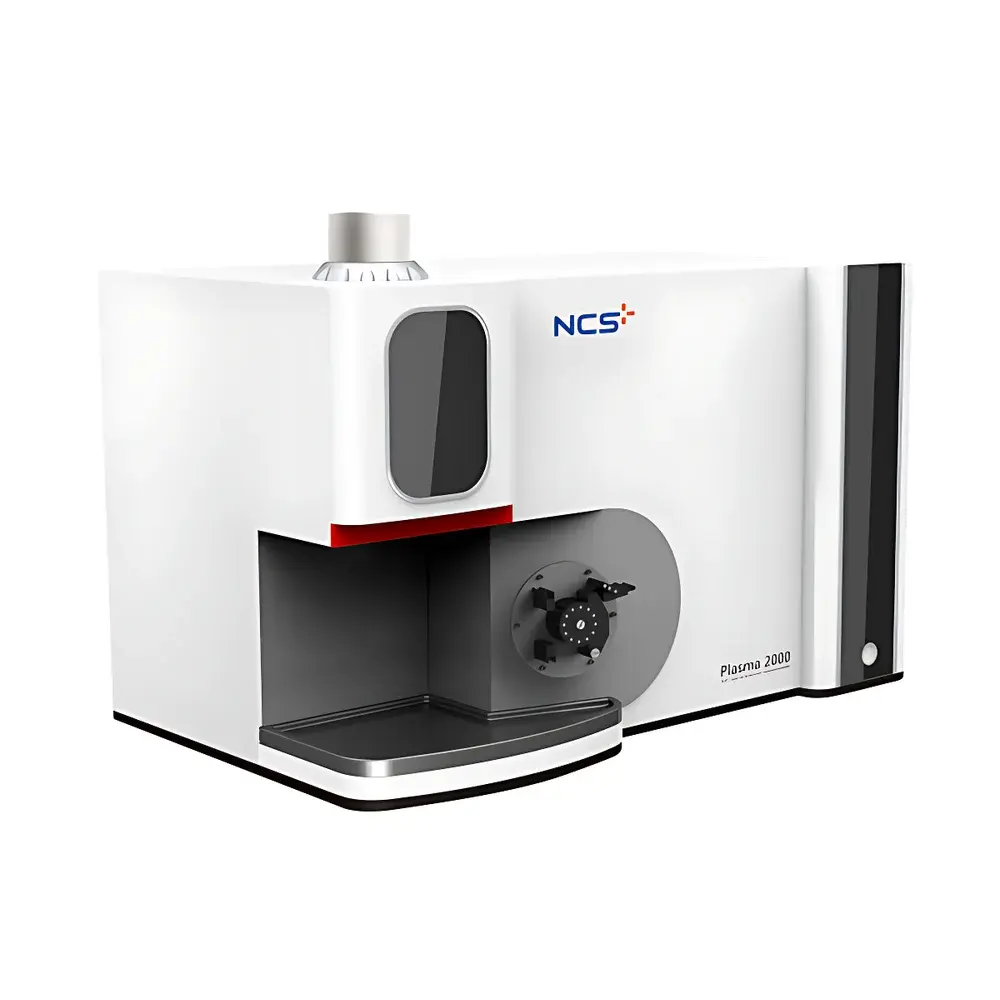
NCS Plasma 2000 Inductively Coupled Plasma Optical Emission Spectrometer
| Brand | NCS |
|---|---|
| Origin | Jiangsu, China |
| Manufacturer Type | Original Equipment Manufacturer (OEM) |
| Product Category | Domestic |
| Model | Plasma 2000 |
| Instrument Type | Full-Spectrum Direct-Reading ICP-OES |
| Detection Limit | Zn at 213.856 nm ≤ 0.003 mg/L |
| Repeatability | RSD ≤ 0.5% (1 mg/L, n = 10) |
| Short-Term Stability | RSD ≤ 0.5% (500 × LOD) |
| Long-Term Stability | RSD ≤ 1.0% (500 × LOD) |
| Wavelength Range | 165–950 nm |
| Optical Resolution | 0.007 nm (at 200 nm) |
Overview
The NCS Plasma 2000 is a full-spectrum direct-reading inductively coupled plasma optical emission spectrometer (ICP-OES) engineered for high-precision elemental analysis across diverse sample matrices. Based on a robust echelle-grating crossed-dispersion optical architecture with a 400 mm focal length, the instrument employs a back-illuminated, large-area CCD detector cooled to < –40 °C via triple-stage thermoelectric refrigeration. This configuration enables simultaneous acquisition of the entire spectral range from 165 nm to 950 nm in a single exposure—eliminating sequential wavelength scanning and ensuring true multielement quantification without time-dependent drift. The system utilizes a solid-state RF generator operating at 27.12 MHz, delivering rapid impedance matching, enhanced signal-to-noise ratio, and stable plasma maintenance even with challenging matrices—including high-salt solutions, volatile organic solvents, and hydrofluoric acid-containing samples. Its vertical torch design, fully assembled quartz torch assembly, and integrated mass-flow-controlled gas delivery (coolant, auxiliary, and nebulizer gases) collectively ensure long-term operational reproducibility and reduced maintenance overhead.
Key Features
- Echelle grating (52.67 grooves/mm, 100 mm × 50 mm) combined with high-purity fused silica prism for high-efficiency UV transmission and optimal spectral dispersion
- Back-illuminated CCD detector with 24 μm × 24 μm pixel size, >1 million pixels, and wide dynamic range (>10⁶), enabling linear response across trace to major element concentrations
- Multi-point purging optical chamber with independent nitrogen or argon supply—reducing purge time and stabilizing deep-UV performance (e.g., As 193.696 nm, P 178.222 nm)
- Enclosed 3D temperature-controlled optical enclosure maintaining thermal stability within ±0.1 °C to prevent spectral drift over extended runs
- Four-channel, 12-roller peristaltic pump with continuously adjustable speed and automated rinse cycle for consistent sample introduction and carryover minimization
- Real-time monitoring of critical operational parameters (RF power, reflected power, coolant flow, plasma gas pressure) via CAN-based industrial fieldbus architecture
Sample Compatibility & Compliance
The Plasma 2000 supports direct analysis of aqueous digests, organic extracts, and high-dissolved-solid content samples—including geological leachates, metallurgical slags, rare-earth concentrates, environmental soils (EPA Method 6010D), pharmaceutical excipients (USP /), and food-grade commodities (AOAC 2015.03). Its optimized nebulization system accommodates HF-based digestion residues when paired with quartz or sapphire components. The instrument conforms to ISO/IEC 17025 requirements for analytical laboratory competence and aligns with key regulatory frameworks including ASTM D1976, ISO 11885, and GB/T 36244–2018—the national standard for ICP-OES instruments in China, for which NCS served as lead drafting organization. Data integrity is supported through audit-trail-enabled software compliant with ALCOA+ principles, suitable for GLP and GMP environments requiring 21 CFR Part 11–aligned electronic records.
Software & Data Management
NCS SmartSpectra™ software provides an intuitive, workflow-driven interface for method development, calibration management, interference correction (including internal standardization and matrix-matched standards), and automated QC checks. It supports customizable reporting templates aligned with ISO/IEC 17025 documentation requirements and exports structured data in ASTM E1382-compliant formats. All raw spectral files are stored in vendor-neutral HDF5 format, enabling third-party reprocessing and long-term archival. Software modules include spectral deconvolution algorithms for overlapping line identification (e.g., V 292.402 nm / Fe 292.399 nm), background correction using polynomial fitting, and real-time drift compensation based on reference line intensity tracking.
Applications
The Plasma 2000 delivers quantitative multi-element results for up to ~70 elements—from Li to U—in single-run analyses. Typical applications include: trace metal screening in drinking water (EPA 200.7); impurity profiling in battery-grade lithium carbonate (ISO 18302); rare-earth element distribution mapping in NdFeB magnets; heavy metal speciation in soil leachates (TCLP); nutrient and contaminant monitoring in agricultural feedstocks; catalyst residue analysis in petrochemical streams; and elemental fingerprinting of herbal medicines per Chinese Pharmacopoeia Chapter 0412. Its low detection limits (sub-μg/L for most transition metals), high repeatability, and robustness against complex matrices make it suitable for routine QC laboratories, contract testing facilities, and university core analytical centers.
FAQ
What is the typical detection limit for common elements such as Cu, Pb, and Cd?
Detection limits vary by element and matrix but typically range from 0.001–0.005 mg/L for Cu (324.754 nm), Pb (220.353 nm), and Cd (228.802 nm) under standard aqueous conditions with 15 s integration time.
Does the system support hydride generation or laser ablation interfaces?
The Plasma 2000 is configured for solution nebulization only; however, its open optical design and standardized flange interface allow integration with third-party LA-ICP or HG-AFS accessories upon customization.
Is remote diagnostics and software update capability available?
Yes—via secure TLS-encrypted connection, authorized service engineers can perform remote health checks, firmware updates, and spectral recalibration assistance while preserving local data sovereignty.
How often does the CCD detector require recalibration?
Pixel-to-wavelength mapping is factory-calibrated and remains stable for ≥24 months under normal operation; optional annual verification using Hg/Ar hollow-cathode lamp is recommended for regulated environments.
Can the instrument operate unattended overnight for batch analysis?
Yes—integrated autosampler compatibility, automatic torch alignment validation, and failure-recovery protocols enable fully autonomous 12–24 h sequences with email alerts triggered by abnormal events (e.g., plasma extinction, pump stall).






