
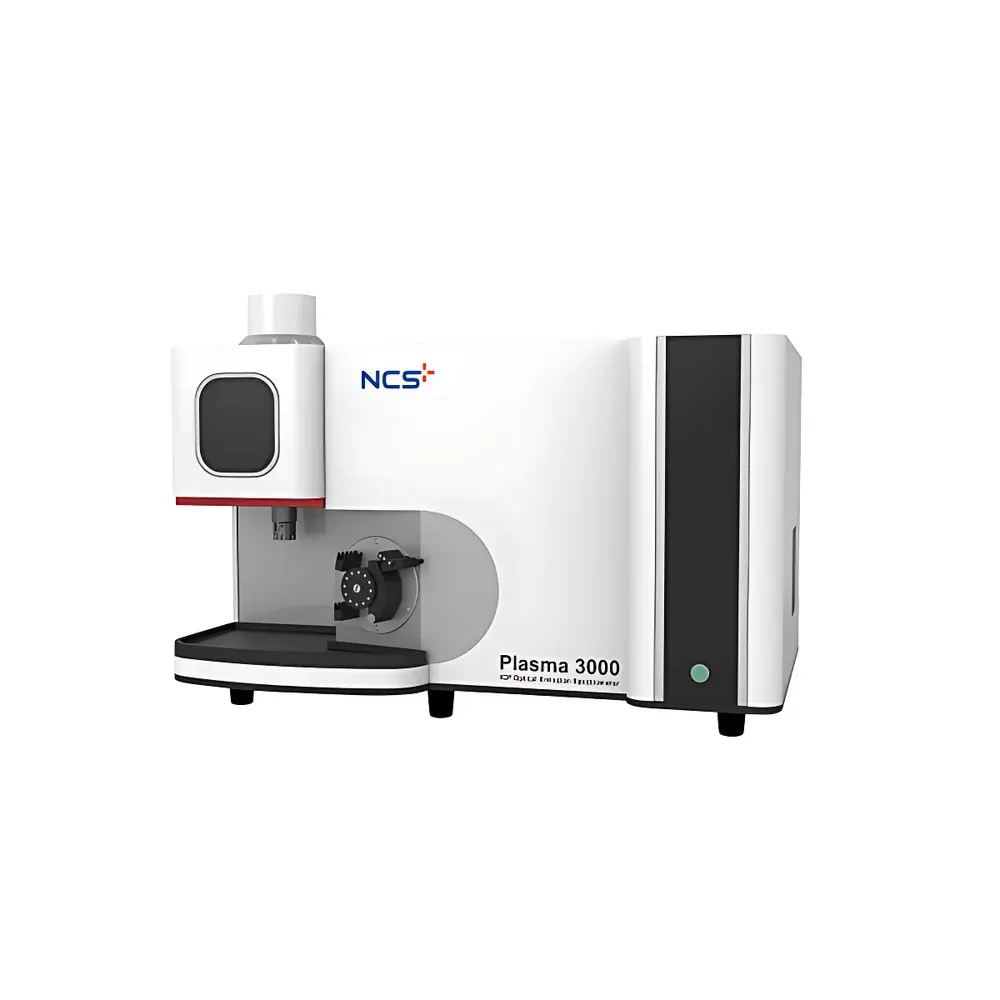
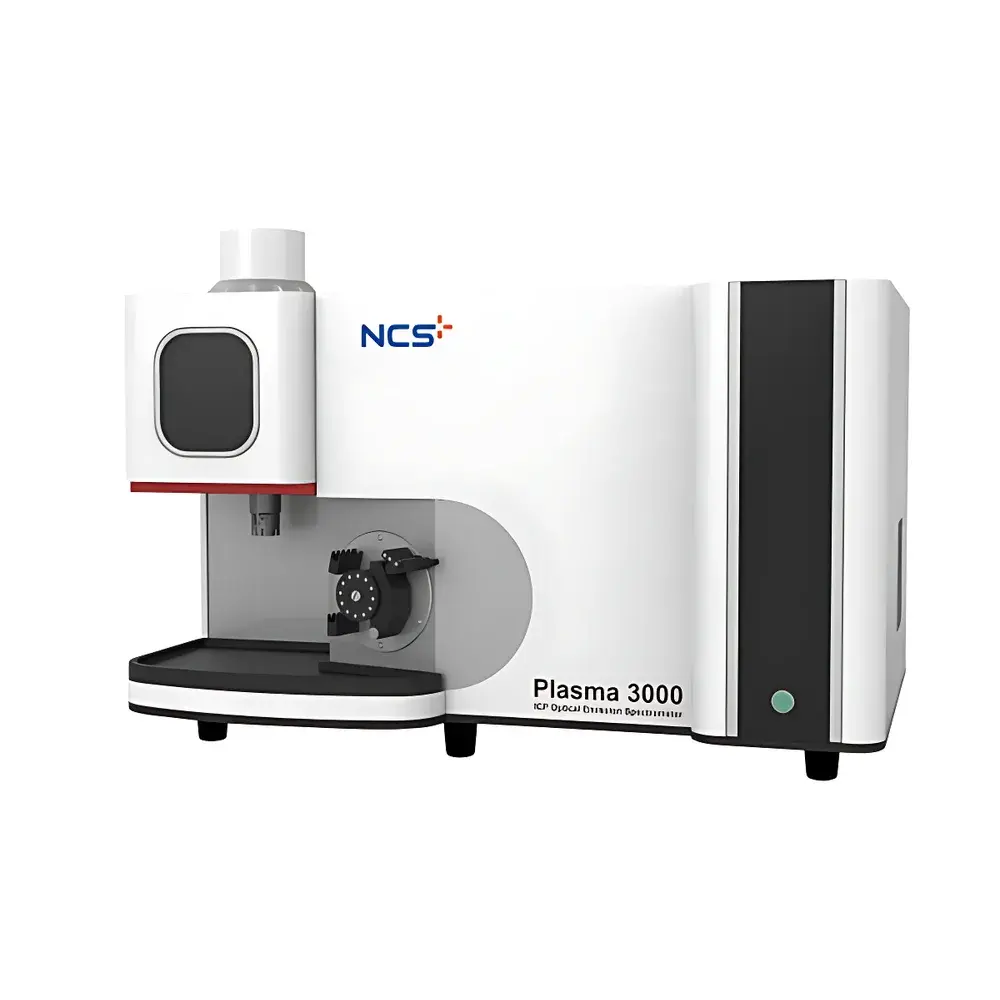
NCS Plasma 3000 Inductively Coupled Plasma Optical Emission Spectrometer
| Brand | NCS |
|---|---|
| Origin | Jiangsu, China |
| Manufacturer Type | Direct Manufacturer |
| Origin Category | Domestic |
| Model | Plasma 3000 |
| Instrument Type | Full-Spectrum Simultaneous ICP-OES |
| Detection Limit | Sub-ppt to ppt (ng/L–µg/L) |
| Precision | RSD ≤ 0.5% (1 mg/L, n = 10) |
| Short-Term Stability | RSD ≤ 0.5% (500×LOD) |
| Long-Term Stability | RSD ≤ 1.0% (4 h, 500×LOD) |
| Wavelength Range | 165–950 nm |
| Optical Resolution | 0.006 nm @ 200 nm |
Overview
The NCS Plasma 3000 is a high-performance, full-spectrum simultaneous inductively coupled plasma optical emission spectrometer (ICP-OES) engineered for precision elemental analysis across demanding laboratory environments. Based on robust Cu–Al alloy vertical torch architecture with dual-view (radial and axial) observation geometry, the system leverages cold-cone tail-flame suppression to minimize self-absorption and ionization interferences—thereby extending dynamic linear range and reducing spectral background. Its solid-state RF generator (27.12 MHz, 500–1600 W, 1-W fine power adjustment) delivers exceptional impedance matching speed and long-term plasma stability, even with volatile organic solvents or high-salt matrices. The optical path employs a CaF₂ prism in conjunction with a high-efficiency echelle grating, non-spherical optics, and thermally stabilized vacuum-sealed optical chamber maintained at 38 °C ±0.1 °C—ensuring sub-ppb detection capability and reproducible UV throughput from 165 nm onward.
Key Features
- Vertical ICP torch with cold-cone tail-flame elimination for improved matrix tolerance and reduced maintenance frequency
- Dual-view optical configuration (radial + axial) enabling quantitative analysis across concentration ranges from sub-ppb to high-percentage levels
- Echelle-prism cross-dispersion optical system with CaF₂ prism for enhanced UV transmission efficiency and minimized chromatic aberration
- Thermally isolated optical chamber with rapid purge gas stabilization technology—enabling immediate UV measurement after startup
- Enclosed 3D temperature control system maintaining optical alignment stability over extended operational periods
- Back-illuminated, deep-depletion CCD detector (1024 × 1024 pixels, 24 µm × 24 µm pixel size) with triple-stage semiconductor cooling (–45 °C typical), delivering low dark current, wide dynamic range (>10⁶), and anti-blooming capability
- Simultaneous full-spectrum acquisition via single-exposure CCD readout—no sequential scanning or wavelength stepping required
- Mass flow controllers for precise regulation of nebulizer gas, auxiliary gas, and coolant gas flows; multi-channel 12-roller peristaltic pump for stable sample introduction
- Modular, tool-free torch mounting system with mechanical repeatability < ±0.1 mm; optional detachable or monolithic torch configurations for HF-resistant or organic solvent applications
- Integrated CAN bus architecture for real-time monitoring of RF power, plasma impedance, coolant temperature, gas pressures, and detector status
Sample Compatibility & Compliance
The Plasma 3000 accommodates diverse sample types—including aqueous solutions, digested geological and metallurgical matrices, organic solvents (e.g., kerosene, xylene), high-TDS environmental extracts, and HF-containing samples—via application-optimized nebulizers, spray chambers, and torch assemblies. Its design conforms to key international analytical standards including ISO/IEC 17025:2017 for testing laboratories, ASTM D1976 (metals in water), ASTM D5185 (lubricants), and USP / for elemental impurities in pharmaceuticals. As the primary drafting entity for GB/T 36244–2018 (Chinese national standard for ICP-OES performance verification), NCS ensures traceability to SI units and supports GLP/GMP-compliant workflows through audit-ready instrument logs, electronic signatures, and secure user access controls aligned with FDA 21 CFR Part 11 requirements.
Software & Data Management
The proprietary NCS ICP Analysis Suite provides an intuitive, workflow-driven interface optimized for routine QC and method development. It features an extensive, curated spectral library containing >10,000 certified emission lines with interference flagging algorithms that recommend optimal analytical wavelengths based on sample composition. Method setup includes automated wavelength selection, internal standard correction, matrix-matched calibration, and drift compensation routines. All raw spectra are stored in vendor-neutral HDF5 format with embedded metadata (instrument parameters, operator ID, timestamp, environmental conditions). Data export supports CSV, XML, and LIMS-compatible formats. Software validation documentation (IQ/OQ/PQ protocols) and 21 CFR Part 11 compliance packages are available upon request.
Applications
The Plasma 3000 serves as a core elemental analysis platform in accredited laboratories across multiple sectors: trace metal quantification in ultrapure water and semiconductor process chemicals (ASTM D5127); multi-element profiling of rare-earth concentrates and battery cathode materials; speciation-independent total element determination in soil and sediment per EPA Method 6010D; residual catalyst analysis in petrochemical feedstocks; nutritional mineral screening in food and dietary supplements (AOAC 993.14); heavy metal monitoring in wastewater per ISO 11885; and elemental impurity testing in active pharmaceutical ingredients per ICH Q3D guidelines. Its robustness under variable argon supply pressure and ambient humidity (20–80% RH) ensures reliable operation in both centralized core facilities and satellite QA labs.
FAQ
What regulatory standards does the Plasma 3000 support for pharmaceutical testing?
It complies with ICH Q3D, USP /, and EP 2.4.20, and supports 21 CFR Part 11–compliant data integrity practices.
Can the system analyze samples containing hydrofluoric acid (HF)?
Yes—optional HF-resistant quartz torches and PFA-based sample introduction components are available for safe, accurate analysis of HF-digested samples.
Is the optical resolution verified at multiple wavelengths?
Resolution is specified as ≤0.006 nm at 200 nm (measured using Fe 200.056 nm line), with full spectral resolution mapping provided in factory calibration reports.
How does the cold-cone technology improve analytical accuracy?
By physically intercepting and quenching the plasma tail-flame, it suppresses recombination radiation and ionization-induced line broadening—reducing background equivalent concentration (BEC) and improving LODs by up to 3× in axial view.
What maintenance intervals are recommended for routine operation?
Torch inspection every 500 hours; nebulizer cleaning weekly; optical chamber purge gas filter replacement every 6 months; annual RF generator performance verification per NCS Service Bulletin SB-ICP-2023.





