
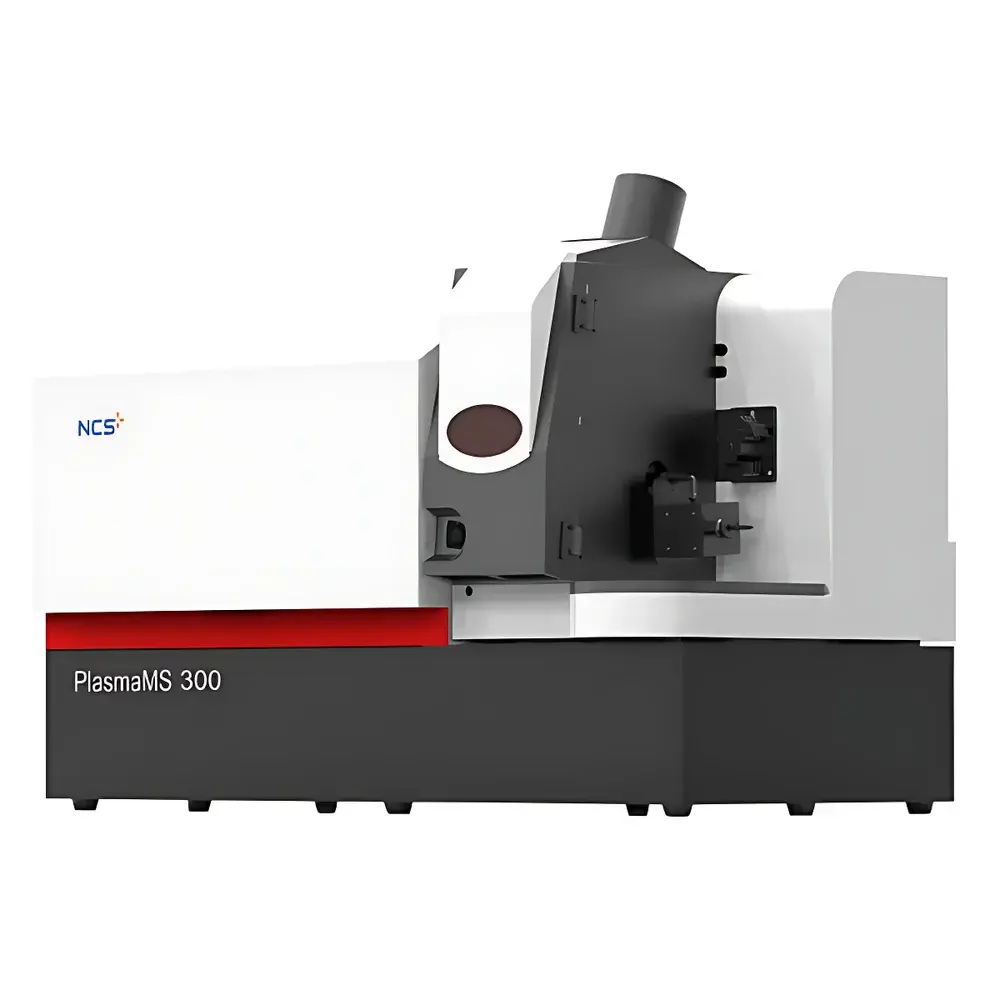
NCS PlasmaMS 300 Inductively Coupled Plasma Mass Spectrometer
| Brand | NCS |
|---|---|
| Origin | Beijing, China |
| Manufacturer Type | Original Equipment Manufacturer (OEM) |
| Instrument Type | Quadrupole ICP-MS |
| Application Environment | Laboratory |
| Mass Resolution (Full Width at Half Maximum, FWHM) | ≤0.8 amu |
| Detection Limits (ng·L⁻¹) | Be ≤ 2 |
| Sensitivity (Mcps / mg·L⁻¹) | Be ≥ 6 |
Overview
The NCS PlasmaMS 300 is a high-performance quadrupole inductively coupled plasma mass spectrometer engineered for ultra-trace multi-element analysis in demanding laboratory environments. Based on the fundamental principle of ionization in a high-temperature argon plasma (~7,000–10,000 K), followed by mass separation via a radiofrequency-driven quadrupole mass filter and detection using a discrete-dynode electron multiplier, the PlasmaMS 300 delivers robust analytical performance for isotopic and elemental quantification across environmental, geological, metallurgical, food safety, and materials science applications. Its design emphasizes operational stability, low background noise, and high ion transmission efficiency—achieved through an integrated solid-state RF generator, optimized ion optics with beam deflection, and a vacuum architecture featuring fail-safe interlocks and automated pressure regulation. The system operates at standard atmospheric pressure sample introduction and supports both solution nebulization and solid sampling when coupled to compatible accessories.
Key Features
- Stable solid-state RF generator (27.12 MHz) with automatic impedance matching and thermal overload protection, ensuring consistent plasma ignition and long-term power delivery stability.
- Optimized ion transmission path incorporating a dual-cone interface (Ni or Pt skimmer and sampler cones), beam-deflecting ion lens assembly, and collision/reaction cell compatibility for polyatomic interference mitigation.
- High-transmission quadrupole mass analyzer with real-time mass calibration and frequency-tuned resolution control, enabling routine operation at ≤0.8 amu (FWHM) for enhanced elemental specificity.
- Electron multiplier detector with analog/digital dual-mode operation, supporting dynamic range exceeding 8 orders of magnitude without hardware switching.
- Integrated automation architecture allowing full sequence control—from auto-tune and mass calibration to method execution and data acquisition—via a single software interface.
- Modular front-end compatibility with laser ablation (LA) systems (e.g., NCS LA300) and liquid chromatography (LC) platforms, enabling direct solid sampling and speciation analysis without offline sample preparation.
Sample Compatibility & Compliance
The PlasmaMS 300 accepts aqueous solutions (0.1–5% HNO₃ matrix), digested environmental solids, acid-leached geological samples, enzymatically hydrolyzed biological extracts, and aerosolized particles generated via laser ablation. It meets essential requirements for GLP-compliant laboratories, including audit-trail-enabled software logging, user-access-level permissions, and electronic signature support aligned with FDA 21 CFR Part 11 principles. Method validation protocols developed in collaboration with national reference laboratories—including the National Environmental Analysis and Testing Center and the National Geological Experimentation Testing Center—align with ISO/IEC 17025, ASTM D5673 (for water metals), and USP / (elemental impurities in pharmaceuticals). Routine performance verification follows IUPAC recommendations for detection limit estimation (3σ of blank) and precision assessment (RSD ≤ 3% for replicate analyses).
Software & Data Management
The instrument is controlled by NCS MassSight™, a Windows-based acquisition and processing platform featuring intuitive workflow templates, customizable report generation (PDF, Excel, XML), and embedded quality control tools—including internal standard drift correction, spike recovery tracking, and calibration curve diagnostics. The software supports direct integration with LIMS via ASTM E1384-compliant HL7 messaging and ODBC database connectivity. All raw spectral data are stored in vendor-neutral .raw format compliant with mzML standards, facilitating third-party reprocessing and long-term archival. Audit trails record operator identity, timestamp, parameter changes, and result modifications, satisfying regulatory documentation requirements for ISO 17025 and GMP environments.
Applications
- Environmental Monitoring: Quantification of trace heavy metals (e.g., As, Cd, Pb, Hg, U) in surface water, wastewater, soil leachates, airborne particulates (PM₂.₅/PM₁₀), and solid waste extracts—validated per EPA Method 6020B and China’s HJ 700–2014.
- Geochemical Analysis: Multi-isotope ratio measurement (e.g., Nd, Sr, Pb, Hf) and rare-earth element (REE) profiling in silicate rocks, ores, and monazite concentrates, supporting mineral resource assessment and provenance studies.
- Food & Feed Safety: Total elemental screening and LC-ICP-MS speciation of toxic elements (e.g., inorganic As, Cr(VI), methylmercury) in cereals, seafood, infant formula, and packaging migrants—aligned with EU Commission Regulation (EU) No 2023/2040.
- Advanced Materials Characterization: Spatially resolved trace element mapping in alloys, ceramics, and additive-manufactured components using LA-ICP-MS, enabling segregation analysis, inclusion identification, and coating homogeneity assessment.
FAQ
What sample introduction methods does the PlasmaMS 300 support?
It natively supports pneumatic nebulization with concentric or microflow glass/sapphire nebulizers, and is fully compatible with commercially available laser ablation systems (e.g., NCS LA300) and HPLC/UHPLC interfaces for hyphenated speciation analysis.
Is the PlasmaMS 300 compliant with international regulatory standards?
Yes—the system architecture, software functionality, and documented validation protocols align with ISO/IEC 17025, ASTM standards for elemental analysis, and FDA 21 CFR Part 11 requirements for electronic records and signatures.
Can the instrument perform isotope ratio measurements?
While optimized for high-sensitivity quantitative multi-element analysis, the PlasmaMS 300 supports semi-quantitative isotope ratio determination (e.g., ²⁰⁸Pb/²⁰⁶Pb, ¹⁴³Nd/¹⁴⁴Nd) with appropriate tuning and bracketing standards; high-precision ratio work requires magnetic sector instrumentation.
What maintenance intervals are recommended for routine operation?
Daily: Torch inspection and nebulizer cleaning. Weekly: Cone cleaning and vacuum pump oil check. Quarterly: Ion lens cleaning and RF matching network verification. Annual: Quadrupole alignment and detector gain recalibration—supported by NCS field service engineers globally.
Related Products




