
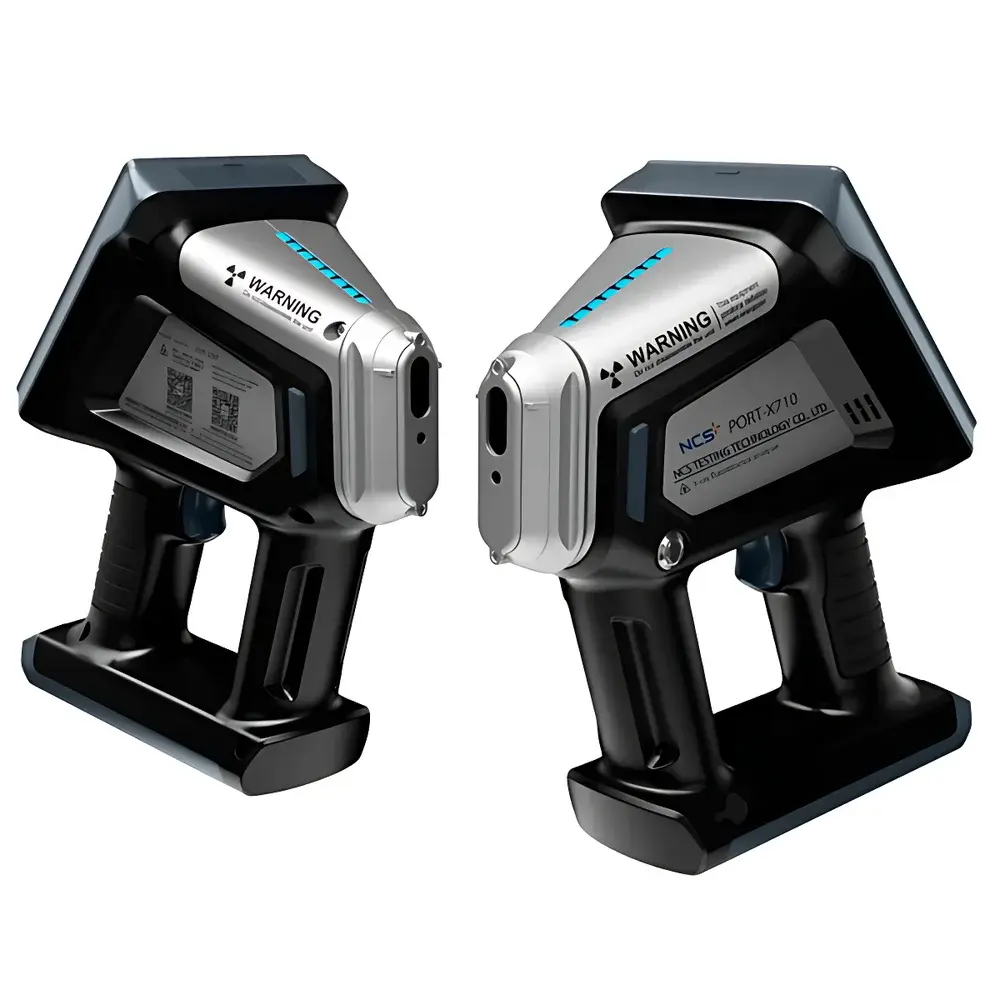
NCS PORT-X710 Handheld Energy Dispersive X-Ray Fluorescence Spectrometer
| Brand | NCS |
|---|---|
| Origin | Jiangsu, China |
| Manufacturer Type | Manufacturer |
| Product Type | Domestic |
| Model | PORT-X710 Handheld ED-XRF Spectrometer |
| Application | Field-Portable |
| Instrument Class | General-Purpose |
| Industry-Specific Use | Multi-Material Alloy Analysis |
| X-ray Tube | 5 W / 50 kV / 200 µA max |
| Target Material | Rhodium (Rh) |
| Detector | Si-Pin |
| Energy Resolution | ≤185 eV |
| Operating Temperature | –10 °C to 50 °C |
| Dimensions | 240 mm (L) × 110 mm (W) × 240 mm (H) |
| Weight | 1.6 kg |
| Quantitative Method | Fundamental Parameters (FP) |
| Elemental Range | Ti to U |
| Battery | Dual Li-ion, 7.4 V / 9600 mAh |
| Runtime | ≥10 h (typical) |
| Processor | Qualcomm Snapdragon™ octa-core, 2.0 GHz, 14 nm FinFET, 1 MB L2 cache |
| OS | Android 7.1 |
| Display | 5.5-inch Full HD (1080p) capacitive touchscreen |
| Connectivity | Wi-Fi 802.11 a/b/g/n/ac, Bluetooth 4.2/LE |
| Radiation Safety | Integrated shutter, sample proximity sensor, password-protected startup, certified radiation shielding per CNAS and GBZ 188–2014 |
| Sample Compatibility | Solid metal alloys (e.g., stainless steels, low-alloy steels, Cu-based, Ni-based, Ti alloys), scrap fragments, billets, pipes, fasteners |
Overview
The NCS PORT-X710 is a field-deployable, handheld energy dispersive X-ray fluorescence (ED-XRF) spectrometer engineered for rapid, non-destructive elemental analysis of metallic materials in industrial, scrap recycling, and quality assurance environments. Based on the physical principle of X-ray fluorescence—where primary X-rays from a rhodium-target microfocus tube excite characteristic secondary (fluorescent) X-rays from sample atoms—the instrument quantifies elemental composition via energy-resolved detection using a silicon PIN diode detector (≤185 eV resolution at Mn Kα). Its design emphasizes operational robustness under variable ambient conditions (–10 °C to 50 °C), immediate readiness (no warm-up required), and regulatory compliance with national radiation safety standards (GBZ 188–2014) and ISO 13198:2013 for portable XRF performance validation. The integrated fundamental parameters (FP) quantification algorithm enables matrix-independent calibration for multi-elemental analysis across diverse alloy systems without reliance on matched reference standards alone.
Key Features
- High-power excitation source: 50 kV / 5 W Rh-anode X-ray tube delivering stable photon flux and extended service life (>20,000 h typical).
- Ergonomic dual-handle chassis: Eliminates need for external stands; optimized weight distribution (1.6 kg) and grip geometry reduce operator fatigue during prolonged field use.
- Real-time radiation interlock system: Proximity sensor disables X-ray emission unless the instrument is in direct contact with a valid sample surface, ensuring ALARA (As Low As Reasonably Achievable) exposure.
- Thermal management architecture: Active/passive hybrid cooling sustains spectral stability during continuous operation in elevated ambient temperatures.
- Integrated calibration & safety module: Built-in calibration check standard co-located with beam collimator and shield—enabling one-step verification before each measurement session.
- Industrial-grade computing platform: Octa-core Qualcomm Snapdragon processor running Android 7.1 supports concurrent data acquisition, onboard FP calculation, and real-time spectrum visualization on the 5.5-inch 1080p display.
- Extended field endurance: Dual 9600 mAh Li-ion batteries support >10 hours of continuous operation; hot-swappable and chargeable-in-use via USB-C or vehicle adapter.
Sample Compatibility & Compliance
The PORT-X710 is validated for direct analysis of solid metallic samples including but not limited to austenitic/ferritic/martensitic stainless steels (e.g., 304, 316, 430), low-alloy structural steels (ASTM A572, A992), copper-nickel alloys (C71500, C70600), aluminum-magnesium castings, and titanium grades (Ti-6Al-4V). It meets mechanical and radiological requirements for portable analytical instrumentation per GB/T 35192–2017 (Handheld XRF instruments — Technical specifications) and conforms to IEC 62495:2010 for radiation safety of handheld X-ray devices. For regulated environments—including ISO/IEC 17025-accredited laboratories and GMP-compliant metal supplier qualification programs—the instrument supports audit-ready data logging with timestamped spectra, user authentication, and immutable measurement records exportable in ASTM E1361-compliant .csv and .trc formats.
Software & Data Management
The embedded Android-based firmware provides an intuitive graphical interface for method selection, live spectrum monitoring, and pass/fail grade matching against user-defined or preloaded libraries (≥800 alloy grades per ISO 17025 traceable database). Custom method development is supported via the NCS MethodBuilder SDK, enabling users to define new calibration curves, interference corrections, and reporting templates compliant with internal QA protocols or customer-specific SPC requirements. All measurements are stored locally with full metadata (operator ID, GPS coordinates, environmental temperature, tube current/voltage, count time, detector livetime). Data export options include USB mass storage, Wi-Fi transfer to LIMS or ERP systems, and Bluetooth pairing with certified thermal printers for on-site report generation. Audit trails meet FDA 21 CFR Part 11 criteria when deployed with optional NCS SecureLog extension (user role management, electronic signatures, and encrypted database).
Applications
- Raw material inspection: Rapid verification of incoming heats against purchase specifications (e.g., Cr/Ni/Mo in stainless steel, Al/Si/Cu in aluminum alloys) to prevent misapplication in fabrication.
- Scrap sorting and valuation: Discrimination of high-value alloys (Inconel®, Monel®, Hastelloy®) from commodity grades based on minor and trace elements (Nb, Ta, W, Co, V) within seconds.
- In-process quality control: On-line verification of weld deposit chemistry, heat treatment consistency, and plating thickness estimation (via ratio analysis) in manufacturing lines.
- Field metallurgical verification: Positive material identification (PMI) per ASME B31.3, API RP 578, and NACE MR0175/ISO 15156 for piping integrity assurance in oil & gas infrastructure.
- Recycling facility throughput optimization: Automated grade classification of shredded automotive or aerospace scrap streams to maximize recovery yield and minimize cross-contamination.
FAQ
Does the PORT-X710 require daily calibration checks?
Yes—users must perform a quick verification using the integrated calibration standard prior to each measurement session, as required by ISO 13198:2013 and internal QA procedures.
Can it analyze coated or painted metals?
Surface coatings < 50 µm thick (e.g., Zn, Cr, paint) can be penetrated under optimized conditions; however, quantitative accuracy requires either coating removal or empirical correction models developed during method validation.
Is spectral data export compatible with third-party chemometric software?
Yes—raw spectrum files (.trc) and processed results (.csv) adhere to ASTM E1361 and IUPAC spectral data interchange conventions, enabling import into Unscrambler®, MATLAB®, or open-source tools like PyMca.
What radiation safety documentation is provided with shipment?
Each unit ships with a CNAS-accredited radiation safety certificate, GBZ 188–2014 compliance statement, and user-accessible dose rate test report measured at 5 cm from the aperture under worst-case operating conditions.
How is method validation performed for custom alloys?
NCS provides application support for CRM-based validation per ISO 17025 Annex B, including uncertainty budgeting, linearity assessment, limit of detection (LOD) determination, and long-term stability monitoring over ≥30 days.






