
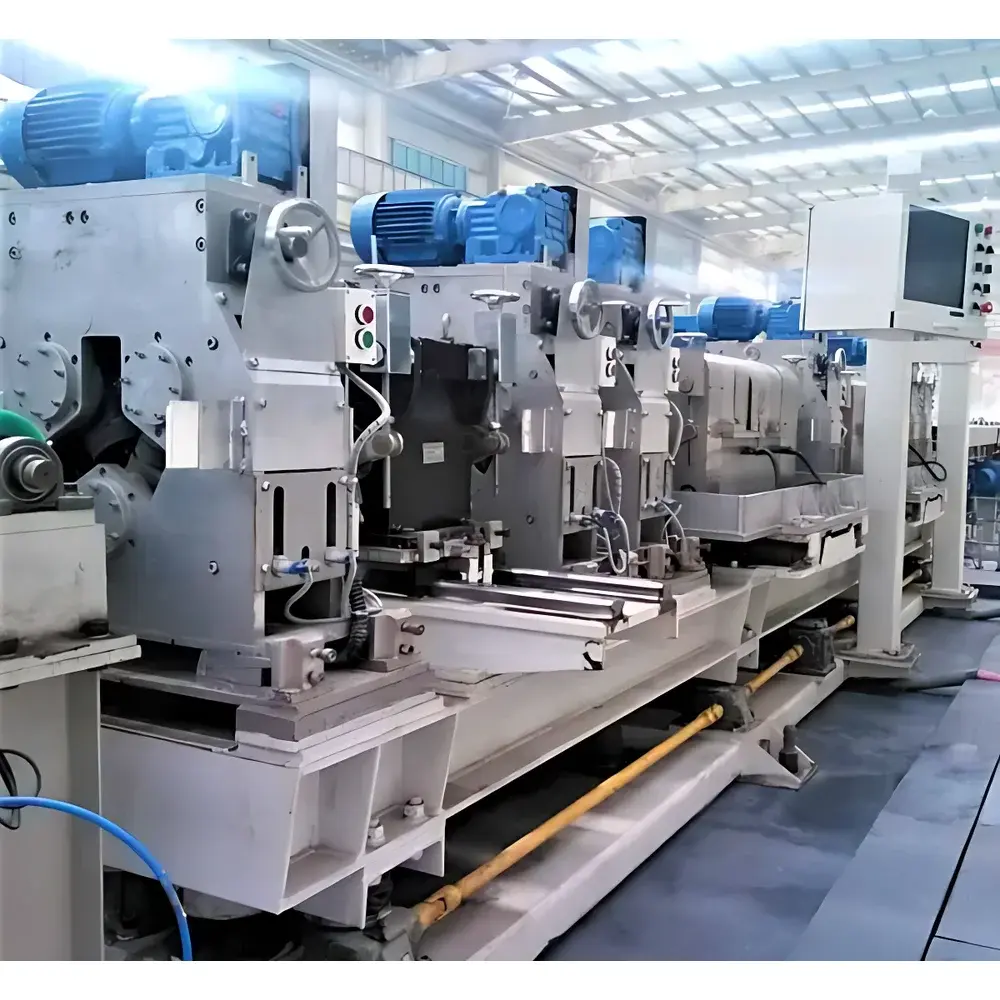
NCS-RBET Series Rotational Water-Bath Ultrasonic & Rotational Spot Eddy Current Testing System
| Brand | NCS |
|---|---|
| Origin | Beijing, China |
| Manufacturer | NCS (National Center for Steel Research) |
| Type | Domestic |
| Model | NCS-RBET Series |
| Pricing | Upon Request |
Overview
The NCS-RBET Series is a dual-modality non-destructive testing (NDT) system engineered for high-throughput, high-fidelity inspection of metallic bars and seamless tubes. It integrates two complementary electromagnetic and acoustic techniques—rotational water-bath ultrasonic testing (UT) and rotational spot eddy current testing (ECT)—within a single synchronized mechanical platform. The UT module employs immersion-based pulse-echo and through-transmission modes using focused broadband transducers, enabling detection of volumetric flaws (e.g., inclusions, voids, porosity) throughout the cross-section. The ECT module utilizes rotating probe assemblies with differential absolute coils operating at variable frequencies (10 kHz–10 MHz), optimized for surface and near-surface discontinuities—including cracks, seams, grinding burns, and localized conductivity variations—in conductive materials. Both subsystems share a common rotary stage that rotates the test specimen at programmable speeds (0.5–6 rpm) while maintaining precise axial translation control (±0.02 mm positioning repeatability), ensuring full 360° circumferential coverage and consistent helical scan pitch.
Key Features
- Simultaneous or sequential operation of ultrasonic and eddy current channels, configurable via integrated PLC and motion controller
- Water-bath ultrasonic system with temperature-stabilized deionized water circulation (±0.5 °C), low-turbidity filtration, and automatic degassing to minimize signal noise
- Rotational spot ECT probe head with motorized angular positioning (0.1° resolution) and interchangeable coil configurations (absolute, differential, reflection)
- High-speed data acquisition: UT channel supports up to 100 MHz sampling rate with 16-bit ADC; ECT channel provides real-time impedance plane analysis at ≥1 kHz per rotation
- Ruggedized gantry architecture with stainless-steel frame, corrosion-resistant wet-zone components, and IP54-rated electronics enclosures
- Compliance-ready design: hardware-level trigger synchronization, timestamped raw data logging, and audit-trail-capable event history
Sample Compatibility & Compliance
The NCS-RBET Series accommodates solid round bars and hollow tubes with diameters from 6 mm to 250 mm and lengths up to 12 m. It supports ferromagnetic (e.g., carbon steel, stainless steel) and non-ferromagnetic alloys (aluminum, copper, titanium, nickel-based superalloys) without probe reconfiguration. All measurement protocols and acceptance criteria align with internationally recognized NDT standards, including ASTM E2192 (UT of seamless pipe), ASTM E309 (ECT of tubular products), ISO 11484 (steel bar inspection), and API RP 5L3 (ultrasonic testing of line pipe). The system meets the technical requirements specified in DEP 31.40.20.37 (Shell), ASME A578/A578M (straight-beam UT of plates), ASTM A53/A500 (welded and seamless pipe), JIS G3444 (carbon steel pipes), GB/T 3091 (galvanized steel pipes), GB/T 5777 (UT of stainless steel tubes), YB/T 4082 & YB/T 4083 (eddy current testing of steel bars), and Q/SY GJX101 (CNPC specification for pipeline material inspection). Full traceability is maintained for GLP/GMP-regulated environments.
Software & Data Management
The proprietary NCS-Insight™ software suite runs on Windows 10 IoT Enterprise and provides unified control, real-time visualization, and post-processing. UT data is displayed as C-scan, B-scan, and A-scan overlays with adjustable gain, gate thresholds, and depth calibration. ECT results are rendered in impedance plane plots, strip charts, and color-mapped circumference maps. All raw datasets (including waveform files, position stamps, and environmental logs) are stored in HDF5 format with SHA-256 checksum integrity verification. The software supports 21 CFR Part 11-compliant user access control, electronic signatures, and immutable audit trails. Export options include ASTM E2371-compliant XML reports, PDF inspection certificates, and CSV/Excel-compatible defect tables with positional metadata (axial location, angular orientation, depth estimation).
Applications
This system is deployed in primary metal production facilities for in-line quality assurance of hot-rolled and cold-drawn bars prior to heat treatment or finishing. It serves as a final release inspection tool in OEM supply chains for aerospace fasteners, nuclear fuel cladding tubes, and power-generation turbine shafts. In oil & gas infrastructure, it verifies integrity of OCTG (oil country tubular goods), subsea risers, and pipeline girth welds. Additional use cases include incoming material verification for automotive drivetrain components, R&D validation of novel alloy extrusions, and periodic in-service inspection of critical rotating equipment shafts under API RP 571 guidelines.
FAQ
What types of defects can the NCS-RBET detect?
It identifies surface-breaking cracks, subsurface laminations, internal voids, inclusions, seam defects, and localized conductivity deviations—down to 0.1 mm equivalent reflector size under standard calibration conditions.
Is operator certification required to run the system?
Yes. Personnel must hold Level II certification per ISO 9712 or SNT-TC-1A for both UT and ET methods. NCS provides optional training aligned with ASNT Recommended Practice No. SNT-TC-1A.
Can the system be integrated into an existing factory MES or QMS?
Yes. It supports OPC UA server interface (IEC 62541) and RESTful API endpoints for bidirectional data exchange with SAP QM, Siemens Opcenter, or custom LIMS platforms.
What maintenance intervals are recommended?
Ultrasonic transducer calibration every 90 days; ECT probe coil impedance verification weekly; water bath conductivity and particle count monitoring per shift; full mechanical alignment check semiannually.
Does the system support remote diagnostics and firmware updates?
Yes. Secure TLS 1.2-enabled remote access is available via NCS RemoteCare™, with over-the-air firmware updates and predictive health analytics based on motor current signature analysis.



