
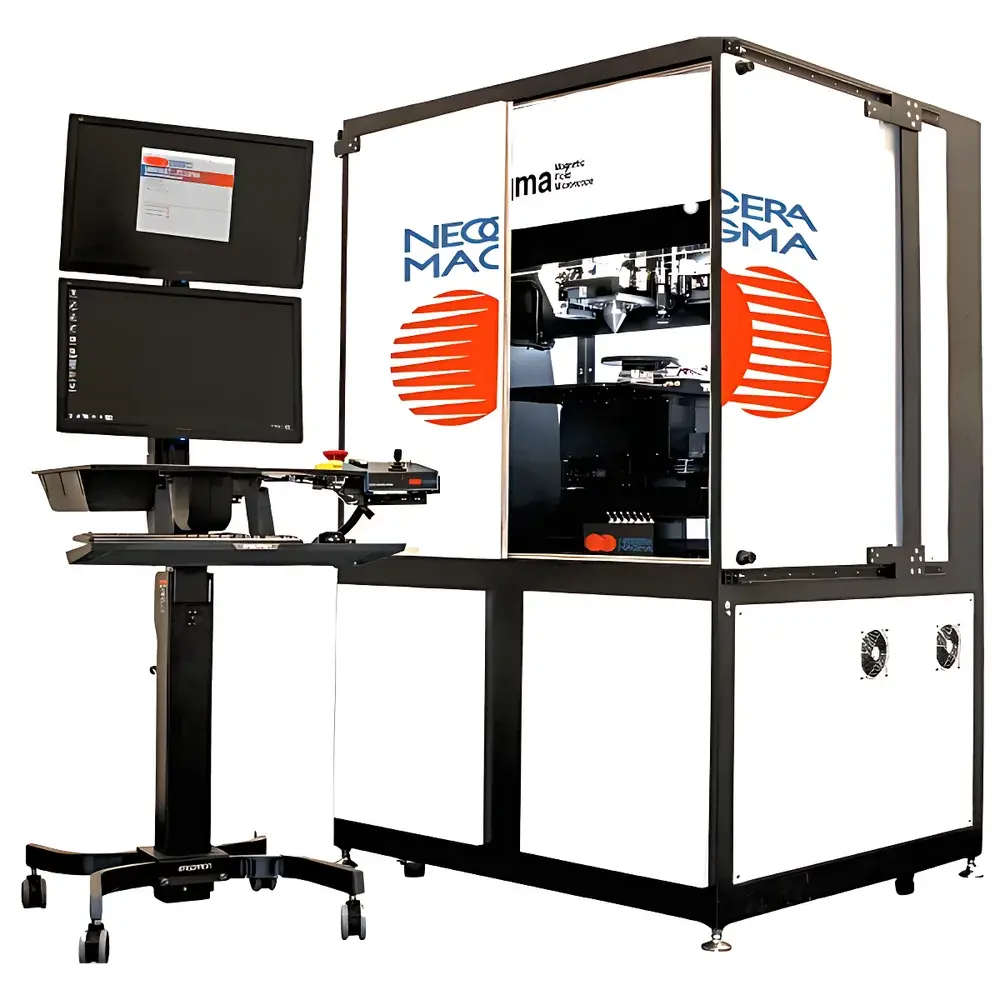
Neocera Magma EFI HiRes Magnetic Field Imaging Microscope System
| Brand | Neocera |
|---|---|
| Origin | USA |
| Manufacturer Type | Authorized Distributor |
| Origin Category | Imported |
| Model | Magma EFI HiRes |
| Pricing | Upon Request |
Overview
The Neocera Magma EFI HiRes Magnetic Field Imaging Microscope System is a high-precision, non-destructive failure analysis platform engineered for static defect localization in advanced semiconductor devices. It operates on the physical principle of magnetic field mapping—detecting minute current-induced magnetic fields generated by fault currents (e.g., shorts, leakage paths, or open-circuit resistive heating) using quantum-limited superconducting quantum interference device (SQUID) and high-resolution magnetoresistive (MR) sensing technologies. Unlike optical or thermal techniques constrained by material opacity or thermal diffusion, magnetic imaging penetrates all non-ferromagnetic packaging materials—including molded compounds, underfills, interposers, and stacked die—enabling subsurface current path reconstruction without deprocessing. The system supports full-wafer (300 mm), packaged ICs, PCBs, heterogeneous multi-chip modules (MCMs), 3D ICs, and system-in-package (SiP) assemblies, delivering depth-resolved localization from surface-level traces to buried interconnects up to 10 mm deep.
Key Features
- Triple-sensor modular architecture: SQUID (ultra-high sensitivity), HiRes (sub-250 nm spatial resolution), and SDR (high-frequency RF detection for opens)
- Simultaneous dual-sensor operation: Co-registered SQUID + MR scanning enables concurrent optimization of magnetic field sensitivity (down to 500 nA at 333 µm) and spatial fidelity (250 nm resolution)
- Depth-resolved 3D current path reconstruction: Proprietary algorithms compute vertical distance from sensor plane to current-carrying trace using field gradient inversion and multi-angle field modeling
- Full-stack compatibility: Supports die-level interconnects on 300 mm wafers, final-package PCBs, and complex heterogeneous integration structures including TSV-based 3DICs
- DC–200 kHz programmable current injection: Integrated ±10 V / 100 mA function generator with precise frequency sweep capability for stimulus-synchronized field mapping
- Automated scan calibration and drift compensation: Real-time thermal and mechanical stabilization ensures reproducible sub-micron positional accuracy over multi-hour acquisitions
Sample Compatibility & Compliance
The Magma EFI HiRes accommodates samples ranging from bare silicon dies to fully assembled SiPs with metal lids, organic substrates, or ceramic packages. Its non-contact, non-ionizing measurement modality complies with JEDEC JESD22-A108 (reliability stress testing) and ASTM F2793 (failure analysis of microelectronic packages). The system’s data acquisition and reporting workflows support GLP/GMP-aligned documentation requirements, including audit-trail-enabled user authentication, timestamped metadata logging, and export-ready reports compatible with ISO/IEC 17025 laboratory accreditation frameworks. All hardware components meet UL 61010-1 and CE safety standards; electromagnetic compatibility conforms to EN 61326-1.
Software & Data Management
Control and analysis are performed via a dedicated Windows 10 64-bit application suite featuring intuitive workflow-driven GUI navigation. Core modules include: (1) Scan Planner for adaptive region-of-interest definition and multi-resolution tiling; (2) Field Inversion Engine for quantitative current density vector mapping; (3) 3D PathBuilder for volumetric current trajectory reconstruction using Biot–Savart modeling; and (4) FA Report Generator with customizable templates compliant with IPC-J-STD-033 and IEEE 1149.1 boundary-scan correlation protocols. Raw field data (Bx, By, Bz) are stored in HDF5 format with embedded calibration metadata, enabling traceable reprocessing and third-party algorithm integration. Software supports FDA 21 CFR Part 11-compliant electronic signatures and role-based access control.
Applications
- Static short detection in advanced nodes (≤5 nm FinFET, GAA transistors) where conventional OBIRCH or LIVA lack penetration depth
- Leakage path localization in low-power IoT SoCs exhibiting sub-µA standby current anomalies
- High-resistance open identification in Cu/low-k interconnect stacks using SDR-mode RF magnetic field excitation (20–200 MHz)
- Through-silicon via (TSV) continuity verification in 2.5D/3D heterogeneous integration without decapsulation
- Failure root cause attribution in automotive AEC-Q200 qualified modules under temperature cycling stress
- Process development feedback for BEOL metallization integrity assessment in foundry PDK validation
FAQ
What types of defects can the Magma EFI HiRes detect?
It detects static electrical defects—including shorts, leakage paths, high-resistance opens, and resistive opens—across wafer, package, and board levels.
Does it require sample deprocessing or electrical contact?
No. It is fully non-contact and non-destructive; no probe landing, wire bonding, or delidding is required.
How does it achieve depth information without tomography?
By analyzing the spatial decay and vector orientation of measured magnetic fields, combined with known current injection geometry and material permeability models.
Is the system compatible with automated failure analysis (FA) workflows?
Yes—it integrates with SEM/FIB platforms via SECS/GEM protocol and exports coordinate data for direct stage navigation.
What environmental conditions are required for stable SQUID operation?
The integrated cryogenic subsystem maintains the SQUID sensor at ≤4.2 K using closed-cycle helium refrigeration; no liquid helium handling is required.



