
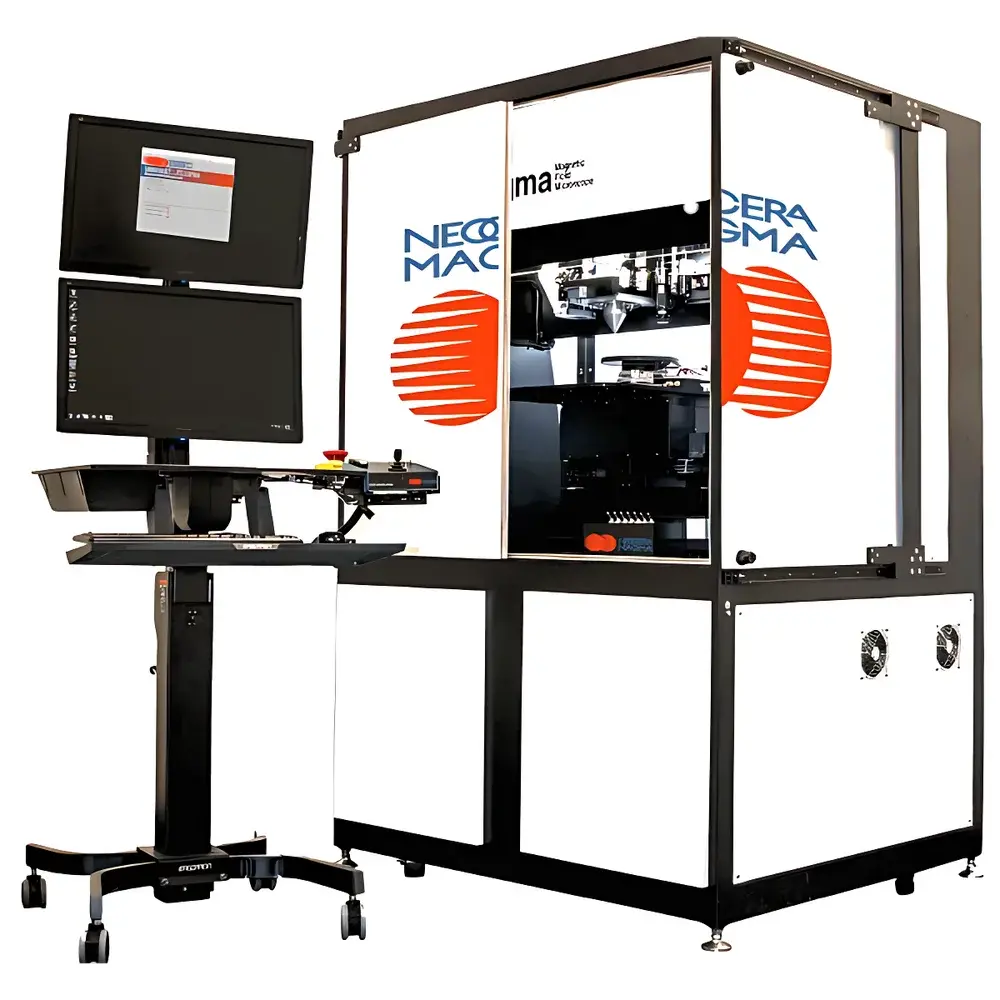
Neocera Magma SSM HiRes Magnetic Field Imaging Microscope System
| Brand | Neocera |
|---|---|
| Origin | USA |
| Manufacturer Type | Authorized Distributor |
| Origin Category | Imported |
| Model | Magma SSM HiRes |
| Pricing | Available Upon Request |
| SQUID Spatial Resolution | 3 µm |
| HiRes Spatial Resolution | 250 nm |
| SQUID Scan Area | ≥100 mm × 100 mm |
| HiRes Scan Area | ≥100 mm × 100 mm |
| SQUID Current Sensitivity | 500 nA @ 333 µm, 1.5 µA @ 1000 µm |
| HiRes Current Sensitivity | 5 µA @ 2 µm, 100 µA @ 100 µm |
| SQUID Magnetic Field Sensitivity | 15 pT/√Hz (typ.) |
| HiRes Magnetic Field Sensitivity | 10 nT/√Hz (typ.) |
| SQUID Operating Frequency Range | DC–25 kHz |
| HiRes Operating Frequency Range | 10 kHz–200 kHz |
| SQUID Imaging Depth | ≤10 mm |
| HiRes Imaging Depth | <100 µm |
| Excitation Source | ±10 V @ 100 mA, DC–200 kHz |
| Optical Lens Resolution | 2 µm (NIR/Visible) |
| Power Supply | 110–120 V @ 20 A or 220–240 V @ 10 A |
| OS | Windows 10 64-bit |
Overview
The Neocera Magma SSM HiRes Magnetic Field Imaging Microscope System is a dual-sensor, non-destructive failure analysis platform engineered for high-precision localization of static electrical faults in semiconductor devices across multiple packaging tiers—from bare die and 300 mm wafers to fully assembled PCBs and heterogeneous multi-chip modules (MCMs), 3D ICs, and system-in-package (SiP) architectures. It operates on the principle of magnetic field mapping: when current flows through conductive paths—whether intentional or parasitic—it generates a spatially varying magnetic field detectable outside the device package. By scanning with ultra-sensitive magnetometers, the system reconstructs 2D and depth-resolved 3D current density distributions without physical probing, decapsulation, or backside thinning. This enables root-cause identification of open circuits, short circuits, leakage paths, and high-resistance discontinuities (up to 100 kΩ) under operational or quasi-static bias conditions. The system integrates two complementary sensing modalities: a low-noise SQUID (Superconducting Quantum Interference Device) sensor optimized for sub-nanoampere current detection and deep-penetration imaging, and a high-resolution anisotropic magnetoresistive (AMR) sensor delivering nanoscale spatial fidelity for surface-near current features.
Key Features
- Dual-sensor architecture combining SQUID and AMR technologies for simultaneous high-sensitivity and high-resolution magnetic field imaging
- SQUID mode: 3 µm spatial resolution, ≥100 mm × 100 mm scan area, 15 pT/√Hz field sensitivity, DC–25 kHz bandwidth, and ≤10 mm imaging depth—ideal for buried interconnects and through-silicon vias (TSVs)
- HiRes mode: 250 nm spatial resolution, ≥100 mm × 100 mm scan area, 10 nT/√Hz field sensitivity, 10 kHz–200 kHz bandwidth, and <100 µm depth sensitivity—optimized for fine-pitch metallization, bond wires, and surface-level shorts
- Non-invasive operation requiring no device modification, deprocessing, or electrical overstress—preserves device integrity during analysis
- Integrated excitation source (±10 V / 100 mA, DC–200 kHz) supporting both DC bias and AC stimulus for dynamic fault isolation
- Optical overlay capability with 2 µm resolution in visible/NIR spectrum, enabling precise co-registration of magnetic maps with optical reference images and CAD/GDS design data
- Windows 10 64-bit control software with automated scan sequencing, real-time field visualization, and export-ready data formats (HDF5, TIFF, CSV)
Sample Compatibility & Compliance
The Magma SSM HiRes accommodates a broad range of sample geometries and integration levels: full 300 mm wafers (die-level interconnect analysis), singulated dies, wire-bonded and flip-chip packages, stacked-die assemblies, fan-out wafer-level packages (FOWLP), and populated PCBs up to ATX form factor. Its non-contact, non-destructive methodology aligns with industry-standard failure analysis workflows defined in JEDEC JESD22-A108 (life testing), IPC-J-STD-033 (moisture sensitivity), and ASTM F2197 (failure analysis of microelectronic devices). Data acquisition and reporting support audit-ready traceability per GLP and GMP requirements; metadata logging includes timestamp, environmental conditions, excitation parameters, sensor calibration status, and operator ID. While not FDA-certified as a medical device, its data handling architecture complies with foundational principles of 21 CFR Part 11 for electronic records and signatures where applicable in regulated development environments.
Software & Data Management
The proprietary Magma Control Suite provides unified instrument control, real-time magnetic field visualization, and post-processing tools for quantitative current reconstruction. Scan parameters—including step size, dwell time, field-of-view, excitation frequency/amplitude, and sensor selection—are programmable via intuitive GUI or script-based automation (Python API available). Raw magnetic field data are stored in HDF5 format with embedded metadata, ensuring long-term reproducibility and interoperability with MATLAB, Python (NumPy/SciPy), and commercial EDA tools. Overlay registration algorithms align magnetic maps to optical images using feature-matching and affine transformation, facilitating direct comparison with layout databases. Export options include georeferenced TIFF stacks, vectorized contour plots, and tabular current density profiles. Audit trails record all user actions, parameter changes, and calibration events—fully compliant with internal QA protocols and external ISO/IEC 17025 documentation standards.
Applications
- Localization of resistive opens in advanced nodes (e.g., Cu interconnect voids, EM-induced breaks) without destructive cross-sectioning
- Identification of latent leakage paths in FinFET and GAA transistor structures under sub-threshold bias
- 3D fault mapping in TSV-based 2.5D/3D ICs by correlating SQUID-derived bulk current flow with HiRes surface anomalies
- Rapid screening of solder joint integrity and trace continuity in high-density HDI PCBs
- Failure root-cause analysis of power delivery network (PDN) anomalies in SiP modules integrating logic, memory, and RF die
- Validation of electrostatic discharge (ESD) protection circuit behavior under transient current injection
- Correlation of magnetic signatures with thermal hotspots (via lock-in thermography integration) for multi-physics failure modeling
FAQ
Does the Magma SSM HiRes require cryogenic cooling for SQUID operation?
Yes—the SQUID sensor operates at liquid helium temperatures (4.2 K) and is housed in a closed-cycle cryocooler integrated into the system chassis. No user handling of cryogens is required.
Can the system image alternating current (AC) faults?
Yes—both SQUID and HiRes modes support AC field detection across their respective bandwidths (DC–25 kHz and 10 kHz–200 kHz), enabling lock-in detection of phase-resolved current distributions.
Is sample preparation necessary prior to scanning?
No—devices may be analyzed in their native packaging state. No decapsulation, polishing, or metal layer removal is needed.
How is depth information extracted from magnetic field data?
Depth resolution is derived from multi-frequency excitation combined with forward-modeling inversion (Biot-Savart-based deconvolution), calibrated against reference structures with known geometry and conductivity.
What level of electromagnetic shielding does the system include?
The instrument enclosure incorporates multi-layer mu-metal and aluminum shielding, achieving >80 dB attenuation of ambient 50/60 Hz fields and broadband RFI up to 1 GHz—suitable for standard lab environments without dedicated Faraday rooms.



