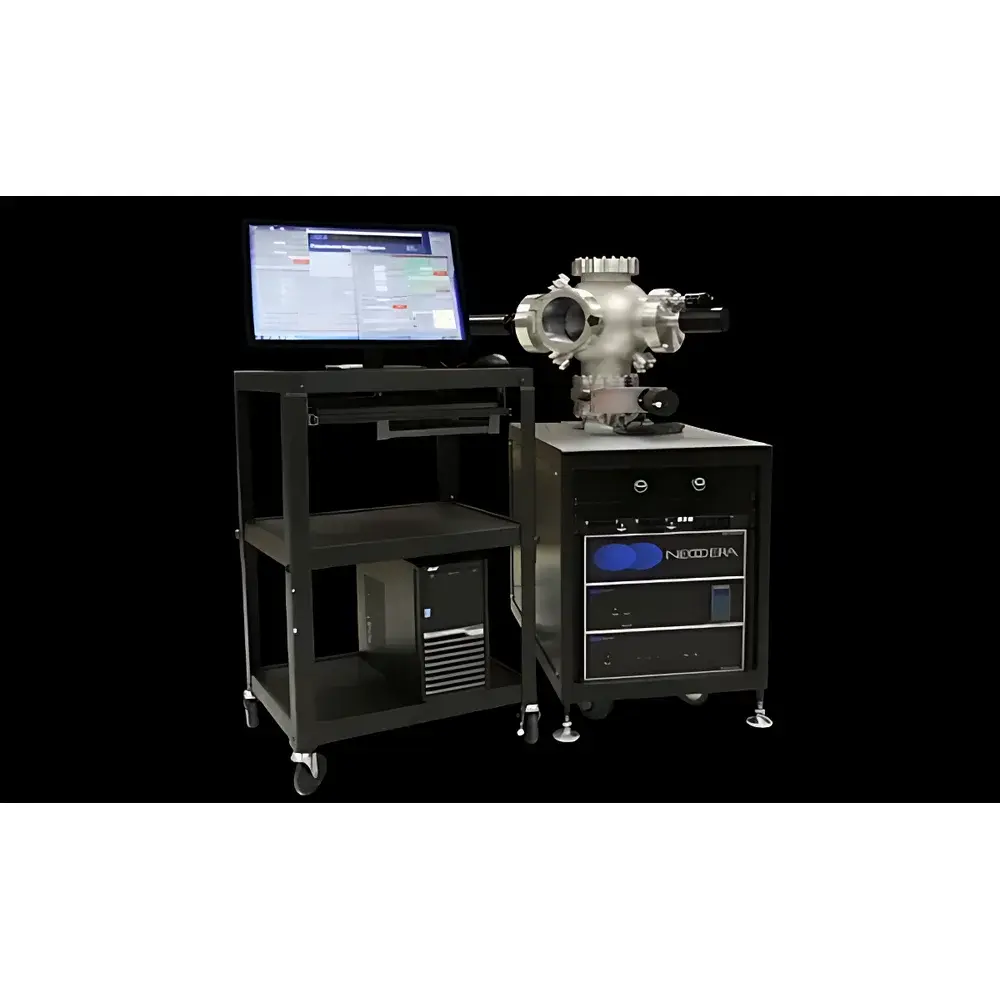
Neocera Pioneer 120 PLD System
| Brand | Neocera |
|---|---|
| Origin | USA |
| Model | Pioneer 120 PLD System |
| Substrate Heater Type | Conductive (electrical) heating stage |
| Max Substrate Temperature | 950 °C |
| Heater Compatibility | O₂-compatible up to 1 atm (760 Torr) |
| Target Changer | Motorized, programmable multi-target rotator with rastering and position indexing |
| Vacuum System | Dry-pump stack — turbomolecular pump backed by diaphragm or scroll pump |
| Deposition Chamber Ports | 8" CF for pump, 8" CF for heater, 8" CF for target assembly |
| Laser Source | KrF excimer laser (248 nm) |
| Optical Path | 45° turning mirror, plano-convex lens (f ≈ 50 cm) |
| Control Software | Windows 7 + LabVIEW 2013 (integrated real-time control of heater, target rotation, pressure regulation, pump sequencing, and laser triggering) |
| Compliance | Designed for GLP/GMP-aligned thin-film R&D |
Overview
The Neocera Pioneer 120 PLD System is a fully integrated, turnkey pulsed laser deposition platform engineered for the reproducible growth of epitaxial thin films, multilayer heterostructures, and artificial superlattices—particularly in complex oxide, nitride, and chalcogenide material systems. Based on the fundamental principle of laser ablation under controlled background gas environments, the system delivers high-flux, stoichiometric plume generation via KrF excimer laser irradiation (248 nm) focused onto rotating solid targets. The ablated species travel across a well-defined vacuum gap and condense on a precisely heated substrate, enabling atomic-layer-level control over crystallinity, orientation, and interfacial sharpness. Unlike radiative heating configurations used in alternative PLD platforms, the Pioneer 120 employs a conductive (electrical) substrate heater—engineered for direct thermal coupling and exceptional temperature stability at elevated setpoints. This architecture is critical for achieving thermodynamically stable epitaxy in oxygen-sensitive materials such as YBCO, LSMO, STO, and PZT, where both in-situ oxygen partial pressure (up to 1 atm) and post-deposition annealing under oxidizing conditions are required.
Key Features
- Conductive substrate heater capable of stable operation up to 950 °C, with O₂ compatibility validated at 1 atm (760 Torr) partial pressure—enabling in-chamber oxidation and annealing without chamber venting.
- Motorized, software-controlled multi-target rotator with positional indexing and rastering capability—supporting automated sequential deposition of up to six targets for complex multilayer stacks and superlattice synthesis.
- Full dry vacuum architecture: turbomolecular pump (TMP) backed by either diaphragm or scroll pump—eliminating oil contamination risks and ensuring ultra-low base pressure (<1×10⁻⁸ Torr) and rapid process gas exchange.
- Closed-loop pressure regulation using mass flow controllers (MFCs) for precise, repeatable control of reactive gases (O₂, N₂, Ar) during deposition and cooldown phases.
- Integrated KrF excimer laser optics path: 45° high-damage-threshold turning mirror and f ≈ 50 cm plano-convex fused silica lens optimized for uniform fluence distribution on target surfaces (typical spot size: 2–4 mm²).
- LabVIEW 2013-based control suite running on Windows 7 OS—providing synchronized, event-driven automation of heater ramping, target selection, pressure modulation, pump sequencing, and laser firing triggers.
Sample Compatibility & Compliance
The Pioneer 120 accommodates substrates up to 2 inches (50.8 mm) in diameter, with custom heater configurations available for non-standard geometries. Its O₂-compatible heater design and full-pressure-range gas handling make it suitable for epitaxial growth of perovskite oxides, spinel ferrites, cuprates, and wide-bandgap semiconductors requiring high-temperature, oxidizing ambient conditions. The system meets mechanical and electrical safety standards per UL 61010-1 and IEC 61000-6-3. Its modular vacuum architecture and traceable parameter logging support audit readiness for GLP-compliant laboratories and pre-clinical materials development workflows. While not certified for GMP manufacturing, its deterministic process control aligns with ASTM F3127 guidance for PLD process validation and ISO 14644-1 Class 5 cleanroom integration protocols.
Software & Data Management
The embedded LabVIEW 2013 application provides hierarchical control through a calibrated GUI with real-time telemetry display (temperature, pressure, target position, laser status). All operational parameters—including heater ramp rates, dwell times, MFC setpoints, and laser pulse counts—are logged with timestamps into structured .tdms files. Audit-trail functionality records user login events, parameter changes, and emergency stops—meeting foundational requirements for 21 CFR Part 11 compliance when deployed with networked authentication and electronic signature modules. Export options include CSV and MATLAB-compatible formats for offline analysis of growth kinetics, thickness correlation, and stoichiometric drift.
Applications
- Growth of high-Tc superconducting thin films (e.g., YBa₂Cu₃O₇₋δ) with atomically abrupt interfaces and low defect density.
- Epitaxial synthesis of ferroelectric/ferromagnetic multilayers (e.g., BiFeO₃/La₀.₇Sr₀.₃MnO₃) for magnetoelectric coupling studies.
- Preparation of oxide heterostructures for 2D electron gas (2DEG) formation at polar/nonpolar interfaces (e.g., LaAlO₃/SrTiO₃).
- Rapid prototyping of compositionally graded libraries for combinatorial materials discovery.
- Deposition of transparent conducting oxides (e.g., ITO, AZO) and photovoltaic absorbers (e.g., CZTS) under tunable reactive atmospheres.
FAQ
What substrate sizes does the Pioneer 120 support?
Standard configuration accommodates up to 2-inch (50.8 mm) diameter substrates; custom heater stages are available for rectangular or smaller circular wafers.
Is the system compatible with ozone or NO₂ as reactive gases?
Yes—the O₂-compatible heater and stainless-steel wetted path allow safe use of ozone and nitrogen dioxide, provided appropriate MFC calibration and corrosion-resistant seals are specified.
Can the software interface with external metrology tools?
Yes—via TCP/IP or serial RS-232, the LabVIEW controller supports handshake protocols with in-situ RHEED, ellipsometers, and quartz crystal microbalances (QCMs).
What vacuum level can be achieved before laser operation?
Base pressure typically reaches ≤5×10⁻⁹ Torr after 4–6 hours of pumping with a clean, conditioned system.
Does Neocera provide installation qualification (IQ) and operational qualification (OQ) documentation?
Yes—factory-verified IQ/OQ protocols are included, covering vacuum integrity, temperature uniformity mapping, pressure regulation linearity, and laser energy stability testing.