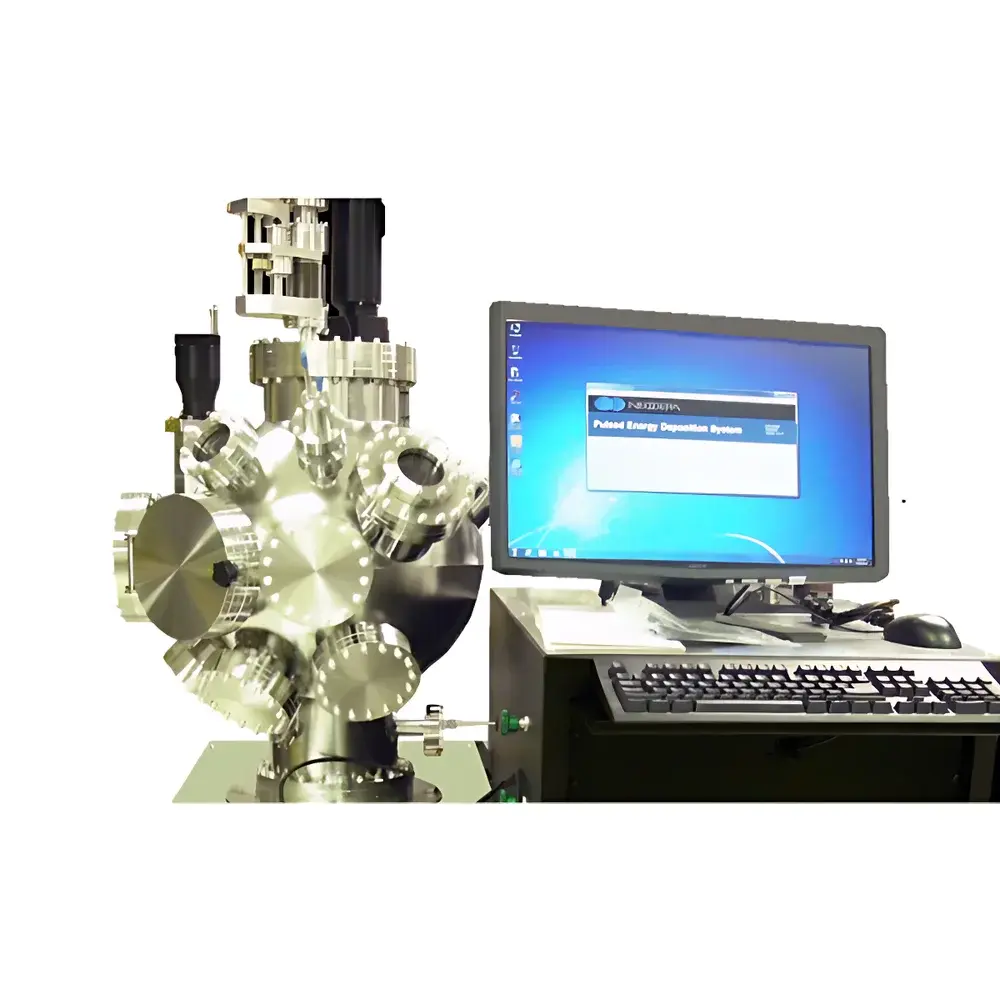
Neocera Pioneer 180 MAPLE PLD System
| Brand | Neocera |
|---|---|
| Origin | USA |
| Model | Pioneer 180 MAPLE PLD System |
| Substrate Heating | Up to 500 °C with programmable controller |
| Substrate Size | Max. 2" diameter or multiple 1 cm × 1 cm samples |
| Substrate Rotation | 20 RPM |
| Vacuum Chamber Diameter | 18" |
| Target Stage | LN₂-cooled, single-target standard (multi-target optional) |
| Gas Flow Control | 50–100 SCCM MFC |
Overview
The Neocera Pioneer 180 MAPLE PLD System is a high-precision, research-grade thin-film deposition platform engineered for the controlled synthesis of functional organic, polymeric, and hybrid organic–inorganic thin films via Matrix-Assisted Pulsed Laser Evaporation (MAPLE). Unlike conventional UV-based pulsed laser deposition (PLD), which subjects thermally labile molecules to direct photon absorption and potential photochemical degradation, MAPLE employs a cryogenically frozen target composed of a volatile solvent matrix (e.g., acetone, toluene, or THF) doped with the active solute—typically polymers, biomolecules, or small-molecule organics. Upon irradiation with nanosecond UV laser pulses (e.g., 248 nm KrF excimer), energy is preferentially absorbed by the matrix, inducing gentle ablation and co-ejection of intact solute molecules into the vacuum chamber. The high vapor pressure of the matrix ensures rapid desorption from the film surface during transport, leaving behind high-fidelity, chemically unaltered organic layers on heated or room-temperature substrates. This principle enables reproducible deposition of sensitive materials—including conjugated polymers, pharmaceuticals, and bioactive peptides—under ultra-high vacuum (UHV) to moderate background pressures (10−10–10−1 Torr), while maintaining stoichiometric fidelity and molecular integrity.
Key Features
- Integrated MAPLE-specific target cryostage with liquid nitrogen cooling and temperature monitoring for stable frozen-target operation
- Dual-mode operation: Standalone MAPLE configuration or combined MAPLE/PLD mode using interchangeable target holders
- Programmable substrate heater with closed-loop PID control (up to 500 °C) and real-time thermocouple feedback
- Motorized substrate rotation at precisely regulated 20 RPM for uniform film thickness distribution
- 18-inch-diameter stainless steel vacuum chamber with all-metal seals, ISO-KF and CF flanges, and ≥10−9 Torr base pressure capability
- Optional multi-source integration: RF/DC sputtering, pulsed electron deposition (PED), and DC ion source for hybrid growth processes
- Load-lock substrate transfer stage enabling rapid sample exchange without breaking main chamber vacuum
- Direct UHV-compatible interface for in-situ transfer to XPS, AES, or LEED analysis chambers (via differential pumping stages)
Sample Compatibility & Compliance
The Pioneer 180 MAPLE PLD System accommodates substrates up to 2 inches in diameter or arrays of discrete 1 cm × 1 cm specimens—ideal for combinatorial library synthesis and device prototyping. Compatible substrate materials include Si, SiO2, ITO, quartz, sapphire, flexible polymer foils (e.g., PET, PI), and epitaxial wafers (e.g., SrTiO3, MgO). All vacuum components comply with ASTM F2787 (Standard Practice for Leak Testing Vacuum Systems) and ASME BPE-2021 specifications for surface finish (Ra ≤ 0.4 µm) and electropolished passivation. The system supports GLP-compliant operation through audit-trail-enabled software logging (timestamped parameter sets, event logs, and user authentication), aligning with FDA 21 CFR Part 11 requirements when configured with validated LabVIEW-based control architecture.
Software & Data Management
Control and automation are implemented via a Windows 7–based host running custom LabVIEW 2013 software with modular VI architecture. The interface provides synchronized sequencing of laser firing, shutter actuation, substrate heating ramps, rotation initiation, gas flow modulation (via 50–100 SCCM mass flow controllers), and vacuum interlocks. All operational parameters—including laser fluence, repetition rate, chamber pressure, substrate temperature profile, and stage position—are logged in HDF5 format with metadata tagging (user ID, timestamp, experiment ID). Export options include CSV, MATLAB .mat, and ASCII for post-processing in Igor Pro, Origin, or Python-based analysis pipelines. Remote monitoring and script-driven batch runs are supported via TCP/IP API, facilitating integration into automated materials discovery workflows.
Applications
- Deposition of light-emitting conjugated polymers (e.g., MEH-PPV, PFN) for OLED and LEC fabrication
- Stable thin-film encapsulation layers for perovskite photovoltaics using cross-linkable organic matrices
- Biointerface engineering: MAPLE-deposited collagen, fibronectin, or heparin coatings for biosensor and implant surfaces
- Hybrid organic–inorganic heterostructures (e.g., P3HT:PCBM on ZnO nanorods) for organic–inorganic tandem cells
- Functionalized MOF thin films for gas sensing and selective membrane applications
- Library-based optimization of donor–acceptor blends in organic photovoltaics under controlled atmosphere
FAQ
What distinguishes MAPLE from conventional PLD for organic materials?
MAPLE avoids direct UV photolysis of fragile organic species by using a volatile, laser-absorbing matrix—enabling deposition without chemical fragmentation or cross-linking.
Can the system perform both MAPLE and standard PLD in the same run?
Yes; interchangeable target stages and independent laser path alignment allow sequential or interleaved MAPLE and ceramic/metallic PLD deposition within one vacuum cycle.
Is the system compatible with reactive gas environments (e.g., O2, N2) during deposition?
Yes; integrated MFCs and pressure-stabilized gas inlets support controlled reactive atmospheres up to 100 Torr, enabling oxidation, nitridation, or plasma-assisted variants.
What vacuum performance is achieved with the standard pumping configuration?
Using a turbomolecular pump backed by a dry scroll pump, the system achieves ≤2 × 10⁻⁹ Torr base pressure after 6-hour bakeout, meeting UHV requirements for sensitive surface science applications.
Does Neocera provide process development support beyond hardware delivery?
Yes; Neocera offers application-specific protocol development, target formulation guidance, and on-site commissioning—including MAPLE matrix selection, laser fluence mapping, and film characterization correlation services.