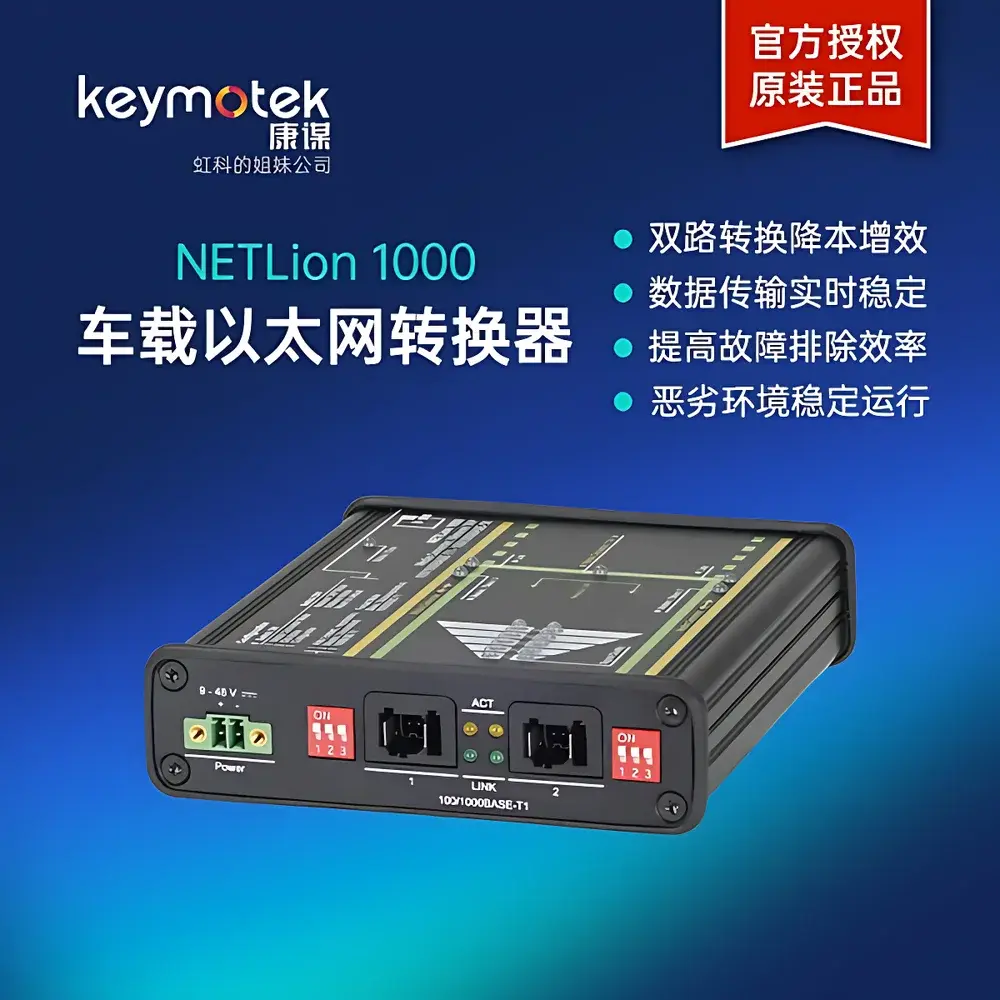

b-plus NETLion 1000 Automotive Ethernet Protocol Signal Acquisition & Media Converter
| Brand | b-plus |
|---|---|
| Origin | Germany |
| Model | KM-B18005-NEL-001-0001 / KM-B18005-NEL-001-0002 |
| Interface Types | 100/1000BASE-T1 (Automotive Ethernet), 100BASE-TX, 1000BASE-T, MGMT Ethernet |
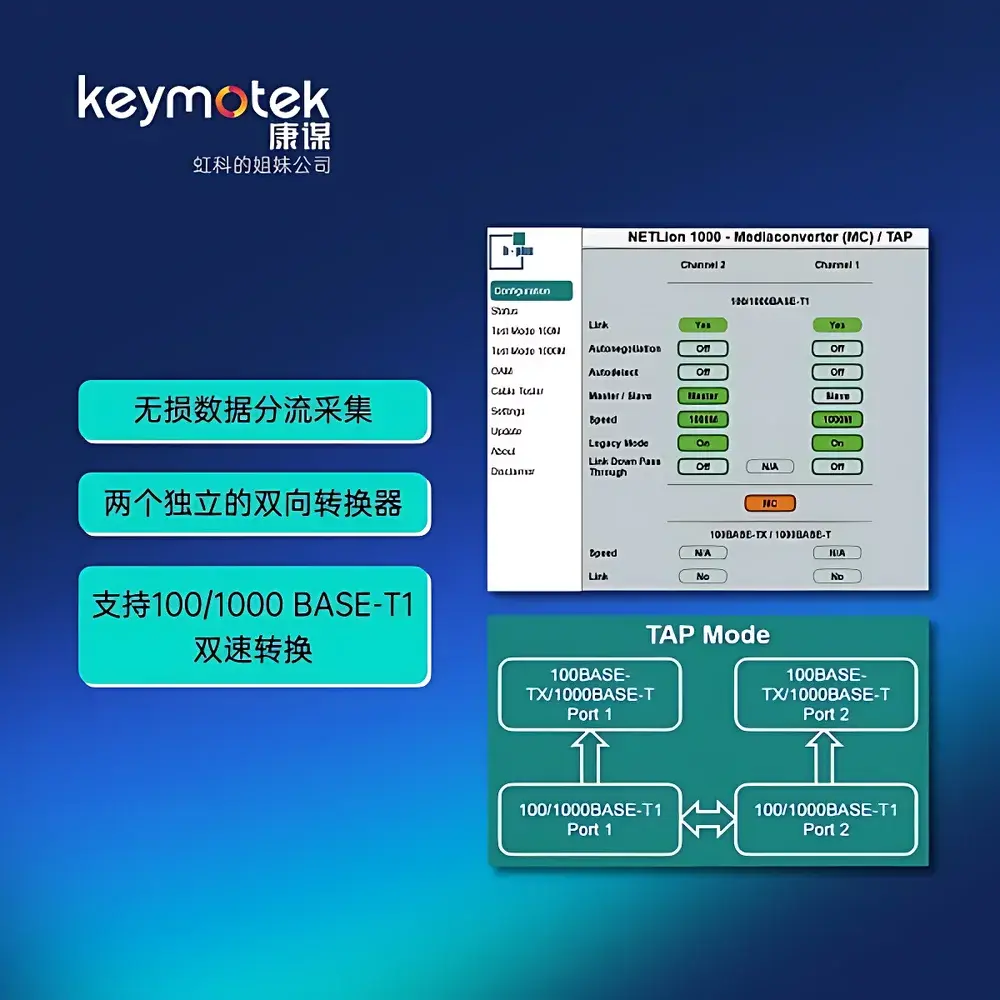
| Operating Modes | Media Conversion, Network TAP, PHY-layer Diagnostic Mode, Cable Certification Mode |
| Configuration | DIP-switch (standalone), Web-based GUI via MGMT port |
| LED Indicators | Link status, signal quality, mode status, fault conditions |
| Compliance Support | ISO 10605, IEEE 802.3bw (100BASE-T1), IEEE 802.3bp (1000BASE-T1), OPEN Alliance TC8/TC15 test requirements |
Overview
The b-plus NETLion 1000 is a purpose-built, dual-function hardware platform engineered for development, validation, and compliance testing of automotive Ethernet networks. It integrates two critical functionalities—media conversion between 100/1000BASE-T1 and standard 100BASE-TX/1000BASE-T physical layers, and non-intrusive network TAP (Test Access Point) operation—into a single compact, ruggedized unit. Unlike generic Ethernet converters, the NETLion 1000 operates at the physical layer (PHY) with full visibility into analog signal integrity metrics, enabling engineers to perform real-time assessment of automotive-grade twisted-pair channel performance without disrupting live ECUs or gateway communication. Its architecture supports deterministic latency, galvanic isolation, and bidirectional signal mirroring—essential for validating time-sensitive networking (TSN) readiness and diagnosing intermittent link failures in ADAS, infotainment, and zonal E/E architectures.
Key Features
- Dual-mode operation: seamless switching between media converter mode (T1 ↔ TX/T) and passive TAP mode for protocol-agnostic traffic monitoring
- Real-time PHY-layer diagnostics: integrated signal quality indicators for amplitude, jitter, rise/fall time, and common-mode noise on 100/1000BASE-T1 links
- Cable certification suite: automated polarity verification, open/short/crossed pair detection, and estimated cable length estimation per IEEE 802.3bw/bp specifications
- Zero-footprint configuration: hardware-level setup via DIP switches—no host PC required for basic mode selection, power-up behavior, or link negotiation parameters
- Web-based management interface: accessible via dedicated MGMT Ethernet port; supports firmware updates, detailed diagnostic logs, and exportable CSV reports for traceability
- Rugged industrial design: conformal-coated PCBs, wide temperature range (-40°C to +85°C), and EMC-hardened enclosure compliant with CISPR 25 Class 5 and ISO 11452-2
Sample Compatibility & Compliance
The NETLion 1000 is validated for use with all major automotive Ethernet implementations including AUTOSAR-compliant ECUs, Vector CANoe.Ethernet, ETAS INCA-Ethernet, and Keysight PathWave. It supports both PAM-3 (100BASE-T1) and PAM-2 (1000BASE-T1) signaling schemes and maintains full interoperability with OPEN Alliance conformance test suites (TC8 for physical layer, TC15 for interoperability). The device meets functional safety requirements per ISO 26262 ASIL-B readiness guidelines when deployed in diagnostic and validation workflows—not as a safety-related component, but as a qualified test tool supporting ASIL-rated system verification. All diagnostic outputs and configuration actions are timestamped and logged for GLP-aligned lab documentation, and the web interface supports role-based access control (RBAC) to satisfy internal audit requirements.
Software & Data Management
Configuration and diagnostics are managed exclusively through a standards-compliant HTTP/HTTPS web interface served from the onboard embedded Linux system. No proprietary drivers or client software are required. The interface provides real-time waveform previews (via FFT-based spectral analysis), historical trend charts for signal quality metrics, and exportable JSON/CSV datasets compatible with MATLAB, Python (pandas), and LabVIEW. Audit logs record all user-initiated actions—including mode changes, DIP-switch override events, and firmware update attempts—with ISO 8601 timestamps and source IP tagging. While not FDA 21 CFR Part 11 certified (as it is not used in regulated clinical environments), its logging architecture satisfies internal QA traceability requirements for IATF 16949-certified automotive R&D labs.
Applications
- Pre-compliance PHY-layer validation during ECU integration testing
- Root-cause analysis of intermittent link drops in vehicle-level Ethernet backbone testing
- Verification of cable harness quality prior to series production (e.g., polarity mismatches, unterminated stubs)
- Calibration and synchronization of multi-node TSN deployments using precise T1 link timing data
- Training and education platforms for automotive Ethernet fundamentals, including impedance mismatch and return loss effects
- Supporting ISO/SAE 21434 cybersecurity validation by enabling unfiltered traffic capture for protocol anomaly detection
FAQ
Does the NETLion 1000 support Power over Data Line (PoDL)?
No. The device does not inject or extract power from the 100/1000BASE-T1 line; it operates as a signal conditioning and monitoring node only.
Can it be used inline between two ECUs without breaking the network?
Yes—in TAP mode, it provides fully passive, non-intrusive mirroring with <1 ns skew and no packet modification or injection.
Is firmware update capability available over the MGMT port?
Yes. Signed firmware images can be uploaded via HTTPS; the bootloader enforces cryptographic signature verification before installation.
What is the maximum supported cable length for accurate diagnostics?
Up to 15 m for 1000BASE-T1 and 40 m for 100BASE-T1, consistent with OPEN Alliance reference channel definitions.
Does it generate or interpret higher-layer protocols (e.g., SOME/IP, DoIP)?
No. The NETLion 1000 operates exclusively at Layer 1; protocol decoding requires external tools such as Wireshark or CANoe.Ethernet.
Related Products