
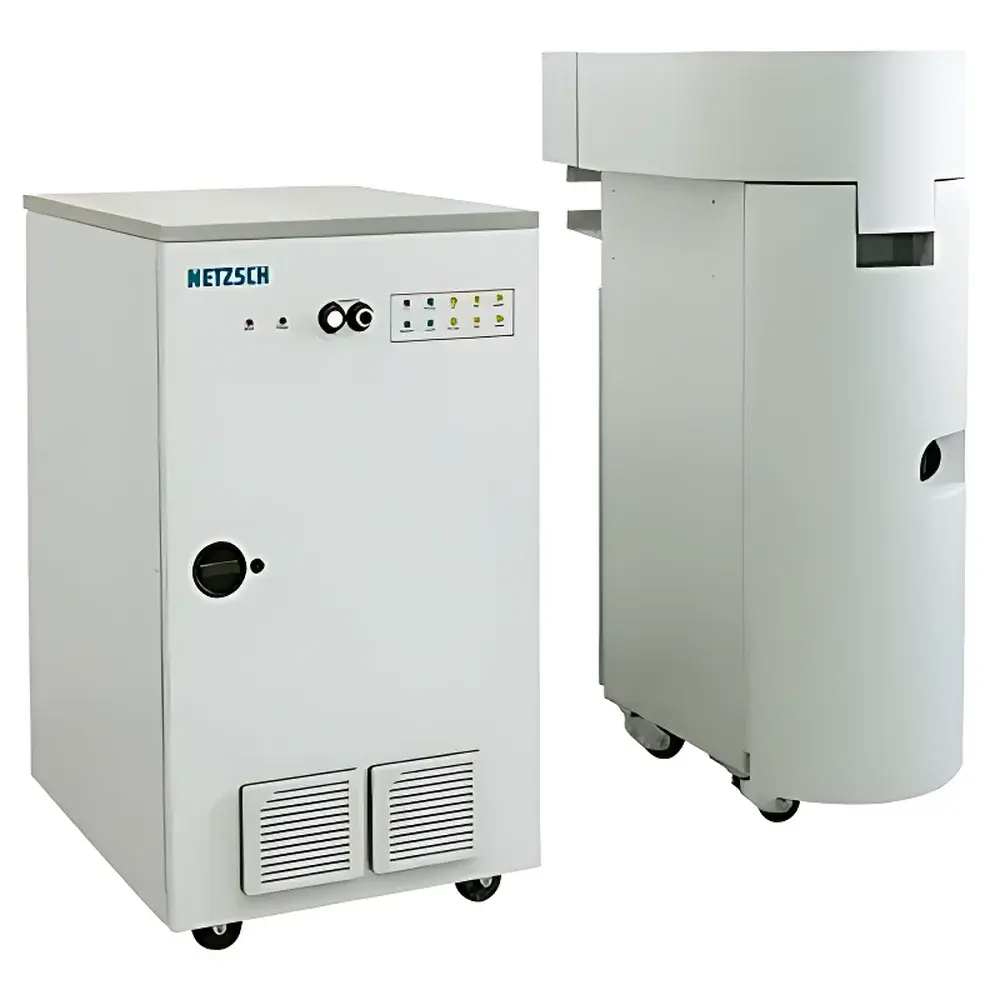
NETZSCH APTAC 264 Automatic Pressure-Tracking Accelerating Rate Calorimeter
| Brand | NETZSCH |
|---|---|
| Origin | Germany |
| Model | APTAC 264 |
| Temperature Range | RT to 500 °C |
| Temperature Tracking Rate | 0–400 °C/min |
| Minimum Detectable Heat Flow Rate | 0.002 °C/min |
| Pressure Range | 0–140 bar |
| Pressure Tracking Rate | 0–680 bar/min |
| Standard Functions | Integrated Stirring, Liquid Injection, and Effluent Discharge |
| Optional Feature | VARIPHI™ Thermal Inertia Compensation Technology |
Overview
The NETZSCH APTAC 264 is an advanced automatic pressure-tracking accelerating rate calorimeter engineered for high-fidelity thermal and pressure hazard assessment under near-adiabatic conditions. Unlike conventional ARC (Accelerating Rate Calorimetry) systems, the APTAC 264 integrates real-time pressure tracking synchronized with temperature evolution, enabling simultaneous measurement of exothermic onset, self-heating rates, pressure rise kinetics, and gas generation profiles during runaway reactions. Its core operating principle relies on heat-flux compensation via active pressure modulation—maintaining near-zero temperature gradient between sample and furnace while dynamically adjusting containment pressure to match evolving vapor-phase behavior. This architecture is particularly critical for evaluating thermally unstable materials where vapor pressure development governs vent sizing, relief system design, and process safety limits—especially in batch chemical synthesis, battery electrolyte decomposition, energetic material handling, and pharmaceutical intermediate processing.
Key Features
- Patented VARIPHI™ technology enables quantitative correction of sample cell thermal inertia, significantly improving accuracy in onset temperature determination and apparent activation energy calculation.
- Integrated high-speed pressure actuation system supports dynamic pressure tracking up to 680 bar/min, ensuring mechanical equilibrium during rapid gas evolution—essential for modeling two-phase (liquid/vapor) runaway scenarios.
- Full automation of stirring, reagent injection, and effluent discharge allows unattended execution of complex reaction protocols including semi-batch additions and emergency depressurization simulations.
- Robust stainless-steel sample containment rated to 140 bar maximum working pressure, compliant with PED 2014/68/EU for pressurized equipment used in hazardous environments.
- Modular sensor architecture with dual thermocouple arrays and piezoresistive pressure transducers calibrated traceably to NIST standards ensures long-term measurement stability and inter-instrument reproducibility.
Sample Compatibility & Compliance
The APTAC 264 accommodates heterogeneous systems including solids, liquids, gas–liquid slurries, immiscible liquid pairs, and suspended particulates—enabling direct testing of realistic process mixtures without simplification artifacts. It supports ASTM E1981 (Standard Guide for Evaluating Thermal Stability of Chemicals by ARC), ISO 8007-1 (Reaction Calorimetry), and IEC 62619 (Safety Requirements for Industrial Secondary Cells and Batteries). Data acquisition and reporting comply with FDA 21 CFR Part 11 requirements for electronic records and signatures when configured with audit-trail-enabled software modules, supporting GLP and GMP-regulated safety qualification studies.
Software & Data Management
Control and analysis are performed using NETZSCH’s ThermoKinetics Suite v5.x, a validated platform offering automated test sequencing, real-time adiabaticity monitoring, and kinetic parameter extraction via Ozawa–Flynn–Wall and ASTM E698 methods. Raw thermal and pressure time-series data are stored in HDF5 format with embedded metadata (operator ID, calibration certificate IDs, environmental conditions), ensuring full traceability. Export options include CSV, XML, and PDF reports conforming to CCPS (Center for Chemical Process Safety) guidelines for Process Hazard Analysis (PHA) documentation.
Applications
- Process safety scale-up: Deriving safe operating limits (e.g., MTSR, TD24, Pmax) for reactor design and relief sizing per DIERS methodology.
- Battery safety: Quantifying thermal runaway onset, gas composition evolution, and vent burst pressure in Li-ion electrolyte formulations under simulated internal short-circuit conditions.
- Energetic materials characterization: Measuring decomposition enthalpy, pressure-dependent ignition thresholds, and deflagration-to-detonation transition (DDT) propensity.
- Pharmaceutical development: Assessing thermal hazards of nitration, hydrogenation, and diazotization steps involving unstable intermediates.
- Transportation safety: Generating UN Test Series H data for classification of substances under ADR/RID/IMDG regulations.
FAQ
What distinguishes APTAC from traditional ARC instruments?
APTAC introduces synchronized pressure tracking as a fundamental operational mode—not merely as an add-on sensor—enabling true adiabatic control even during vigorous gas evolution where conventional ARC systems lose thermal fidelity due to vapor-phase heat loss.
Can the APTAC 264 be used for low-temperature exotherms below ambient?
No; the base configuration operates from room temperature to 500 °C. Sub-ambient capability requires optional cryogenic furnace integration, which is not part of the standard APTAC 264 specification.
Is VARIPHI™ compensation validated against reference materials?
Yes; validation uses certified NIST SRM 3451 (potassium acid phthalate) and SRM 3470 (indium), with residual thermal inertia errors quantified at < ±0.8% across the 100–400 °C range.
How does the system handle reactive gas mixtures during venting tests?
The integrated effluent discharge line connects to external gas analysis systems (e.g., FTIR or GC-MS) via heated transfer lines, preserving speciation integrity for quantitative off-gas composition analysis.
Does the instrument support remote operation and cybersecurity protocols?
Yes; ThermoKinetics Suite includes TLS 1.2 encryption, role-based access control, and OPC UA server integration for secure connection to distributed control systems (DCS) or MES platforms in Industry 4.0 environments.



