
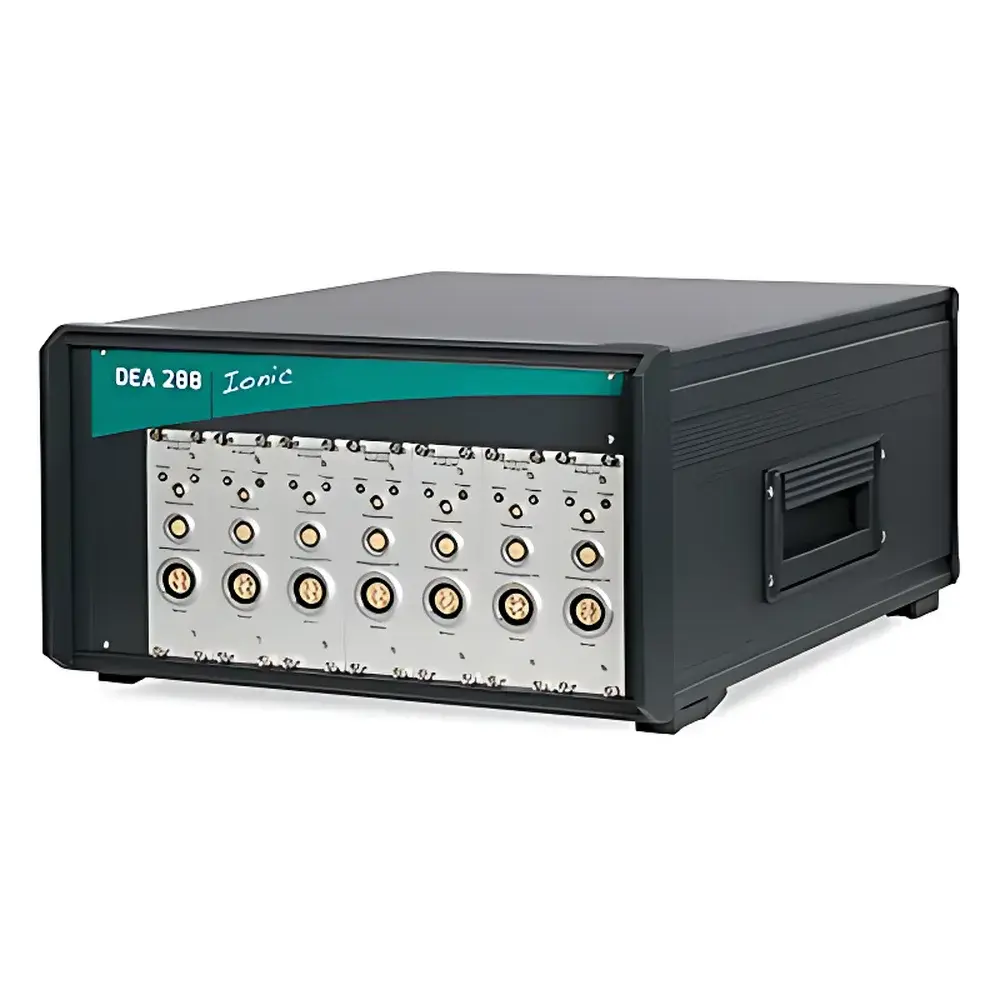
NETZSCH DEA 288 Dielectric Cure Analyzer
| Brand | NETZSCH |
|---|---|
| Origin | Germany |
| Model | DEA 288 |
| Frequency Range | 0.001–1 MHz |
| Resistivity Measurement Range | 10⁰–10¹⁶ Ω·cm (sensor-dependent) |
| Data Channels | 1–16 (configurable) |
| Configuration Options | Portable Version or Industrial Rack-Mounted Version |
| Sensor Compatibility | In-mold, embedded, and lab-grade dielectric sensors |
| Environmental Test Capabilities | Compatible with heating/cooling stages, hot presses, humidity chambers, and UV irradiation systems |
| Compliance | Designed for GLP/GMP-aligned workflows |
Overview
The NETZSCH DEA 288 Dielectric Cure Analyzer is a precision-engineered instrument designed for real-time, non-invasive monitoring of the curing kinetics of thermosetting polymers and reactive formulations. Based on dielectric analysis (DEA), it measures changes in ionic conductivity and dipole mobility—reflected as complex permittivity (ε* = ε′ − jε″) and loss factor (tan δ)—as a function of time, temperature, humidity, or UV exposure. Unlike calorimetric or rheological methods, DEA provides direct insight into molecular-level network formation by tracking ion mobility decay and dipole relaxation shifts during crosslinking. This enables quantitative determination of critical process milestones—including onset of reaction, gel point, vitrification, and full cure—without sample destruction or physical contact interference. The system is widely deployed across R&D laboratories, pilot-scale production lines, and fully integrated manufacturing environments where process robustness, repeatability, and regulatory traceability are mandatory.
Key Features
- Multi-channel architecture supporting 1 to 16 synchronized measurement channels, enabling parallel monitoring of multiple molds, layers, or process zones
- Wide dynamic frequency range (0.001 Hz to 1 MHz) ensures resolution of both low-frequency ion-conduction phenomena and high-frequency dipole relaxations
- Dual hardware configurations: portable unit for field deployment and troubleshooting; industrial rack-mounted version for permanent integration into PLC-controlled production cells
- Modular sensor ecosystem—including embeddable, high-temperature (>250 °C), and chemically resistant sensors—for in-situ measurements inside molds, autoclaves, compression presses, and coating lines
- Native compatibility with thermal platforms (e.g., NETZSCH DSC and TMA furnaces), hydraulic hot presses, environmental chambers, and UV LED arrays for multi-stimulus curing studies
- Real-time calculation of ion viscosity (IV), degree of cure (α), and time–temperature–transformation (TTT) diagrams using built-in kinetic models (e.g., Kamal–Sourour, autocatalytic)
Sample Compatibility & Compliance
The DEA 288 accommodates a broad spectrum of reactive materials, including epoxy, phenolic, polyurethane, unsaturated polyester, vinyl ester, acrylic, and silicone-based resins—alongside composites (e.g., carbon fiber prepregs), adhesives, coatings, encapsulants, and electronic potting compounds. It supports rapid-cure systems such as SMC/BMC molding compounds and UV-initiated acrylates. All measurement protocols adhere to ASTM D4473 (Standard Test Method for Dielectric Cure Monitoring of Thermosetting Resins), ISO 22315 (Plastics — Determination of degree of cure by dielectric analysis), and align with ICH Q5C and USP guidelines for polymer characterization in pharmaceutical device manufacturing. Data acquisition and storage comply with ALCOA+ principles (Attributable, Legible, Contemporaneous, Original, Accurate, Complete, Consistent, Enduring, Available) and support 21 CFR Part 11-compliant electronic signatures when used with validated software packages.
Software & Data Management
The instrument operates under NETZSCH’s ThermoKinetics™ software platform, which provides synchronized control of external stimuli (temperature ramps, UV intensity, pressure cycles) alongside dielectric signal acquisition. Features include automated baseline correction, adaptive noise filtering, multi-curve overlay, derivative analysis for inflection-point detection, and export-ready reporting in CSV, PDF, and XML formats. Audit trails record all user actions, parameter modifications, and calibration events with timestamps and operator IDs. Raw data files are stored in encrypted, tamper-evident containers compliant with ISO/IEC 17025 laboratory accreditation standards. Optional integration with MES/SCADA systems via OPC UA or Modbus TCP enables closed-loop process feedback in Industry 4.0 environments.
Applications
- Optimization of oven dwell times and ramp profiles in aerospace composite autoclave cycles
- Validation of out-time limits and rework criteria for pre-impregnated materials
- Development of low-VOC, fast-cure coatings for automotive OEM lines
- In-process verification of adhesive bond strength development in structural bonding operations
- Accelerated aging studies correlating dielectric response with mechanical property evolution
- Root-cause analysis of delamination or void formation linked to incomplete cure gradients
- Supporting Design of Experiments (DoE) for resin formulation screening under variable humidity conditions
FAQ
What distinguishes DEA from DSC or DMA in cure monitoring?
DEA detects ionic and dipolar mobility changes directly tied to covalent bond formation, offering higher sensitivity to early-stage reactions and spatial resolution within thick sections—unlike DSC (heat flow) or DMA (mechanical modulus), which respond later in the network evolution.
Can the DEA 288 be integrated into an existing PLC-controlled production line?
Yes—the Industrial Rack Version includes analog I/O, digital trigger ports, and industrial communication protocols (PROFINET, EtherCAT, Modbus TCP) for seamless integration with factory automation infrastructure.
Is sensor calibration traceable to national standards?
All reference sensors are calibrated against NIST-traceable impedance standards; certificate-of-calibration is provided with each sensor shipment and updated annually per ISO/IEC 17025 requirements.
Does the system support real-time pass/fail decision logic at the edge?
Via optional firmware module, users can define configurable thresholds for IV slope, tan δ minimum, or α(t) targets—triggering discrete outputs or SCADA alerts without host PC intervention.
How is data integrity ensured during long-duration curing cycles (e.g., >72 h)?
The system employs redundant onboard flash memory, cyclic error-checking (CRC32), and automatic journaling to prevent data loss during power interruption or communication dropout.



