
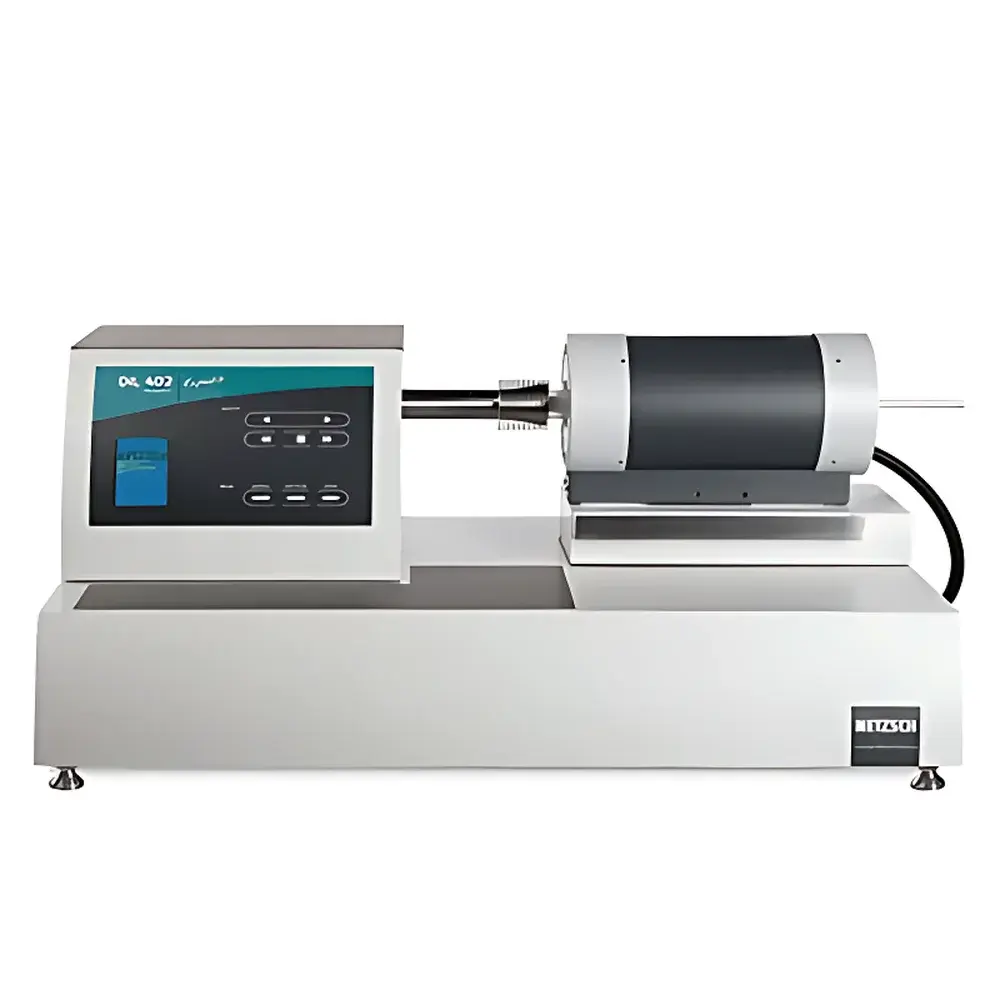
NETZSCH DIL 402 Expedis Classic Thermal Dilatometer
| Brand | NETZSCH |
|---|---|
| Origin | Germany |
| Model | DIL 402 Expedis Classic |
| Temperature Range | RT to 1600 °C |
| Heating Rate | 0–50 °C/min |
| Temperature Accuracy | ±1 °C |
| Sample Length | 0–52 mm |
| Measurement Range | ±5000 µm |
| Resolution | 2 nm |
| Atmosphere Options | Oxidizing, Reducing, Inert, Vacuum |
Overview
The NETZSCH DIL 402 Expedis Classic is a high-precision horizontal push-rod thermal dilatometer engineered for accurate, reproducible measurement of linear dimensional changes in solid materials as a function of temperature or time. Operating on the principle of contact-based mechanical displacement detection under near-zero-load conditions, it complies with standardized thermomechanical testing protocols defined in ISO 11359-1/-2, ASTM E228, and DIN 51045. Designed for laboratory and industrial R&D environments, the instrument delivers traceable thermal expansion data critical for material qualification, phase transition analysis, sintering behavior assessment, and coefficient of linear expansion (CTE) determination across ceramics, metals, polymers, refractories, composites, and thin-film coatings.
Key Features
- Integrated NanoEye optical displacement sensor system — a self-calibrating, feedback-controlled photonic encoder delivering 2 nm resolution over a full ±5000 µm range, ensuring exceptional linearity and long-term signal stability without mechanical hysteresis.
- Modular configuration options: available as single-sample or dual-sample differential mode, both housed within a fully integrated mainframe that incorporates furnace, sensor electronics, gas management, and thermal shielding — eliminating external cabling, auxiliary chillers, or water-cooling infrastructure.
- Robust horizontal push-rod geometry with low-friction ceramic guidance and optimized thermal symmetry, minimizing parasitic expansion artifacts and enabling reliable measurements up to 1600 °C.
- Gas-tight sample chamber with integrated mass flow controllers and direct gas routing through the measurement zone — ensuring rapid atmosphere exchange, uniform gas distribution across the sample, and minimal boundary-layer interference.
- Thermally insulated furnace architecture with multi-zone active temperature control and optimized heat shielding, reducing ambient thermal drift and improving temperature homogeneity across the sample length.
- Tool-free, ergonomic sample holder exchange mechanism — designed to prevent mechanical stress on fragile support rods and eliminate alignment errors during routine setup changes.
Sample Compatibility & Compliance
The DIL 402 Expedis Classic accommodates cylindrical or rectangular specimens up to 52 mm in length and compatible with solid metals, sintered oxides, polymer pellets, powdered compacts, vitreous enamels, and layered composite substrates. Its zero-load or micro-load measurement mode ensures minimal constraint-induced stress, preserving intrinsic thermal response characteristics. The system meets essential regulatory requirements for quality-controlled environments: full audit trail capability, user-access-level permissions, electronic signature support, and data integrity features aligned with FDA 21 CFR Part 11 and EU Annex 11 guidelines. All calibration procedures follow ISO/IEC 17025 traceability pathways using NIST-traceable reference standards.
Software & Data Management
Controlled via the proprietary Proteus® software platform, the instrument provides real-time visualization of dimensional change, derivative (dL/dT), CTE calculation, and automated baseline correction. Data export supports CSV, ASCII, and universal thermal analysis formats (e.g., .itx) for integration into third-party statistical or modeling tools (MATLAB®, Python Pandas, Thermo-Calc®). Proteus® includes GLP-compliant reporting templates, customizable test methods, and secure database archiving with timestamped operator logs. Optional modules enable advanced kinetic analysis (e.g., sintering onset, glass transition inflection), multi-cycle thermal cycling, and isothermal hold sequences with programmable dwell times.
Applications
- Determination of linear thermal expansion coefficients (CTE) for aerospace alloys and turbine blade materials.
- Analysis of densification kinetics and shrinkage behavior during ceramic sintering processes.
- Characterization of thermal mismatch stresses in multilayer electronic packaging and MEMS devices.
- Evaluation of reversible/irreversible dimensional changes in shape-memory alloys and ferroelectric ceramics.
- Quantification of softening points and viscoelastic transitions in high-performance thermoplastics and thermosets.
- Validation of thermal stability and decomposition onset in refractory linings and fire-resistant composites.
FAQ
What is the maximum operating temperature for the DIL 402 Expedis Classic?
The furnace is rated for continuous operation from ambient (RT) up to 1600 °C, with optional high-temperature accessories supporting extended service life at upper-range conditions.
Can the instrument operate under vacuum or reactive atmospheres?
Yes — the sealed sample chamber supports vacuum down to 10⁻³ mbar and is fully compatible with oxidizing (air, O₂), reducing (H₂, CO), and inert (Ar, N₂, He) gas environments via integrated MFCs.
Is the NanoEye sensor susceptible to thermal drift during long-duration tests?
No — the NanoEye system employs active optical feedback compensation and is thermally decoupled from the furnace structure, maintaining sub-nanometer positional stability over multi-hour thermal cycles.
How is calibration verified and maintained?
Calibration is performed using certified reference materials (e.g., fused quartz, α-alumina) traceable to national metrology institutes; Proteus® software includes automated calibration validation routines and deviation logging per ISO 17025 requirements.
Does the system support differential measurement between two samples?
Yes — the dual-sample configuration enables true differential dilatometry, allowing comparative analysis of matched specimens or reference-compensated measurements to suppress common-mode thermal effects.



