
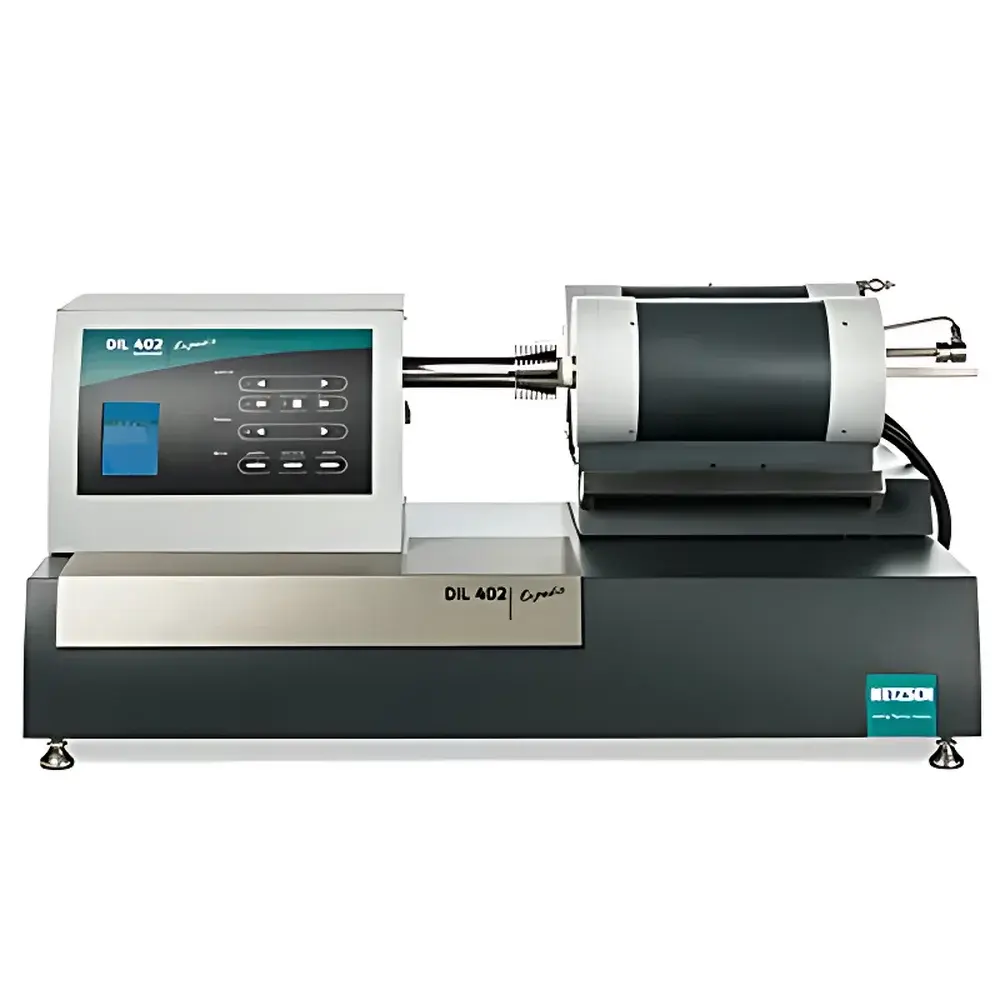
Netzsch DIL 402 Expedis Select Thermal Dilatometer
| Brand | Netzsch |
|---|---|
| Origin | Germany |
| Model | DIL 402 Expedis Select |
| Temperature Range | −180 °C to 2000 °C |
| Heating Rate | 0–50 K/min (up to 100 K/min with specific furnace options) |
| Temperature Accuracy | ±1 °C |
| Sample Length | 0–52 mm |
| Measurement Range | ±10,000 µm / ±25,000 µm |
| Resolution | 1 nm / 0.1 nm |
| Atmosphere Options | Oxidizing, Reducing, Inert, Vacuum |
| Force Control | Adjustable from 10 mN to 3 N (optional) |
Overview
The Netzsch DIL 402 Expedis Select Thermal Dilatometer is a high-precision, modular instrument engineered for the quantitative measurement of dimensional changes in solid, liquid, and powdered materials as a function of temperature. Based on the principle of contact dilatometry—where a precisely calibrated pushrod transmits dimensional variations from the sample to an ultra-sensitive displacement transducer—the system delivers traceable, reproducible linear expansion and contraction data across an exceptional thermal range. Its design integrates advanced thermal management, real-time force regulation, and sub-nanometer resolution sensing to support rigorous materials characterization under controlled atmospheric conditions. The instrument is widely deployed in R&D laboratories, quality control environments, and industrial process development settings where compliance with international standards—including ASTM E228, ISO 11359-1/2, and DIN 51045—is required for reporting thermal expansion coefficients (CTE), glass transition temperatures (Tg), sintering kinetics, phase transformation onset, and softening behavior.
Key Features
- Modular furnace architecture supporting interchangeable high-temperature (up to 2000 °C) and cryogenic (down to −180 °C) configurations—enabling single-instrument coverage of nearly the entire practical thermal domain.
- NanoEye displacement sensing technology: A patented optical encoder system delivering true 1 nm resolution over full-scale ranges (±10,000 µm or ±25,000 µm), with linearity deviation < ±0.05% FS and no hysteresis effects.
- Digitally regulated contact force control: Continuously adjustable between 10 mN and 3 N, ensuring minimal mechanical perturbation for fragile ceramics, thin films, or low-modulus polymers while maintaining stable probe-sample interface.
- Dual-furnace capability: Simultaneous mounting of two independent furnace modules (e.g., one high-temp and one cryo unit), allowing rapid method switching without hardware reconfiguration or recalibration.
- MultiTouch sample positioning system: Motorized, vibration-damped stage with tactile feedback and auto-centering algorithms to guarantee repeatable axial alignment and eliminate operator-induced tilt errors.
- Vacuum-tight furnace design: Integrated metal-sealed construction rated to 10−5 mbar, compatible with reactive gas dosing systems for in-situ oxidation/reduction studies under dynamic atmosphere control.
Sample Compatibility & Compliance
The DIL 402 Expedis Select accommodates diverse sample geometries—including rods, discs, powders (in crucibles), pastes, and thin films—with lengths up to 52 mm and diameters up to 12 mm. Standard sample holders are fabricated from high-purity alumina, fused quartz, or graphite, selected per thermal stability and chemical compatibility requirements. All measurements adhere to GLP-compliant workflows: full audit trails, electronic signatures, and 21 CFR Part 11–ready software logging ensure regulatory readiness for pharmaceutical excipient qualification, aerospace alloy certification, and battery electrode development. Optional c-DTA® functionality enables simultaneous detection of enthalpic events (e.g., crystallization exotherms) alongside dilatometric transitions—supporting multi-parameter correlation in accordance with USP and ISO 11357-6.
Software & Data Management
Operating via NETZSCH Proteus® software, the system provides fully automated sequence programming, real-time derivative analysis (dL/dT), CTE calculation across user-defined intervals, and automatic baseline correction using reference standard calibration curves (e.g., NIST SRM 735a). Data export complies with ASTM E1447 and ISO/IEC 17025–mandated formats (CSV, XML, PDF reports with metadata embedding). Advanced modules include Identify™ spectral library matching for unknown phase identification, Rate-Controlled Sintering (RCS) protocol generation for ceramic densification optimization, and multi-curve statistical comparison tools for batch-to-batch variability assessment. All raw and processed datasets are stored in encrypted, timestamped project files with immutable version history.
Applications
- Determination of coefficient of linear thermal expansion (CLTE) for metals, composites, and refractory materials in aerospace and energy sectors.
- Quantification of glass transition (Tg) and secondary relaxations in thermoplastics, elastomers, and amorphous pharmaceuticals.
- In-situ monitoring of sintering shrinkage, pore closure kinetics, and densification onset in powder metallurgy and additive manufacturing feedstocks.
- Thermal stability assessment of catalyst supports, battery cathode materials, and nuclear fuel matrices under oxidizing or reducing atmospheres.
- Softening point and deformation temperature evaluation of glasses, enamels, and sealing compounds per ISO 306 and ASTM C336.
- Reaction-coupled expansion analysis during solid-state synthesis, e.g., carbothermic reduction or nitridation processes.
FAQ
What furnace options are available for the DIL 402 Expedis Select?
The system supports up to five interchangeable furnace types: low-temperature cryo (−180 °C), medium-temperature SiC (1600 °C), high-temperature graphite (2000 °C), vacuum-compatible MoSi2 (1750 °C), and fast-heating induction furnaces (up to 100 K/min ramp rates).
Is c-DTA® included as standard?
c-DTA® is an optional add-on module requiring a separate temperature sensor integration kit and corresponding software license; it is not factory-installed by default.
Can the instrument perform measurements under controlled humidity?
While the base configuration supports dry inert/vacuum/oxidizing/reducing gases, humidity-controlled operation requires integration with an external vapor dosing system and is implemented on a case-by-case basis per application requirements.
How is calibration traceability maintained?
All displacement and temperature calibrations are performed using NIST-traceable reference standards (e.g., SRM 735a for expansion, SPRTs for temperature), with certificate documentation generated automatically upon each calibration cycle.
Does the system support unattended overnight operation?
Yes—Proteus® software includes robust error-handling routines, automatic furnace cooldown protocols, and email/SMS alert triggers for abnormal events, enabling secure 24/7 autonomous testing sequences.



