
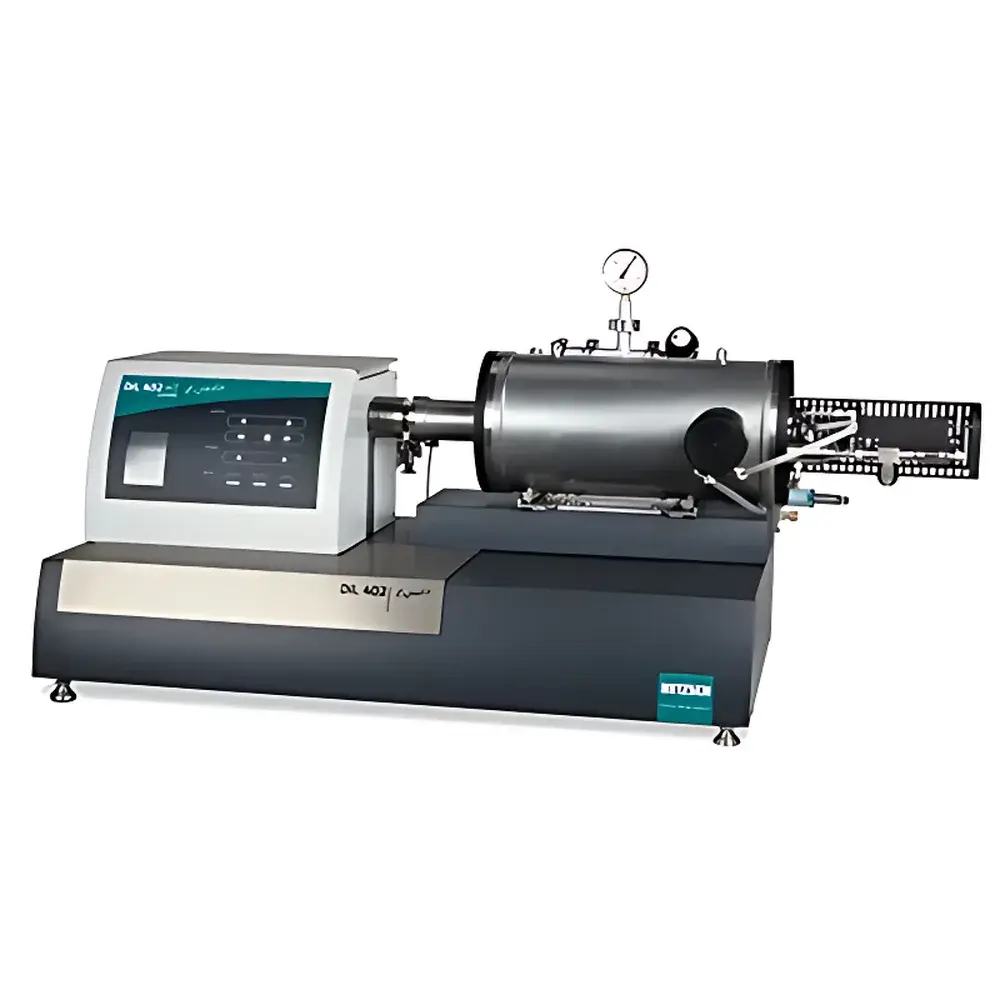
NETZSCH DIL 402 Expedis Supreme HT High-Temperature Dilatometer
| Brand | NETZSCH |
|---|---|
| Origin | Germany |
| Model | DIL 402 Expedis Supreme HT |
| Temperature Range | −180 to 2800 °C |
| Heating Rate | 0–50 K/min (up to 100 K/min with specific furnace options) |
| Temperature Accuracy | ±1 °C |
| Sample Length | 0–52 mm |
| Measurement Range | ±25,000 µm |
| Resolution | 0.1 nm |
| Atmosphere Options | Oxidizing, Reducing, Inert, Vacuum (down to 10⁻⁵ mbar) |
| Furnace Types | Graphite, Alumina, Fused Silica |
| Optional Features | c-DTA® (calibrated Differential Thermal Analysis), Identify™ Spectral Matching, Rate-Controlled Sintering (RCS) |
Overview
The NETZSCH DIL 402 Expedis Supreme HT is a high-precision horizontal push-rod dilatometer engineered for absolute dimensional stability measurements across an unprecedented thermal range—from cryogenic conditions at −180 °C up to extreme temperatures of 2800 °C. It operates on the principle of contact-based linear displacement measurement under controlled thermal programming, enabling quantification of thermal expansion coefficients (CTE), phase transition temperatures, sintering kinetics, and structural relaxation phenomena in solid, powder, and viscous liquid samples. Its modular furnace architecture—compatible with graphite, alumina, and fused silica crucibles—ensures material-specific thermal compatibility while maintaining strict thermal homogeneity and reproducibility. Designed for R&D laboratories and industrial quality control environments subject to ISO/IEC 17025, ASTM E228, ASTM D696, ISO 11359-1/-2, and DIN 51045 compliance, the system delivers traceable, GLP/GMP-ready data suitable for regulatory submissions and process validation.
Key Features
- NanoEye™ high-resolution optical displacement sensor delivering 0.1 nm resolution over the full ±25,000 µm measurement range, with inherent linearity and zero drift compensation
- Motorized, continuously adjustable contact force (0.01–1.0 N), enabling non-destructive analysis of fragile ceramics, thin films, and low-modulus polymers
- MultiTouch™ sample positioning system with real-time tactile feedback and automated length calibration, ensuring repeatable probe-sample alignment
- Vacuum-tight furnace chamber rated to 10⁻⁵ mbar, integrated with mass flow controllers for precise gas blending (N₂, Ar, He, H₂, O₂, forming gas, synthetic air)
- Modular high-temperature furnace options: graphite (up to 3000 °C), high-purity alumina (up to 1750 °C), and fused silica (up to 1200 °C), each with independent thermocouple calibration and thermal shielding
- Integrated c-DTA® module (optional) for simultaneous detection of endo-/exothermic events during dilatometric scans, referenced against certified standards per ISO 11357-4
Sample Compatibility & Compliance
The DIL 402 Expedis Supreme HT accommodates diverse sample geometries—including rods, discs, powders (in crucibles), pastes, and thin-film substrates—within a maximum length of 52 mm and diameter up to 12 mm. Its adaptive probe design supports brittle, porous, or anisotropic materials without slippage or creep-induced artifacts. All furnace configurations comply with IEC 61000-6-3 (EMC) and IEC 61010-1 (safety). Data acquisition meets FDA 21 CFR Part 11 requirements when operated with NETZSCH Proteus® software in audit-trail-enabled mode, including electronic signatures, user access levels, and immutable raw-data archiving. Calibration certificates are traceable to PTB (Physikalisch-Technische Bundesanstalt) and NIST standards.
Software & Data Management
Proteus® 6.x software provides full instrument control, real-time visualization, and advanced post-processing—including CTE calculation across user-defined temperature intervals, inflection point detection for Tg and sintering onset, derivative analysis (dL/dT), and multi-curve comparative overlay. The Identify™ spectral matching tool (optional) cross-references measured expansion profiles against a curated database of >2,400 reference materials. Export formats include ASCII, CSV, XML, and PDF reports compliant with internal SOPs and external regulatory review. Data integrity is enforced via automatic timestamping, checksum validation, and encrypted project file storage.
Applications
- Quantification of coefficient of thermal expansion (CTE) in aerospace alloys, refractory ceramics, and composite matrices
- Detection of glass transition (Tg), crystallization onset (Tx), and melting/solidification hysteresis in amorphous metals and pharmaceutical excipients
- In-situ monitoring of densification kinetics and pore closure during pressureless and hot-press sintering
- Thermal stability assessment of battery electrode materials under inert and reducing atmospheres
- Reaction enthalpy estimation via c-DTA® coupling during oxidation of SiC or carbothermal reduction of metal oxides
- Process window definition for thermal annealing, brazing, and heat treatment of precision optics and MEMS components
FAQ
What is the minimum measurable expansion change?
The NanoEye™ sensor resolves dimensional changes as small as 0.1 nm—equivalent to ~0.002 ppm strain for a 5 mm sample.
Can the system perform measurements under dynamic gas switching?
Yes—integrated MFCs support sequential or gradient gas atmosphere changes during a single run, with programmable ramp rates and dwell times.
Is c-DTA® compatible with all furnace types?
c-DTA® is fully supported with alumina and fused silica furnaces; graphite furnace operation requires optional thermal isolation hardware for optimal signal-to-noise ratio.
How is probe wear compensated over long-term operation?
Proteus® includes automated tip-wear correction routines that recalibrate zero position using reference standards before each measurement series.
Does the system support ASTM E228-compliant CTE reporting?
Yes—preconfigured report templates generate ASTM E228-compliant tables, including uncertainty budgets, standard deviation, and confidence intervals per measurement segment.



