
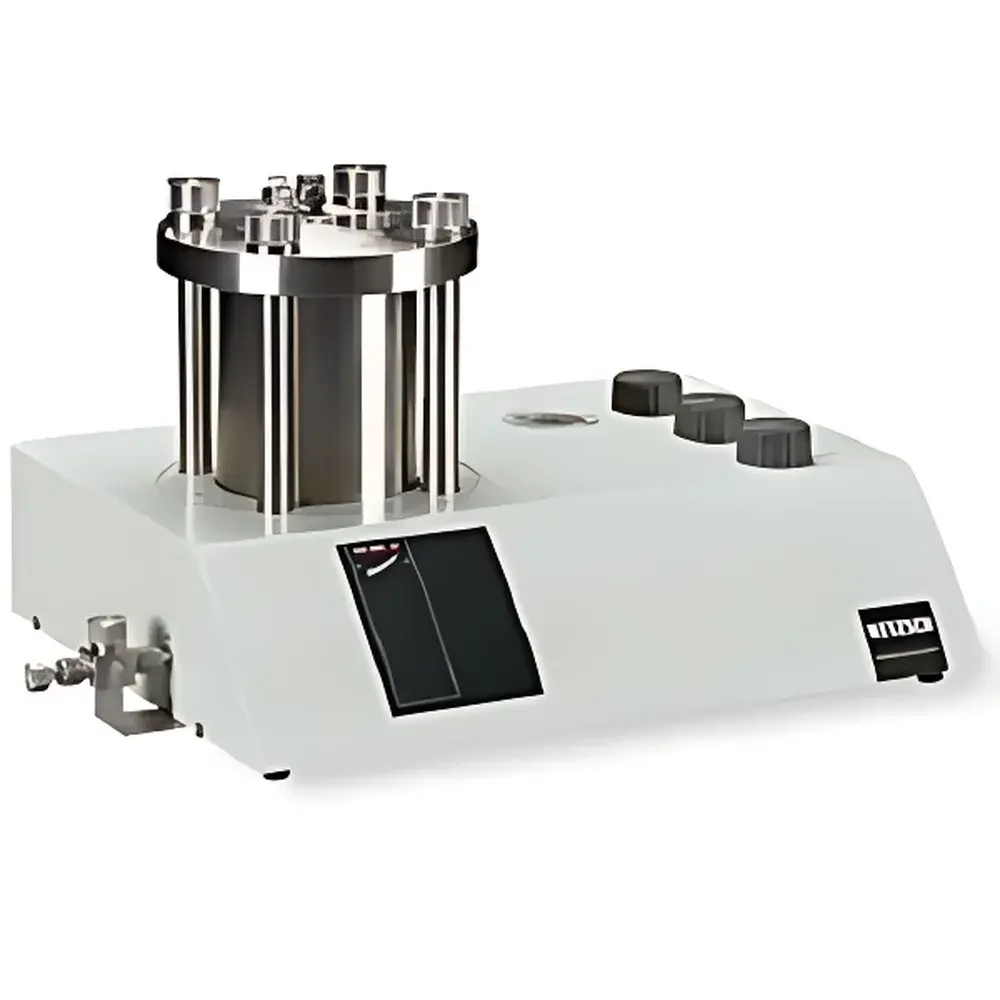
Netzsch DSC 204 HP Phoenix High-Pressure Differential Scanning Calorimeter
| Brand | Netzsch |
|---|---|
| Origin | Germany |
| Model | DSC 204 HP Phoenix |
| Instrument Type | Differential Scanning Calorimeter (DSC) |
| Temperature Range | –150 °C to 600 °C (under vacuum to 15 MPa) |
| Temperature Accuracy | ±0.1 K |
| Heating/Cooling Rate | 0–100 K/min |
| Pressure Range | 0–15 MPa (0–150 bar) |
| Atmosphere Compatibility | Static or dynamic O₂, N₂, Ar, He, H₂, CO₂, CH₄, and other process gases |
Overview
The Netzsch DSC 204 HP Phoenix is a high-pressure differential scanning calorimeter engineered for precision thermal analysis under rigorously controlled pressure and temperature conditions. Based on the heat-flux DSC principle, it measures endothermic and exothermic transitions—including glass transitions, melting, crystallization, solid-solid phase changes, oxidation onset, and decomposition—by quantifying the differential heat flow between a sample and an inert reference as both are subjected to identical, programmable thermal profiles. Unlike conventional DSC systems limited to ambient pressure, the DSC 204 HP Phoenix integrates a robust gold-plated sensor cell and a hermetically sealed, pressure-rated furnace assembly, enabling thermodynamic characterization across an unprecedented pressure range of 0–15 MPa (0–150 bar), from cryogenic temperatures (–150 °C with CC 200 L liquid nitrogen cooling) up to 600 °C. This capability addresses critical gaps in materials science where pressure significantly modulates reaction kinetics, phase stability, polymorphic behavior, and thermodynamic equilibria—particularly in polymer processing, energetic materials safety assessment, geochemical simulation, pharmaceutical solid-state development, and catalytic reaction screening.
Key Features
- World’s highest operational pressure range for DSC: 0–15 MPa (0–150 bar), certified per PED 2014/68/EU and ASME BPVC Section VIII Div. 1
- Full temperature coverage from –150 °C (with optional CC 200 L cryo controller) to 600 °C under pressure, maintaining ±0.1 K temperature accuracy across the entire range
- Electronically regulated pressure control system with integrated digital transducers and real-time PID feedback, enabling stable isobaric holds and precise pressure ramps
- Dynamic or static gas atmosphere compatibility—including reactive (O₂, H₂, CH₄), inert (N₂, Ar, He), and corrosive (CO₂) gases—managed via mass flow controllers and pressure-compensated purge lines
- Gold-coated, corrosion-resistant sensor cell designed for long-term stability and signal reproducibility under aggressive chemical environments and high-pressure cycling
- Integrated safety architecture: dual redundant pressure relief valves, burst disc, real-time pressure/temperature interlock logic, and automated emergency venting compliant with IEC 61508 SIL 2
Sample Compatibility & Compliance
The DSC 204 HP Phoenix accommodates standard crucibles (aluminum, gold-plated aluminum, stainless steel, sapphire, and high-pressure quartz) with capacities up to 100 mg. It supports heterogeneous samples—including powders, granules, gels, films, and pressurized liquids—without modification to the measurement cell. All hardware and software comply with ISO 11357 (Plastics — Differential Scanning Calorimetry), ASTM E794 (Melting and Crystallization Temperatures by DSC), and USP (Thermal Analysis). Data acquisition and instrument control meet FDA 21 CFR Part 11 requirements for electronic records and signatures when configured with Netzsch Proteus® Software in audit-trail mode. The system is validated for GLP and GMP environments, supporting full traceability of calibration, method parameters, raw data, and metadata.
Software & Data Management
Controlled exclusively via Netzsch Proteus® Software (v12.x or later), the DSC 204 HP Phoenix offers synchronized, time-stamped acquisition of heat flow, temperature, pressure, and gas flow signals at 10 Hz resolution. Proteus includes pre-validated methods for oxidative induction time (OIT), pressure-dependent melting point mapping, isothermal decomposition kinetics, and multi-step pressure-temperature protocols. Raw data are stored in vendor-neutral ASCII (.ASC) and HDF5 formats; processed results export to CSV, PDF, and XML for integration into LIMS or ELN platforms. Advanced features include automatic baseline correction using polynomial fitting, peak deconvolution via Gaussian-Lorentzian modeling, and quantitative enthalpy calculation with user-defined baseline anchoring. Audit trail functionality logs all operator actions, parameter changes, and calibration events with digital signature and timestamp.
Applications
- Pharmaceuticals: Polymorph screening under elevated pCO₂ to assess hydrate/anhydrate stability; pressure-modulated eutectic melting in amorphous solid dispersions
- Polymers: Crystallization kinetics of polyolefins under high-pressure N₂; degradation onset under compressed air for automotive under-hood material qualification
- Energetic Materials: Thermal runaway initiation thresholds of propellants and explosives under confinement-relevant pressures
- Food Science: Solid-fat content profiling of cocoa butter analogues under controlled pCO₂ to mimic industrial tempering conditions
- Geochemistry: Phase transitions in mantle mineral analogues (e.g., olivine → wadsleyite) simulated at lithostatic pressures up to 15 GPa-equivalent via calibrated P–T calibration curves
- Battery Materials: SEI formation thermodynamics on Li-ion anodes under inert Ar/H₂ mixtures at 8–12 MPa
FAQ
What pressure media are compatible with the DSC 204 HP Phoenix?
The system supports any non-condensable or low-vapor-pressure gas—including N₂, Ar, He, O₂, H₂, CO₂, CH₄, and custom gas mixtures—provided they remain gaseous within the operating T–P window.
Can the instrument perform simultaneous pressure and temperature ramps?
Yes. Proteus software enables fully independent, synchronized programming of heating/cooling rate and pressure ramp rate, including segmented multi-step P–T profiles.
Is calibration traceable to national standards?
Temperature calibration uses NIST-traceable indium, tin, zinc, and bismuth standards; pressure calibration employs PTB-certified dead-weight testers with uncertainty ≤0.05% FS.
What safety certifications does the DSC 204 HP Phoenix hold?
It complies with PED 2014/68/EU, ASME BPVC Section VIII Div. 1, and carries CE marking with full technical documentation per Annex I. Full risk assessment reports and SIL verification documents are available upon request.
Does the system support automated sample loading?
No. Due to pressure vessel integrity requirements, sample insertion requires manual loading with torque-controlled sealing; however, robotic sample changers are under development for future release.



