
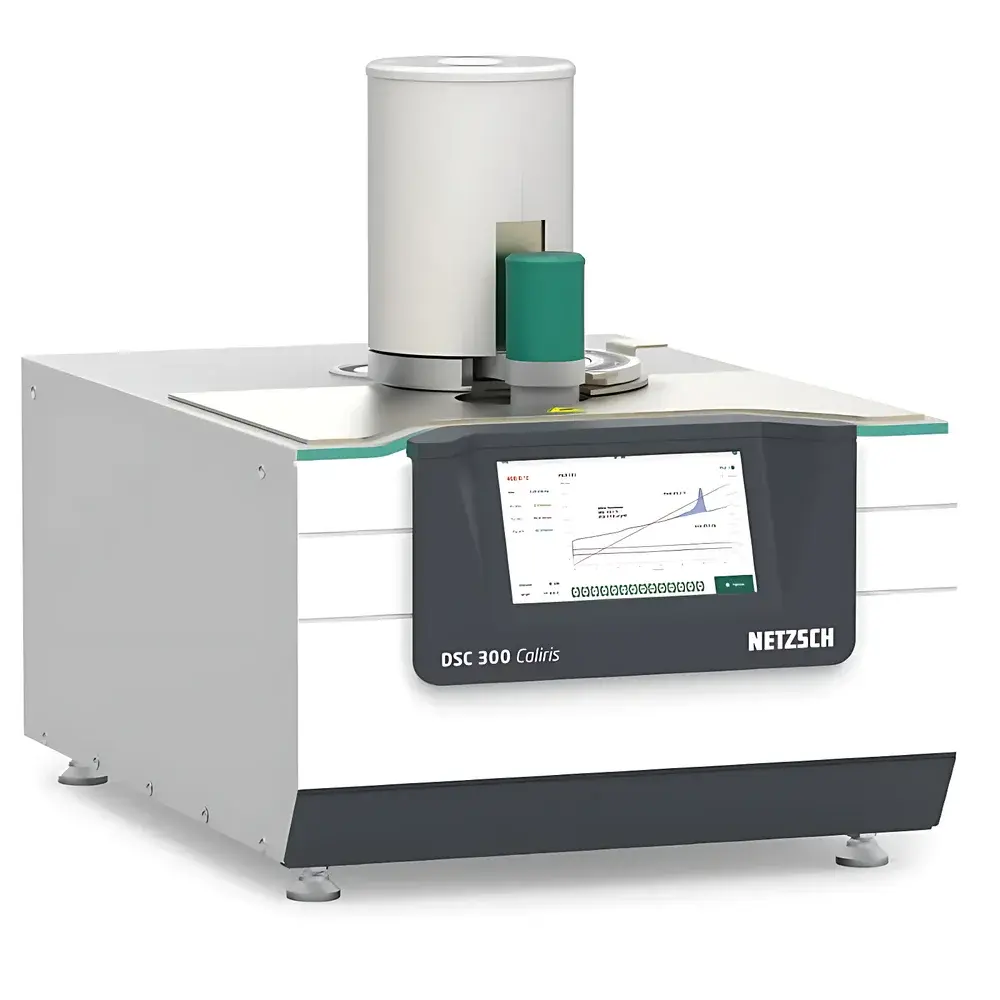
NETZSCH DSC 300 Caliris Classic Differential Scanning Calorimeter
| Brand | NETZSCH |
|---|---|
| Origin | Germany |
| Model | DSC 300 Caliris Classic |
| Instrument Type | Differential Scanning Calorimeter (DSC) |
| Temperature Range | −170 °C to 600 °C |
| Heating/Cooling Rate | 0.001–100 K/min |
| Temperature Accuracy | ±0.1 K (intrinsic) |
Overview
The NETZSCH DSC 300 Caliris Classic is a high-precision, modular differential scanning calorimeter engineered for robust thermal characterization of solid and semi-crystalline materials across academic, industrial R&D, and quality control laboratories. Based on the heat-flux DSC principle, it measures the difference in heat flow between a sample and an inert reference as both are subjected to identical, controlled temperature programs. This enables quantitative determination of endothermic and exothermic transitions—including glass transitions (Tg), melting (Tm), crystallization (Tc), solid–solid transitions, and curing reactions—with high reproducibility and baseline stability. Designed and manufactured in Selb, Germany, the instrument features a symmetrical furnace architecture, low thermal mass sensor design, and active temperature stabilization—ensuring excellent sensitivity, resolution, and long-term signal integrity over its full operational range from −170 °C to +600 °C.
Key Features
- High-resolution thermal analysis with intrinsic temperature accuracy of ±0.1 K, traceable to NIST-certified standards.
- Wide dynamic heating/cooling rate capability (0.001–100 K/min), supporting both slow-scan kinetic studies and rapid thermal profiling.
- BeFlat® baseline correction algorithm: applies polynomial fitting across multiple heating rates to remove instrumental and sample-related baseline drift—critical for accurate enthalpy integration and multi-rate comparison.
- Tau-R mode: compensates for system time constant and thermal resistance effects in real time, yielding sharper, more symmetric peaks and improved transition onset resolution.
- Integrated automatic peak detection and annotation: identifies onset, peak maximum, inflection, and endset temperatures; calculates peak area (ΔH), height, width at half-height, and symmetry metrics in a single evaluation pass.
- Crystallinity quantification module: computes relative crystallinity using standard enthalpy-of-fusion references (e.g., 100% crystalline polyethylene or polypropylene).
- Comprehensive Tg analysis: supports multiple evaluation methods (midpoint, onset, inflection) and optional step-change detection for complex polymer blends and amorphous systems.
Sample Compatibility & Compliance
The DSC 300 Caliris Classic accommodates standard crucibles (aluminum, gold-plated aluminum, stainless steel, and high-purity ceramic) with capacities from 1 mg to 50 mg, enabling analysis of polymers, pharmaceuticals, metals, composites, and food matrices. Optional high-pressure cells (up to 100 bar) and humidity-controlled modules extend applicability to volatile, reactive, or moisture-sensitive samples. The system complies with ISO 11357 (Plastics — Differential Scanning Calorimetry), ASTM E794 (Melting and Crystallization Temperatures by DSC), and USP (Thermal Analysis). When configured with the optional GLP/GMP software package, it supports full 21 CFR Part 11 compliance—including electronic signatures, audit trails, user access levels, and data integrity controls required for regulated pharmaceutical and medical device environments.
Software & Data Management
Operating via NETZSCH Proteus® Software v9.x, the instrument provides intuitive method setup, real-time data visualization, and advanced post-processing workflows. All raw and processed data are stored in a secure, timestamped database with version-controlled metadata (operator ID, instrument ID, calibration history, environmental logs). Batch processing, comparative overlay, derivative analysis (dH/dT), and custom report generation (PDF, Excel, XML) are fully supported. Export formats include ASTM E1868-compliant .qdx files and universal ASCII (.txt) for third-party statistical or modeling tools (e.g., Kinetics Neo, Thermo-Calc). Raw signal export preserves full 100 Hz acquisition fidelity for independent validation.
Applications
- Polymers: Tg, Tm, Tc, cold crystallization, oxidative induction time (OIT), and degree of crystallinity assessment per ISO 11357-3.
- Pharmaceuticals: Polymorph screening, amorphous content quantification, excipient compatibility, and stability-indicating thermal profiling under ICH Q5C guidelines.
- Metals & Alloys: Solidus/liquidus determination, phase transformation enthalpies, and aging behavior in aluminum, titanium, and Ni-based superalloys.
- Battery Materials: SEI layer formation energy, cathode/anode decomposition kinetics, and electrolyte thermal runaway thresholds.
- Food Science: Starch gelatinization, fat polymorphism, protein denaturation, and shelf-life prediction via accelerated aging protocols.
FAQ
What is the minimum detectable heat flow resolution of the DSC 300 Caliris Classic?
The instrument achieves a typical heat flow resolution of ≤0.1 µW (baseline noise RMS), dependent on crucible type, purge gas flow, and scan rate.
Can the system perform modulated DSC (MDSC)?
Yes—TM-DSC (Temperature-Modulated DSC) is available as a factory-installed option, enabling separation of reversing (heat capacity-related) and non-reversing (kinetic) heat flow components.
Is calibration traceable to international standards?
Yes—temperature calibration uses certified indium, tin, zinc, and bismuth standards (NIST SRM 3450 series); enthalpy calibration employs certified potassium bitartrate and benzoic acid standards.
Does the system support purge gas switching during a single run?
Yes—automated gas switching (e.g., N2 → O2) is programmable via the Proteus® software, enabling oxidation stability testing without manual intervention.
What maintenance intervals are recommended for routine operation?
Furnace and sensor alignment verification every 6 months; crucible holder cleaning after each use; annual full recalibration recommended under GLP/GMP conditions.



