
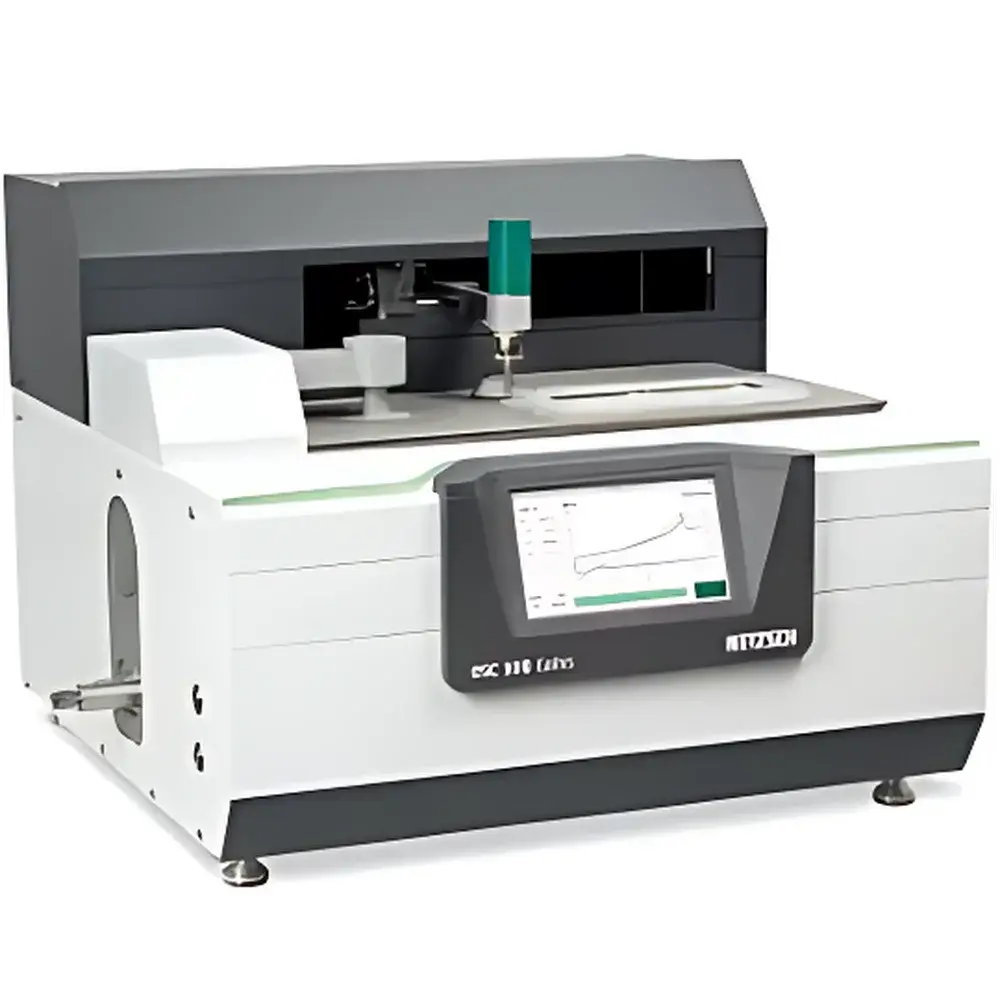
Netzsch DSC 300 Caliris® Select-P Differential Scanning Calorimeter
| Brand | Netzsch |
|---|---|
| Origin | Germany |
| Model | DSC 300 Caliris® Select-P |
| Instrument Type | Differential Scanning Calorimeter (DSC) |
| Temperature Range | –170 to 600 °C |
| Heating/Cooling Rate | 0 to 500 K/min |
| Compliance | GLP/GMP, FDA 21 CFR Part 11 (software-enabled), ISO 11357, ASTM E794, ASTM E1356 |
Overview
The Netzsch DSC 300 Caliris® Select-P is a high-performance differential scanning calorimeter engineered for precision thermal analysis across demanding research, quality control, and regulatory environments. Based on the heat-flux DSC principle, it measures the difference in heat flow between a sample and an inert reference as both are subjected to identical, programmable temperature profiles. This enables quantitative determination of enthalpic transitions—including melting, crystallization, glass transitions, curing, oxidation, and decomposition—under controlled atmospheric conditions (inert, oxidative, or reactive gas). The integrated P-module (Power Compensation-enhanced) delivers exceptional dynamic response, supporting ultra-rapid heating and cooling rates up to 500 K/min while maintaining thermal stability and signal fidelity. Its modular architecture allows seamless integration with optional accessories such as automatic sample changers, humidity-controlled cells, UV exposure units, and high-pressure modules—extending analytical flexibility without compromising baseline reproducibility.
Key Features
- High-speed thermal control: Programmable heating/cooling rates from 0 to 500 K/min, enabling kinetic studies, fast screening, and simulation of industrial thermal processes.
- BeFlat® baseline correction: Polynomial-based algorithm that models and subtracts instrument-specific baseline drift across multiple heating rates—critical for comparative analysis and multi-rate activation energy calculations.
- Tau-R mode: Compensates for instrumental time constant and thermal resistance effects, yielding sharper peaks, improved resolution of overlapping transitions, and more accurate onset/peak temperature assignment.
- TM-DSC capability (optional): Enables separation of total heat flow into reversible (thermodynamic) and irreversible (kinetic) components via sinusoidal temperature modulation—essential for deconvoluting complex transitions such as enthalpy relaxation in polymers or solid-state reactions.
- Comprehensive thermal property quantification: Automatic peak detection with customizable thresholds; multi-point baseline selection (linear, spline, polynomial); partial area integration; crystallinity calculation using reference enthalpies; Cp measurement via step-heating or modulated methods.
- Robust hardware design: Twin-furnace geometry with symmetric sensor layout ensures high symmetry, low noise, and excellent long-term baseline stability—even during extreme rate protocols.
Sample Compatibility & Compliance
The DSC 300 Caliris® Select-P accommodates standard crucibles (aluminum, gold-plated aluminum, stainless steel, sapphire) and supports sample masses from 0.1 mg to 100 mg. It is compatible with volatile, corrosive, and reactive materials when used with appropriate containment (e.g., hermetically sealed pans, high-pressure cells). All operational parameters—including method files, raw data, processed results, and user audit trails—are fully traceable and exportable in standardized formats (e.g., ASCII, .itx, .csv). The system meets key international standards including ISO 11357 (plastics — Differential scanning calorimetry), ASTM E794 (melting and crystallization temperatures), ASTM E1356 (kinetic analysis), and USP . When configured with validated software modules, it supports full compliance with GLP, GMP, and FDA 21 CFR Part 11 requirements—including electronic signatures, role-based access control, and immutable audit logs.
Software & Data Management
The instrument is operated via Proteus® Software—a modular, Windows-based platform designed for scientific rigor and regulatory readiness. Core modules include Evaluation (for peak identification, baseline fitting, enthalpy integration), Kinetics Neo (for isoconversional and model-fitting kinetic analysis), and ThermOptics (for optical-DSC correlation). Optional modules support TM-DSC deconvolution, Cp calibration, and automated reporting compliant with internal SOPs or external regulatory submissions. Data integrity is enforced through password-protected user levels, automatic metadata tagging (operator, timestamp, instrument ID, method version), and secure database archiving. Export functions support direct integration with LIMS, ELN, and statistical process control (SPC) platforms.
Applications
- Pharmaceutical development: Polymorph screening, amorphous content quantification, excipient compatibility, thermal stability assessment under ICH Q1A–Q1E guidelines.
- Polymer science: Crystallinity determination, Tg analysis (including sub-Tg relaxations), crosslink density estimation, degradation onset evaluation, and reaction enthalpy monitoring during curing.
- Materials engineering: Phase diagram construction, solid-state reaction kinetics, heat capacity mapping for battery electrode materials, and thermal aging behavior of composites.
- Food science: Fat crystallization profiling, starch gelatinization enthalpy, moisture-induced transitions, and shelf-life prediction modeling.
- Academic research: Validation of thermodynamic models, benchmarking of computational simulations (e.g., molecular dynamics), and method development for novel thermal characterization protocols.
FAQ
What distinguishes the Select-P configuration from other DSC 300 variants?
The P-module integrates enhanced power compensation circuitry and optimized furnace dynamics to achieve superior signal-to-noise ratio at high scan rates—enabling reliable measurements even at 500 K/min without thermal lag artifacts.
Is TM-DSC functionality built-in or requires additional hardware?
TM-DSC is a software-enabled option requiring no hardware modification; however, optimal performance demands precise temperature control firmware and calibrated sensor response—both included in the Select-P configuration.
Can the system perform specific heat (Cp) measurements according to ASTM E1269?
Yes—using either the step-heating method or temperature-modulated mode, with calibration against certified sapphire standards and automated Cp calculation within Proteus® Evaluation.
Does the system support automated sample handling?
It is fully compatible with the Netzsch ASC 16 automatic sample changer, enabling unattended operation for up to 16 samples with programmable pan type recognition and purge gas sequencing.
How is data integrity ensured for regulated environments?
Through Proteus® GxP Mode: electronic signatures, audit trail generation (with operator, action, timestamp, and reason-for-change), locked method templates, and encrypted database storage compliant with FDA 21 CFR Part 11 Annex 11 requirements.
Related Products



