
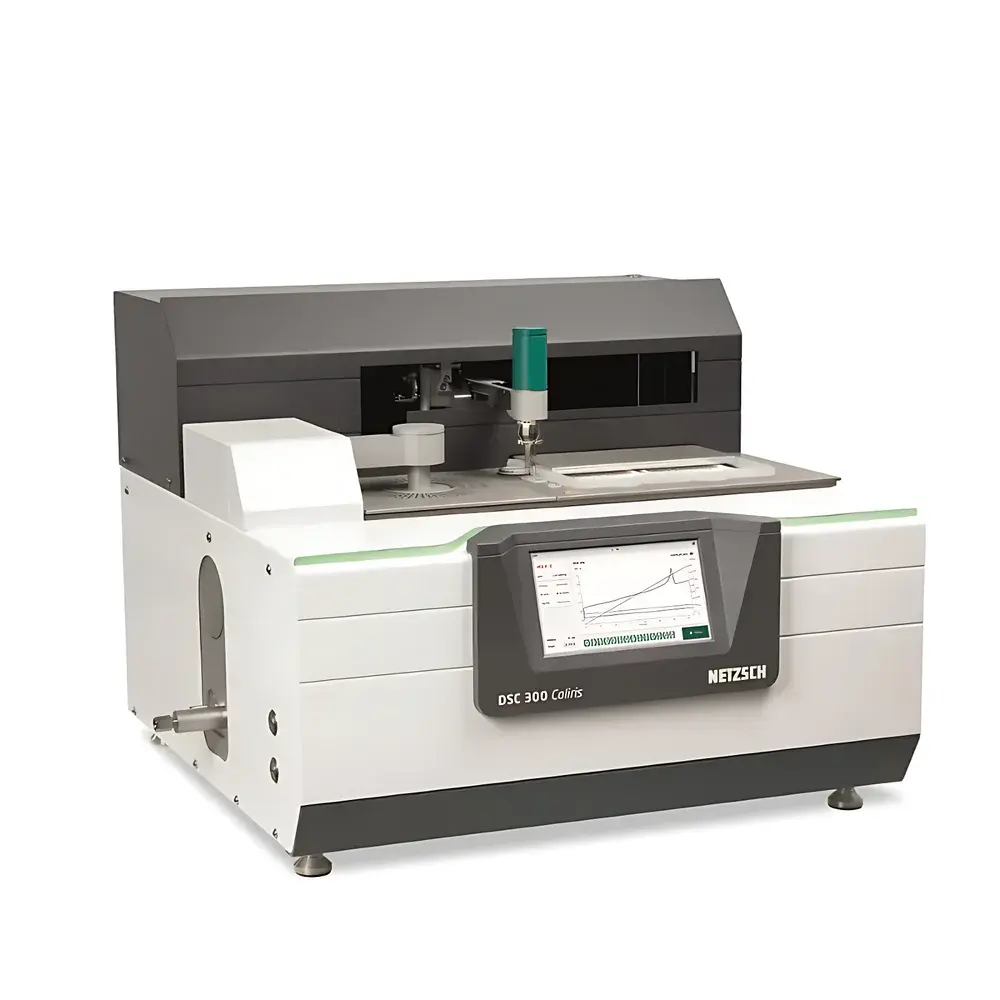
NETZSCH DSC 300 Caliris Supreme-H Differential Scanning Calorimeter
| Brand | NETZSCH |
|---|---|
| Origin | Germany |
| Model | DSC 300 Caliris Supreme-H |
| Instrument Type | Differential Scanning Calorimeter |
| Temperature Range | −180 °C to 750 °C |
| Heating/Cooling Rate | 0 to 200 K/min |
| Module Architecture | Interchangeable Multi-Module Platform |
| Compliance | GLP, GMP, FDA 21 CFR Part 11 (with optional software package) |
Overview
The NETZSCH DSC 300 Caliris Supreme-H is a high-performance, modular differential scanning calorimeter engineered for precision thermal analysis across research, quality control, and regulatory environments. Based on the heat-flux principle, it measures the difference in heat flow between a sample and an inert reference as both are subjected to identical, controlled temperature programs. This enables quantitative determination of enthalpic transitions—including melting, crystallization, glass transitions, curing, oxidative induction time (OIT), and decomposition—under dynamic or isothermal conditions. Its unique multi-module architecture allows seamless integration of interchangeable sensor modules, each optimized for specific temperature ranges and sensitivity requirements. Unlike fixed-platform DSC systems, the Caliris platform ensures long-term adaptability: users can upgrade modules independently—e.g., from low-temperature cryogenic to high-temperature ceramic configurations—without replacing the entire instrument, thereby preserving capital investment while maintaining alignment with evolving analytical standards and application demands.
Key Features
- Modular Sensor Platform: Three standardized module variants support continuous operation from −180 °C (using liquid nitrogen cooling) up to 750 °C (with high-temperature ceramic sensors), with automatic module recognition and calibration transfer.
- Ultra-Wide Dynamic Range: Programmable heating and cooling rates from 0 to 200 K/min enable both high-resolution transition analysis and rapid screening protocols.
- Tau-R Correction Technology: Compensates for instrumental time constant and thermal resistance effects in real time, yielding sharper peaks, improved baseline fidelity, and enhanced resolution of overlapping transitions.
- BeFlat® Baseline Optimization: Employs polynomial fitting across multiple heating rates to generate robust, rate-independent baselines—critical for accurate enthalpy quantification and comparative kinetics studies.
- Temperature-Modulated DSC (TM-DSC): Optional mode that separates total heat flow into reversible (thermodynamic) and non-reversible (kinetic) components, facilitating deconvolution of complex transitions such as enthalpy relaxation during glass formation.
- Automated Transition Analysis: Integrated peak detection algorithms identify onset, peak, inflection, and endset temperatures; support customizable baseline types (tangent, linear, spline) and partial area integration for multi-step reaction modeling.
Sample Compatibility & Compliance
The DSC 300 Caliris Supreme-H accommodates standard crucibles (aluminum, gold-plated aluminum, stainless steel, sapphire) and supports hermetic, high-pressure, and gas-purged environments for reactive or volatile samples. It complies with international testing standards including ASTM E794 (melting point), ASTM E1356 (glass transition), ISO 11357 series (polymer thermal behavior), and USP (thermal analysis in pharmaceutical development). When configured with the optional Proteus® Software GLP/GMP Edition, the system meets full audit-trail requirements per FDA 21 CFR Part 11—including electronic signatures, user access controls, change history logging, and immutable data archiving—making it suitable for regulated laboratories operating under ICH Q5C, Q5E, and Annex 11 frameworks.
Software & Data Management
Controlled via NETZSCH’s Proteus® software suite, the instrument delivers comprehensive data acquisition, real-time visualization, and post-processing capabilities. The software supports method templates, sequence automation, and batch processing for routine QC workflows. Advanced features include crystallinity calculation (via enthalpy ratio against 100% crystalline reference), specific heat capacity (Cp) determination using sapphire calibration, and full glass transition analysis (Tg midpoint, onset, and step height). All raw and processed data are stored in a secure, timestamped database with metadata tagging (operator, instrument ID, environmental conditions). Export options include ASCII, CSV, and universal .tdf formats compatible with third-party statistical and kinetic modeling tools (e.g., Kinetics Neo, Thermo-Calc).
Applications
- Thermal stability assessment of pharmaceuticals, excipients, and biologics (e.g., protein denaturation, polymorph screening)
- Crystallinity quantification in semi-crystalline polymers (PE, PP, PET) and composite materials
- Reaction enthalpy and kinetics of epoxy curing, crosslinking, and degradation pathways
- Phase diagram construction for metallic alloys and solder materials
- Oxidative induction time (OIT) testing per ASTM D3895 for polymer stabilization evaluation
- Quality control of battery electrode materials (SEI layer formation, cathode decomposition)
- Food science applications including fat crystallization profiling and starch gelatinization analysis
FAQ
Can the DSC 300 Caliris Supreme-H be upgraded after purchase?
Yes—the modular design permits field-upgradable sensor modules, furnace assemblies, and software licenses without hardware replacement.
Is TM-DSC available as a retrofit option?
Yes—TM-DSC functionality can be enabled via software license and firmware update, provided the instrument is equipped with a compatible high-speed temperature controller.
What sample mass range is recommended for optimal signal-to-noise ratio?
Typical mass range is 1–10 mg; optimal performance is achieved at 3–5 mg for most organic and polymeric materials.
Does the system support purge gas switching during a single run?
Yes—integrated mass flow controllers allow automated switching between N2, O2, Ar, or synthetic air within one measurement sequence.
How is calibration traceability maintained across modules?
Each module contains embedded calibration constants verified against NIST-traceable standards (In, Zn, Sn, Pb, Bi, Al, KCl); calibration data is auto-loaded upon module insertion.



