
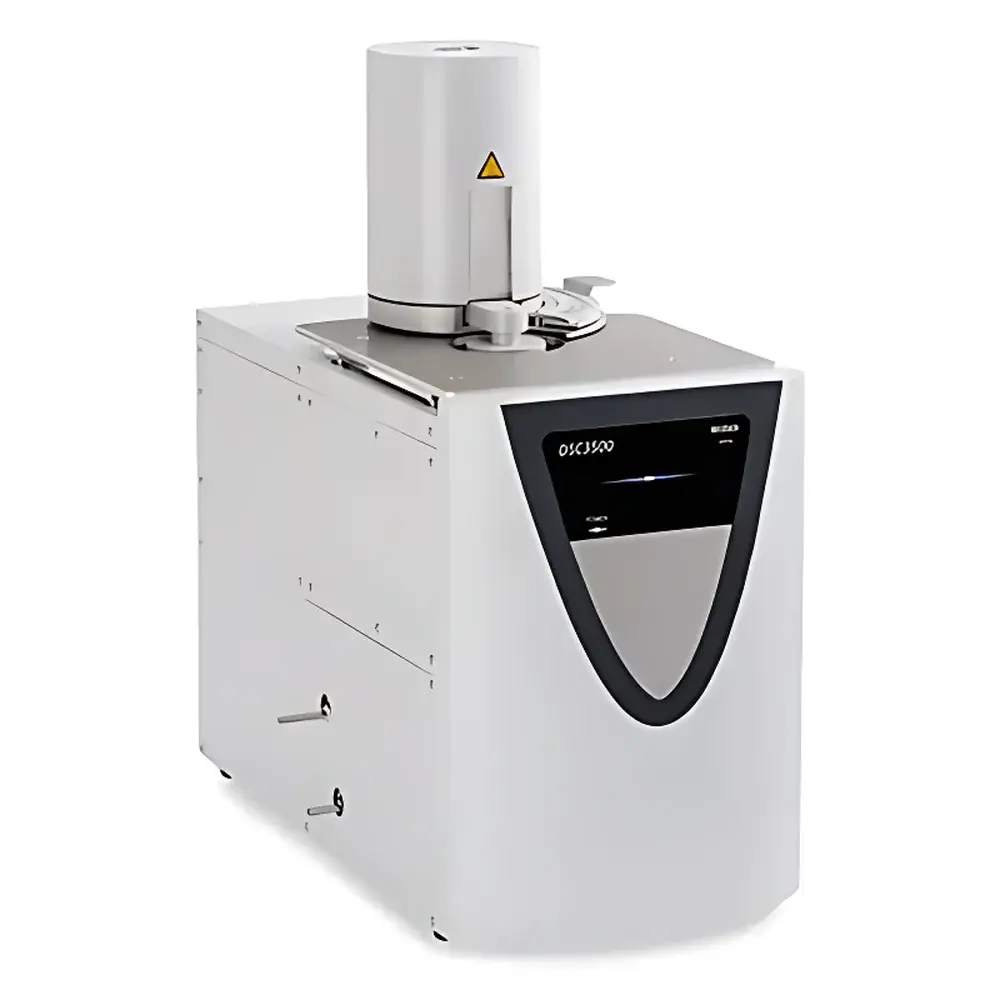
NETZSCH DSC 3500 Sirius Differential Scanning Calorimeter
| Brand | NETZSCH |
|---|---|
| Origin | Germany |
| Model | DSC 3500 Sirius |
| Temperature Range | −170 °C to 600 °C |
| Temperature Accuracy | ±0.1 °C |
| Heating/Cooling Rate | 0–100 K/min |
| Sample Capacity (with ASC) | Up to 20 positions (samples + references) |
| Instrument Type | Differential Scanning Calorimeter |
| 炉 Body Material | Silver-based furnace block |
| Sensor Architecture | Monolithic sensor design |
Overview
The NETZSCH DSC 3500 Sirius is a high-performance differential scanning calorimeter engineered for precision thermal characterization across academic, industrial, and regulatory laboratory environments. It operates on the principle of heat-flux DSC, measuring the difference in heat flow between a sample and an inert reference as both are subjected to identical, programmable temperature profiles. This enables quantitative determination of enthalpic transitions—including glass transitions (Tg), melting (Tm), crystallization (Tc), solid–solid phase changes, oxidative induction time (OIT), and reaction kinetics—under controlled atmospheric conditions (inert, oxidizing, or dynamic gas environments). With a certified operational range from −170 °C to 600 °C and a temperature accuracy of ±0.1 °C, the DSC 3500 Sirius supports rigorous material qualification in compliance with ISO 11357, ASTM E794, ASTM E1356, and USP , making it suitable for GLP- and GMP-aligned workflows.
Key Features
- Monolithic silver-furnace architecture delivering exceptional thermal homogeneity, long-term stability, and extended service life—critical for multi-year instrument deployment in high-throughput labs.
- Integrated high-resolution heat-flux sensor with low thermal mass and optimized thermal coupling, ensuring reproducible baseline stability and detection of subtle thermal events (e.g., weak cold-crystallization exotherms or low-enthalpy polymorphic transitions).
- Programmable heating and cooling rates from 0 to 100 K/min, enabling both conventional slow-scan analysis (e.g., 10 K/min for polymer Tg determination) and fast-scanning protocols (e.g., 50–100 K/min for kinetic modeling or screening).
- Modular auto-sampling capability via the ASC (Automatic Sample Changer), supporting up to 20 positions for crucibles (including aluminum, gold-plated aluminum, stainless steel, and high-pressure hermetic types), minimizing operator intervention and enhancing inter-run consistency.
- Robust mechanical design with electromagnetic shielding, vibration-damping feet, and active temperature stabilization—optimized for installation in shared analytical facilities without dedicated environmental control.
Sample Compatibility & Compliance
The DSC 3500 Sirius accommodates a broad spectrum of sample forms and matrices: solids (powders, films, fibers, granules), semi-crystalline polymers, pharmaceutical APIs and excipients, food lipids, inorganic salts, metallic alloys, and composite materials. Crucible compatibility includes standard 40 µL aluminum pans, high-pressure stainless-steel cells (up to 100 bar), and hermetically sealed gold-coated variants for volatile or reactive samples. All measurement protocols support full traceability per FDA 21 CFR Part 11 requirements when paired with NETZSCH Proteus® software (audit trail, electronic signatures, user access levels). System validation documentation—including IQ/OQ/PQ templates—is provided to facilitate compliance with ISO/IEC 17025, ICH Q5C, and EU Annex 15 guidelines.
Software & Data Management
Controlled exclusively via NETZSCH Proteus® software (v9.x or later), the DSC 3500 Sirius integrates seamlessly into enterprise LIMS and ELN ecosystems through standardized export formats (XML, CSV, PDF/A-2, and ASTM E1447-compliant .qtx). Proteus® provides real-time baseline correction, peak deconvolution (using Gaussian/Lorentzian fitting), kinetic analysis (Ozawa-Flynn-Wall, Kissinger), and comparative overlay of multiple curves with statistical deviation mapping. Raw data files are stored in encrypted, tamper-evident containers; all processing steps—including baseline selection, integration limits, and calibration application—are logged with timestamps and user IDs to satisfy ALCOA+ data integrity principles.
Applications
- Pharmaceutical development: Polymorph screening, amorphous content quantification, excipient compatibility assessment, and thermal stability profiling under ICH Q1A(R3) stress conditions.
- Polymers & composites: Crystallinity calculation (via enthalpy ratio), crosslink density estimation, degradation onset temperature (Td), and aging behavior under isothermal holds.
- Food science: Solid fat content (SFC) profiling, cocoa butter polymorphism analysis, and shelf-life prediction via oxidation induction time (OIT) testing.
- Electronics & packaging: Thermal reliability evaluation of solder pastes, encapsulants, and barrier films under thermal cycling protocols.
- Inorganic materials: Phase diagram validation, eutectic temperature identification, and enthalpy-of-formation determination for ceramics and battery cathode precursors.
FAQ
What calibration standards are recommended for routine verification?
Indium, zinc, tin, and bismuth are certified reference materials used for temperature and enthalpy calibration per ISO 11357-1. Calibration is performed at least once per quarter or after major maintenance.
Can the DSC 3500 Sirius operate under vacuum or reactive atmospheres?
Yes—it supports static vacuum (≤10−2 mbar), inert gas (N2, Ar), oxidizing gas (O2, air), and custom gas mixtures via MFC-controlled purge lines with integrated moisture/oxygen traps.
Is remote monitoring and control supported?
Proteus® software enables secure remote access via TLS-encrypted VNC or Citrix environments; however, real-time instrument control requires local network authentication and hardware handshake validation.
How is baseline drift corrected during long-duration isothermal holds?
Proteus® applies dynamic baseline interpolation using pre- and post-transition segments, supplemented by optional polynomial fitting and automatic drift compensation algorithms trained on historical instrument performance data.
Does the system comply with pharmacopeial requirements for thermal analysis?
Yes—method templates aligned with USP , Ph. Eur. 2.2.42, and JP 17 methods are embedded in Proteus®, including mandatory parameters for resolution, repeatability, and system suitability testing.



