
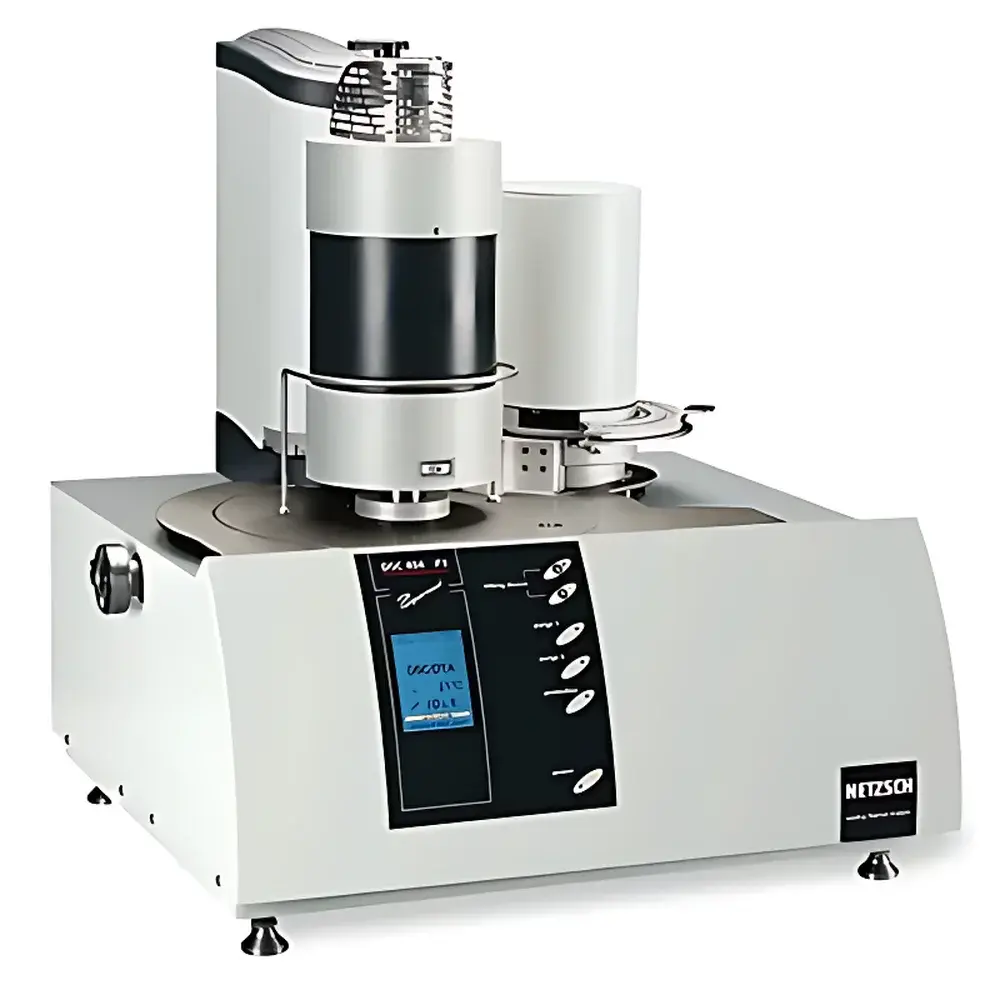
Netzsch DSC 404 F1 Pegasus Differential Scanning Calorimeter
| Brand | Netzsch |
|---|---|
| Origin | Germany |
| Model | DSC 404 F1 Pegasus |
| Temperature Range | −150 to 2000 °C |
| Temperature Accuracy | ±0.1 K |
| Heating/Cooling Rate | 0–50 K/min |
| Sensor Types | Replaceable DSC (−150 to 1650 °C) and DTA (up to 2000 °C) |
| Vacuum Capability | High-vacuum sealed system |
| Gas Control | Integrated stainless-steel gas lines with metal-encapsulated mass flow controllers (MFCs) |
| Optional Automation | Stepper-motor-driven dual-furnace configuration and 20-position auto-sampler |
Overview
The Netzsch DSC 404 F1 Pegasus is a high-performance, modular differential scanning calorimeter engineered for precision thermal analysis across an exceptional temperature range—from cryogenic conditions at −150 °C up to ultra-high temperatures of 2000 °C. It operates on the heat-flux principle, measuring the difference in heat flow between a sample and an inert reference as both are subjected to identical, precisely controlled temperature programs. This enables quantitative determination of enthalpy changes (e.g., melting, crystallization, glass transitions, solid-state reactions) and specific heat capacity (Cp) with high reproducibility and baseline stability. Its robust architecture—featuring dual furnace options, vacuum-tight construction, and thermally optimized sensor design—makes it particularly suitable for research-grade characterization of advanced ceramics, refractory metals, aerospace alloys, pharmaceutical polymorphs, and oxygen-sensitive materials under inert or reducing atmospheres.
Key Features
- Extended operational range: −150 °C to 2000 °C, supported by interchangeable furnaces and sensor modules (DSC sensors up to 1650 °C; DTA sensors up to 2000 °C)
- High-precision temperature control: ±0.1 K accuracy and programmable heating/cooling rates from 0 to 50 K/min
- Vacuum-sealed measurement chamber with integrated metal-encapsulated mass flow controllers (MFCs) and stainless-steel gas delivery lines—ensuring purity, repeatability, and compatibility with air-, moisture-, or oxygen-sensitive samples
- Modular sensor platform: Multiple calibrated DSC and DTA sensor types available, each optimized for sensitivity, time constant, and thermal stability within defined sub-ranges
- Dual-furnace capability: Stepper-motor-driven positioning allows sequential or comparative analysis of two samples or reference/sample pairs without manual intervention
- Optional 20-position automated sample changer: Enables unattended operation, batch processing, and standardized thermal protocols compliant with GLP and ISO 11357 series requirements
Sample Compatibility & Compliance
The DSC 404 F1 Pegasus accommodates diverse sample forms—including powders, granules, foils, fibers, and small bulk specimens—using a wide selection of crucibles (alumina, platinum, gold-plated, sapphire, and sealed high-pressure variants). Its high-vacuum and controlled-atmosphere capabilities support testing per ASTM E793, ASTM E1269, ISO 11357-1 through -7, and USP <1163> for pharmaceutical thermal profiling. The instrument’s hardware and optional software modules comply with data integrity requirements outlined in FDA 21 CFR Part 11, including electronic signatures, audit trails, and user-access controls—making it suitable for regulated environments in pharmaceutical development, quality control laboratories, and materials certification workflows.
Software & Data Management
Operating via Netzsch Proteus® Software, the system provides full instrument control, real-time visualization, and advanced post-processing tools—including Cp calculation via the sapphire method, peak deconvolution, kinetic modeling (e.g., Kissinger, Ozawa-Flynn-Wall), and multi-curve comparison. Raw data are stored in vendor-neutral formats (e.g., ASCII, CSV) and support traceable metadata tagging (operator ID, calibration timestamp, atmosphere log, furnace history). Audit trail functionality records all parameter modifications, method changes, and result exports—enabling full compliance with GMP/GLP documentation standards and facilitating internal or regulatory review.
Applications
- Thermal stability and decomposition kinetics of battery cathode/anode materials under inert gas or vacuum
- Polymorphic transition analysis and eutectic point determination in active pharmaceutical ingredients (APIs)
- Specific heat capacity mapping of superalloys and ceramic matrix composites across service-relevant temperature domains
- Crystallization onset, cold crystallization, and melt behavior of semi-crystalline thermoplastics and biopolymers
- Oxidation onset temperature (OOT) and reaction enthalpy quantification for metal powders and nanomaterials
- Phase diagram construction for refractory systems (e.g., Al2O3–SiO2, ZrO2–Y2O3) using controlled heating ramps and isothermal holds
FAQ
What temperature calibration standards are recommended for routine verification?
Standard reference materials such as high-purity indium (Tm = 156.60 °C), zinc (Tm = 419.53 °C), aluminum (Tm = 660.32 °C), and graphite (Cp certified reference) are used for temperature and enthalpy calibration per ISO 11357-2 and -4.
Can the DSC 404 F1 Pegasus perform simultaneous Cp and transition analysis in a single run?
Yes—using the dynamic sapphire method embedded in Proteus® software, specific heat capacity is calculated continuously during non-isothermal scans without interrupting the primary DSC measurement.
Is remote monitoring or integration with LIMS supported?
The system supports OPC UA communication protocol and offers API-enabled data export; direct LIMS integration is achievable via configurable CSV/XML output templates and secure network deployment.
What maintenance intervals are recommended for the vacuum system and gas control components?
Vacuum pump oil replacement every 6 months (or per manufacturer specifications); MFC recalibration annually or after 500 operating hours; furnace and sensor inspection recommended before high-temperature campaigns exceeding 1500 °C.



