
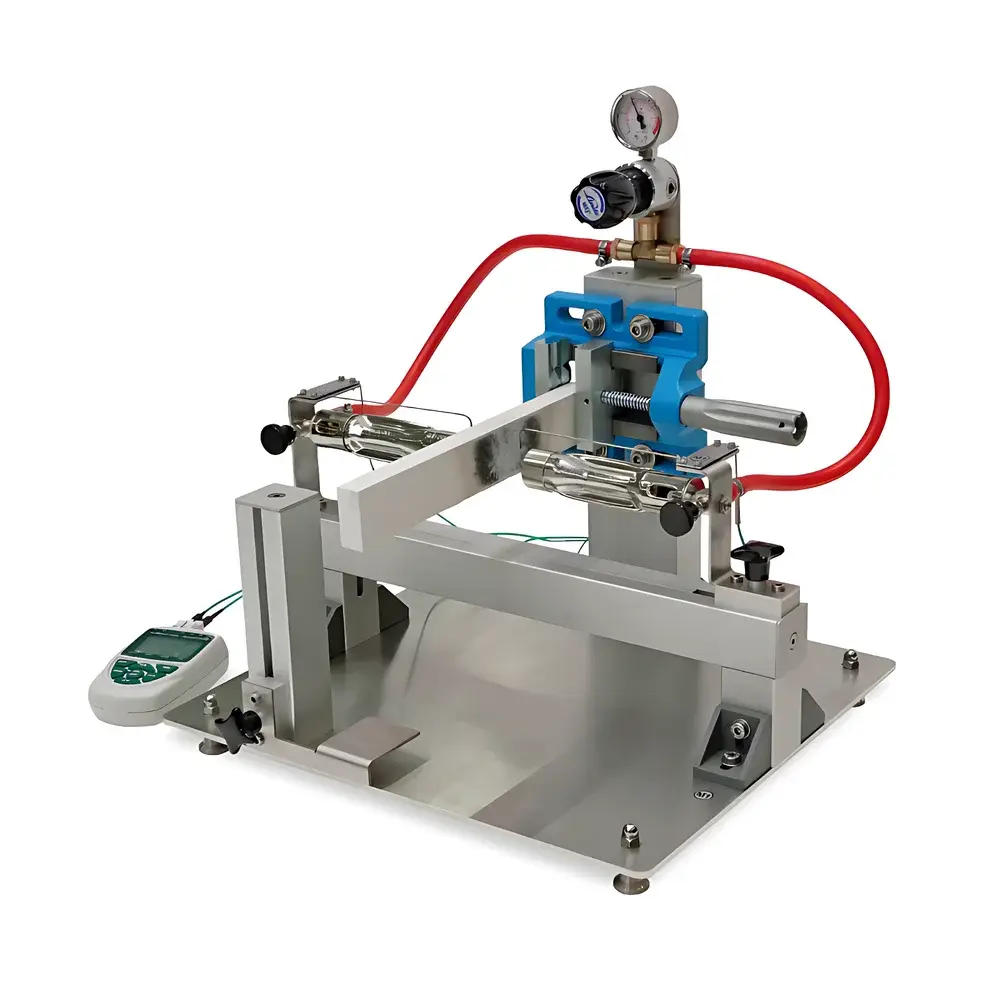
Netzsch FRG Structural Adhesion Tester
| Brand | Netzsch |
|---|---|
| Origin | Germany |
| Model | FRG Structural Adhesion Tester |
| Compliance | DIN EN 520 |
| Sample Dimensions (L × W × T) | 300 × 45 × 9.5 / 12.5 / 15.0 mm |
| Propane Purity | ≥95%, Operating Pressure: 4.0 bar |
| Device Dimensions (W × D × H) | 450 × 400 × 300 mm |
| Weight | 37 kg |
Overview
The Netzsch FRG Structural Adhesion Tester is a purpose-built, benchtop thermal-mechanical testing system engineered to quantify the structural adhesion integrity of gypsum-based building materials under controlled high-temperature exposure. It operates on the principle of thermally induced mechanical failure assessment: two opposing Meker-type propane burners generate a symmetrical, reproducible flame impingement zone across standardized gypsum board specimens, while a calibrated axial load—applied via a precision pressure-indicating actuator—measures the residual mechanical cohesion at defined temperature thresholds. This method directly supports compliance verification against DIN EN 520, the European standard governing the classification and performance requirements of gypsum plasterboards used in fire-resistant construction assemblies. The instrument is not a generic thermal analyzer but a dedicated test platform where flame geometry, gas dynamics, thermal flux uniformity, and mechanical load application are rigorously synchronized to replicate real-world fire-exposure boundary conditions.
Key Features
- Horizontally adjustable sample holder ensures rapid, repeatable specimen positioning without mechanical realignment or torque-induced stress artifacts.
- Integrated digital temperature measurement system provides real-time, traceable surface and core temperature monitoring with resolution sufficient for DIN EN 520-defined thermal ramping profiles.
- Dual Meker propane burners deliver stable, laminar, and symmetrically opposed flame fronts—each independently controllable via fine-adjustment valves to maintain stoichiometric combustion and consistent thermal flux density (kW/m²) across the test zone.
- Pressure-indicating actuator mounted above the specimen enables precise, stepwise or continuous load application during thermal exposure, with visual and analog readout for operator verification prior to test initiation.
- Modular test regime support: the system accommodates both segmental testing (discrete temperature intervals with dwell times) and continuous range-based adhesion profiling, enabling correlation between temperature rise rate, peak exposure temperature, and loss-of-cohesion onset.
Sample Compatibility & Compliance
The FRG tester accepts standardized gypsum board specimens per DIN EN 520 dimensions: 300 mm (length) × 45 mm (width) × 9.5 mm / 12.5 mm / 15.0 mm (thickness), accommodating common commercial board thicknesses used in partition wall and ceiling systems. Specimen mounting fixtures are designed to minimize edge heat loss and ensure unobstructed flame access to the designated test surface. The instrument’s burner configuration, gas supply specification (≥95% purity propane at 4.0 bar regulated inlet pressure), and thermal response calibration are validated against the normative annexes of DIN EN 520. While primarily intended for gypsum products, the mechanical loading architecture and thermal control logic may be adapted—under documented method validation—for comparative adhesion testing of other mineral-bonded composites, provided flame interaction physics remain within the instrument’s operational envelope.
Software & Data Management
The FRG Structural Adhesion Tester operates as a manually supervised, operator-guided system with integrated analog-digital hybrid instrumentation. Temperature data from calibrated thermocouples is logged via external DAQ hardware compatible with standard SCPI protocols; no proprietary software suite is bundled. However, the system is fully compatible with third-party GLP-compliant data acquisition platforms (e.g., LabVIEW, MATLAB Data Acquisition Toolbox, or ISO/IEC 17025-accredited LIMS interfaces) that support audit-trail-enabled timestamping, user authentication, and electronic signature workflows. All critical test parameters—including burner pressure, applied load, elapsed time, and recorded temperatures—are required to be captured in raw format for regulatory review. For GMP or FDA-regulated environments, integration with 21 CFR Part 11–compliant systems necessitates validation of the entire data chain—from sensor signal conditioning through storage—and must be performed by the end-user laboratory per their internal SOPs.
Applications
- Verification of fire-resistance classification for gypsum board products submitted for CE marking under EN 13501-2.
- Quality control screening of batch-to-batch consistency in adhesive binder formulation and calcination homogeneity.
- R&D evaluation of novel additives (e.g., intumescent agents, fiber reinforcements, or retardants) on high-temperature structural retention.
- Failure mode analysis of delamination, blistering, or spalling mechanisms during simulated flashover conditions.
- Interlaboratory round-robin testing programs coordinated under CEN/TC 172 standards development initiatives.
FAQ
Does the FRG tester include automated data logging software?
No—the instrument delivers analog outputs and digital temperature readings suitable for connection to externally configured DAQ systems. Automation level depends on the user’s selected data acquisition platform.
Can the FRG be used for non-gypsum substrates?
It may be technically feasible, but deviation from DIN EN 520 specimen geometry and thermal response characteristics requires full method validation and is outside the scope of factory calibration.
Is flame calibration traceable to national standards?
Burner output is calibrated using certified propane flow meters and thermocouple arrays traceable to PTB (Physikalisch-Technische Bundesanstalt) standards; calibration certificates are supplied with each unit.
What safety certifications does the FRG hold?
The system complies with EU Machinery Directive 2006/42/EC and carries CE marking; it incorporates flame arrestors, pressure relief valves, and interlocked access doors meeting EN ISO 13857 requirements.
Is remote operation supported?
Remote start/stop and parameter monitoring are possible only when integrated with a validated industrial control network (e.g., Modbus TCP or OPC UA); no native Ethernet or Wi-Fi interface is embedded.



