
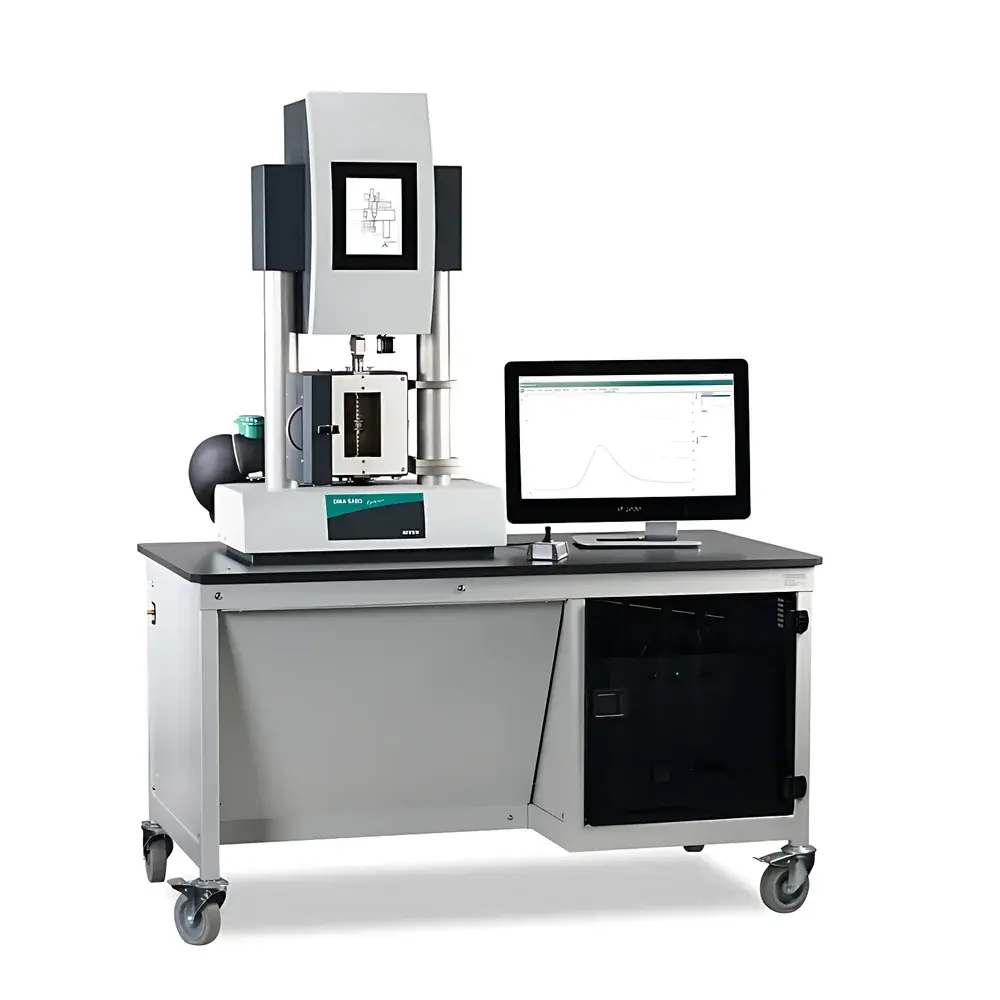
NETZSCH GABO EPLEXOR Dynamic Mechanical Analyzer (DMA/DMTA)
| Brand | NETZSCH |
|---|---|
| Origin | Germany |
| Model | NETZSCH GABO EPLEXOR |
| Instrument Type | Dynamic Mechanical Analyzer (DMA/DMTA) |
| Temperature Range | –160 °C to 500 °C |
| Temperature Accuracy | ±0.1 °C |
| Static Force Range | up to 500 N (optional 1500 N) |
| Dynamic Force Range | ±25 N, ±100 N, ±150 N, or ±500 N |
| Displacement Range | 60 mm |
| Frequency Range | 0.01 Hz to 100 Hz (optional: 0.0001 Hz and 200 Hz) |
Overview
The NETZSCH GABO EPLEXOR is a high-force dynamic mechanical analyzer engineered for precision viscoelastic characterization of structurally complex and mechanically demanding materials under controlled thermal conditions. Operating on the principle of forced oscillatory deformation—applying sinusoidal stress or strain while measuring the resulting strain or stress response—the system quantifies storage modulus (E′), loss modulus (E″), and tan δ across a broad temperature and frequency spectrum. Its dual-motor architecture separates static preloading (via servo motor) from dynamic excitation (via electromagnetic shaker), enabling simultaneous application of high static load and high-amplitude dynamic oscillation—a critical capability for studying thermosets, fiber-reinforced composites, elastomers, metallic alloys, ceramics, and biological tissues where large-scale dimensional stability and mechanical integrity must be maintained during measurement.
Key Features
- Modular mechanical design supporting tension, compression, 3-point bending, dual-cantilever bending, and shear configurations—enabling method-specific sample geometry optimization.
- Dual independent drive system: a high-precision servo motor for static force control (up to 1500 N) and a low-noise electromagnetic shaker for dynamic excitation (±500 N peak-to-peak), ensuring minimal cross-talk and high signal fidelity.
- Interchangeable force transducers with nominal ranges from 10 N to 5000 N—field-replaceable by the user without recalibration downtime.
- Thermally optimized furnace design with uniform heating profiles—even for low-thermal-conductivity bulk samples (e.g., thick rubber or polymer blocks)—validated per DIN 51007 temperature homogeneity requirements.
- Low liquid nitrogen consumption in cryogenic operation (–160 °C), achieved via optimized heat exchanger geometry and vacuum-jacketed cooling lines.
- Optional dielectric analysis (DEA) module for simultaneous acquisition of mechanical and dielectric responses—supporting correlation of molecular mobility (α-, β-relaxations) with dipole reorientation dynamics.
Sample Compatibility & Compliance
The GABO EPLEXOR accommodates diverse material classes—including thermoplastics, thermosets, elastomers, fiber-reinforced composites, metallic foams, sintered ceramics, hydrogels, food matrices, and pressure-sensitive adhesives—across specimen dimensions up to 100 mm in length and 25 mm in thickness. Its wide force range ensures reliable data acquisition for stiff systems (e.g., carbon-fiber epoxy laminates) and compliant ones (e.g., silicone gels) without hardware reconfiguration. The instrument complies with international testing standards including ISO 6721-1/-4/-5/-6 (plastics — determination of dynamic mechanical properties), ISO 4664-1 (rubber — dynamic properties), ASTM D4065 (standard practice for dynamic mechanical testing of plastics), and ASTM D4473 (dynamic mechanical analysis of thermosetting resins). All measurements are traceable to NIST-certified reference materials and support GLP/GMP audit readiness through configurable electronic signatures and 21 CFR Part 11–compliant software logging.
Software & Data Management
Control and analysis are performed via NETZSCH’s TA-Control and Pyris™-compatible software suite, offering real-time parameter monitoring, multi-step temperature/frequency ramping, and automated compliance correction. Data export follows ASTM E1319-compliant ASCII and universal HDF5 formats, enabling integration with MATLAB®, Python-based analysis pipelines, and LIMS environments. Audit trails record operator ID, timestamp, instrument configuration, calibration status, and raw sensor outputs—ensuring full data provenance for regulatory submissions. Optional networked deployment supports centralized fleet management and remote diagnostics via encrypted TLS 1.3 communication.
Applications
- Characterization of glass transition (Tg) and secondary relaxations in high-performance polymers and composites used in aerospace and automotive applications.
- Viscoelastic mapping of thermoset cure kinetics—including vitrification onset, gel point, and post-cure relaxation behavior—under isothermal and dynamic curing protocols.
- Mechanical aging studies of elastomeric seals and O-rings under combined thermal cycling and sustained compressive load.
- Thermo-mechanical stability assessment of battery electrode binders and solid-state electrolytes across operational temperature windows.
- Structure–property relationships in biodegradable scaffolds and tissue-engineered constructs under physiological loading regimes.
- Quality control of adhesive bondlines in structural bonding applications, correlating peel strength, creep resistance, and interfacial relaxation spectra.
FAQ
What is the maximum static force capacity, and can it be upgraded post-purchase?
Yes—the base system supports up to 500 N static load; an optional upgrade kit enables expansion to 1500 N without replacing the main frame or furnace assembly.
Is liquid nitrogen required for sub-ambient measurements?
Yes—cryogenic operation down to –160 °C is achieved using standard LN2 supply; the system features optimized thermal shielding and flow control to minimize consumption (typical rate: 0.8–1.2 L/h at –80 °C).
Can the instrument perform time–temperature superposition (TTS) analysis?
Yes—software includes automated TTS construction with Williams–Landel–Ferry (WLF) and Arrhenius fitting modules, validated against NIST SRM 1475a polycarbonate reference data.
Are there options for humidity-controlled testing?
Humidity control is available via optional environmental chamber integration (RH range: 10–95% at 25–80 °C), compatible with tensile and compression fixtures.
How is calibration traceability maintained across force and displacement channels?
Each force transducer is supplied with individual NIST-traceable calibration certificate; displacement calibration is verified using laser interferometry against ISO 16063-11 standards prior to shipment and annually during service.



