
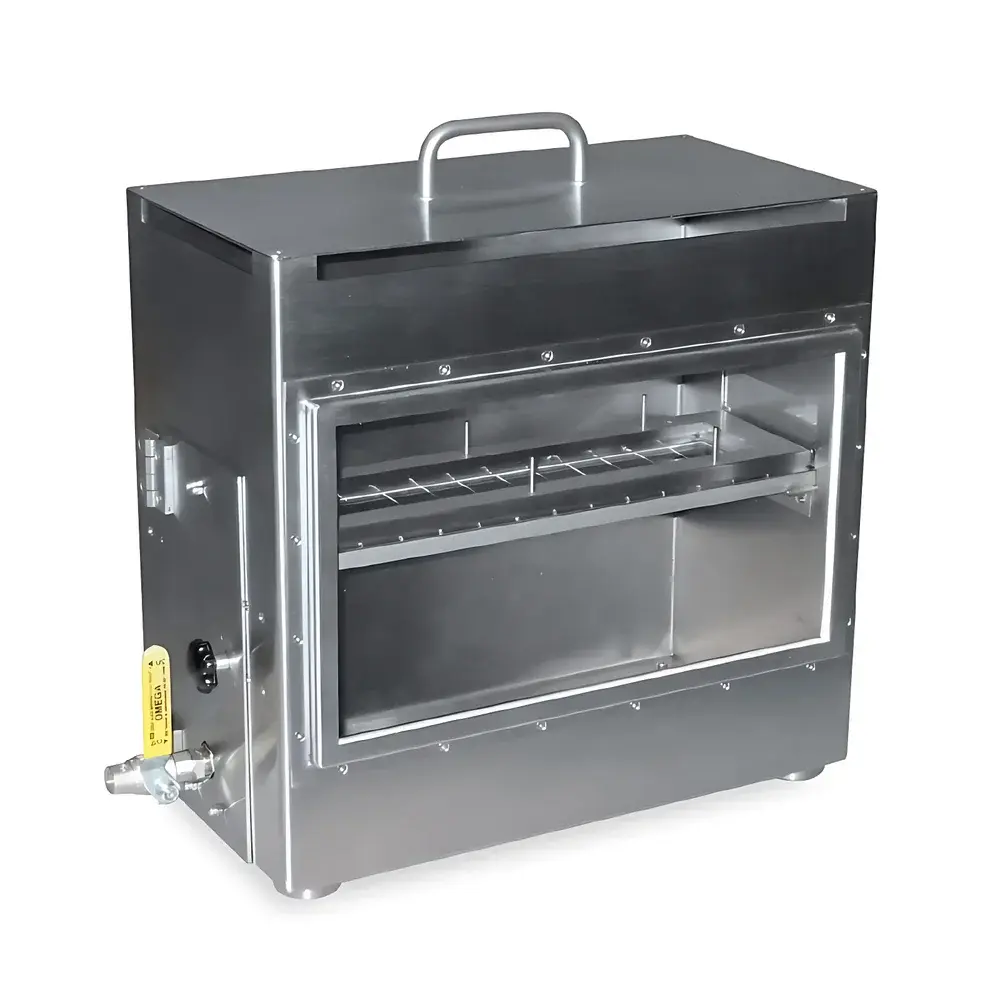
Netzsch HBK Horizontal Burning Chamber
| Brand | Netzsch |
|---|---|
| Origin | Germany |
| Model | HBK Horizontal Burning Chamber |
| Compliance Standards | ISO 3795, DIN 75200, FMVSS 302, GB 8410, CMVSS 302, FAR 25.853 |
| Sample Dimensions | 356 × 100 × ≤13 mm |
| Fuel | ≥95% purity propane |
| Gas Pressure | 4.0 bar |
| Chamber Dimensions (W×D×H) | 385 × 210 × 365 mm |
| Weight | 26 kg |
Overview
The Netzsch HBK Horizontal Burning Chamber is a precision-engineered test apparatus designed to evaluate the horizontal flame propagation behavior of interior materials used in road vehicles, rail systems, and aircraft cabins. It operates on the principle of controlled single-flame exposure under standardized thermal flux conditions, measuring the linear burning rate (mm/min) of horizontally oriented specimens when subjected to a defined propane flame for a specified duration. This method is grounded in established fire safety engineering protocols that correlate material response with real-world ignition and spread scenarios in confined transport environments. The chamber is not a generic combustion analyzer but a purpose-built, standards-aligned testing platform engineered for repeatability, operator safety, and regulatory traceability—critical requirements for Tier-1 automotive suppliers and aerospace component manufacturers undergoing OEM qualification audits.
Key Features
- Full compliance with globally recognized automotive and aviation flammability standards—including ISO 3795, DIN 75200, FMVSS 302, GB 8410, CMVSS 302, and FAR 25.853—enabling direct submission of test reports to OEMs and certification bodies.
- Integrated high-stability propane pressure regulation system featuring an adjustable, calibrated low-pressure valve (set point: 4.0 bar), ensuring consistent flame geometry and thermal output across repeated test cycles.
- Tool-free specimen holder mechanism enabling rapid, repeatable positioning of 356 × 100 × ≤13 mm samples—minimizing setup variability and reducing operator-induced measurement uncertainty.
- Robust all-stainless-steel construction (AISI 304 grade) for corrosion resistance, thermal stability, and long-term dimensional integrity; no routine lubrication or consumable replacement required during normal operation.
- Compact footprint (385 × 210 × 365 mm) and lightweight design (26 kg) facilitate integration into QC laboratories, R&D cleanrooms, and mobile testing units without structural reinforcement.
Sample Compatibility & Compliance
The HBK chamber accommodates flat, rigid, or semi-rigid polymeric composites commonly found in automotive interiors: thermoplastic elastomers (TPE), polyolefin blends, PVC-based trim sheets, nonwoven textile laminates, and foamed polyurethane substrates. Specimens must be conditioned per ISO 291 (23 ± 2 °C, 50 ± 5 % RH) prior to testing. All test procedures strictly follow the specimen mounting orientation, flame application time (15 s), and post-ignition observation window defined in referenced standards. The system supports full audit readiness: calibration records, gas certification documentation (≥95 % purity propane), and chamber temperature verification logs are maintained in accordance with GLP principles and FDA 21 CFR Part 11–compatible data governance frameworks where integrated digital logging is deployed.
Software & Data Management
While the HBK chamber operates as a manually supervised physical test platform, it is fully compatible with Netzsch’s optional Digital Test Log (DTL) module—a Windows-based software suite that captures operator ID, sample ID, environmental conditions, flame-on timestamp, burn front progression (via integrated high-resolution timing scale), and final burn length. DTL enforces electronic signature workflows, auto-generates ASTM/ISO-compliant test reports (PDF + CSV), and maintains immutable audit trails meeting ISO/IEC 17025 clause 7.7 and EU Annex 11 requirements for regulated environments. Raw video recording (via external HD camera mount) can be synchronized with DTL timestamps for forensic review during root-cause analysis of borderline pass/fail results.
Applications
- Pre-release validation of seat fabrics, headliners, door panels, and carpet backing materials against OEM-specific flammability specifications (e.g., VW TL 81300, Ford WSS-M99P1111-A, GMW 3232).
- Comparative screening of flame-retardant additive packages in polymer formulations during compound development.
- Root-cause investigation of batch-to-batch variability in burning rate performance, supported by statistical process control (SPC) integration via DTL export.
- Supporting technical documentation for UN ECE Regulation 118 (flammability of materials used in the passenger compartment of motor vehicles) and EN 45545-2 (railway applications).
- Training and proficiency testing for laboratory personnel accredited to ISO/IEC 17025:2017 in mechanical and fire testing disciplines.
FAQ
Does the HBK chamber require external exhaust ducting?
Yes—operation requires connection to a certified fume hood or dedicated exhaust manifold capable of handling combustion byproducts (CO, CO₂, NOₓ, particulate matter) at ≥120 m³/h flow rate.
Can the chamber be used for vertical burning tests?
No—the HBK is specifically configured for horizontal orientation per ISO 3795 and FMVSS 302. Vertical flame testing (e.g., UL 94 V-0/V-2) requires a separate apparatus.
Is calibration traceable to national metrology institutes?
Yes—gas flow meters, pressure transducers, and timing circuits are calibrated annually using NIST-traceable references; calibration certificates include uncertainty budgets per ISO/IEC 17025.
What maintenance intervals are recommended?
No scheduled maintenance is required beyond quarterly visual inspection of burner tip integrity and annual verification of gas line leak integrity per DIN EN 15607.
Does Netzsch provide test method training?
Yes—on-site or virtual instructor-led training covering standard interpretation, specimen preparation, test execution, result evaluation, and report generation is available upon request.



