
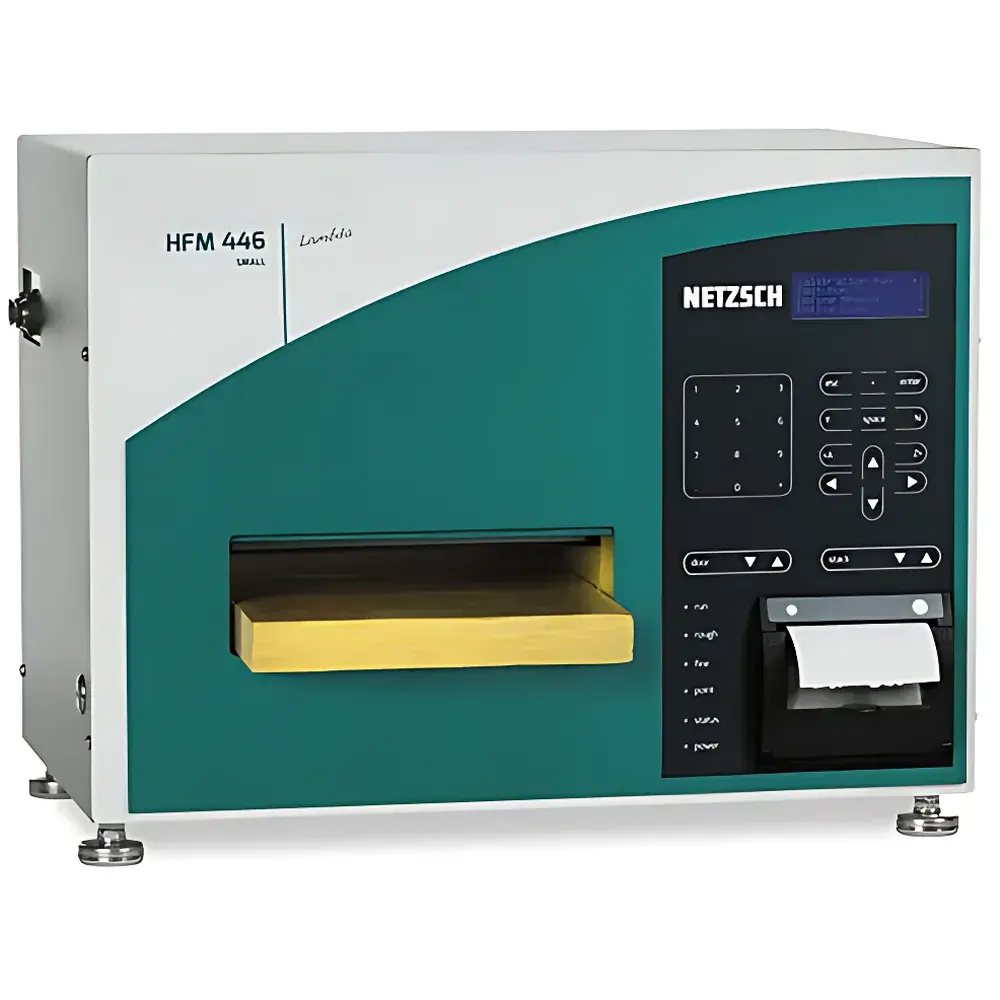
Netzsch HFM 446 S Lambda Heat Flow Meter Thermal Conductivity Analyzer
| Brand | Netzsch |
|---|---|
| Origin | Germany |
| Instrument Type | Heat Flow Method |
| Dimensions (L×W×H) | 490 mm × 300 mm × 390 mm |
| Accuracy | ±1% |
| Thermal Conductivity Range | 0.002 – 2.0 W/(m·K) |
| Repeatability | 0.5% |
| Cold/Hot Plate Temperature Range | −20 °C to +90 °C |
| Temperature Setpoints | 10 |
| Sample Size Max | 200 mm × 200 mm × 50 mm |
| Thermal Resistance Range | 0.05 – 8.0 m²·K/W |
| Maximum Sample Load | 21 kPa |
| Optional Features | SMART MODE, Specific Heat Measurement Module, High-Conductivity Extension Kit |
Overview
The Netzsch HFM 446 S Lambda is a precision-engineered heat flow meter (HFM) thermal conductivity analyzer designed for reliable, standardized measurement of steady-state thermal transport properties in solid and quasi-solid materials. Operating on the principle of one-dimensional, guarded hot plate conduction under controlled temperature gradients, the instrument complies with international standards including ASTM C518, ISO 8301, and EN 12667. It delivers traceable, reproducible thermal conductivity (λ) values across a broad range of low-to-moderate conductivity materials—such as foams, insulating boards, aerogels, composites, polymers, and building materials—without requiring calibration against reference standards for routine operation. Its dual-plate symmetric design with active temperature control minimizes edge losses and ensures uniform heat flux distribution, while the integrated Peltier-based cooling system enables precise sub-ambient operation down to −20 °C without external chillers or refrigerants.
Key Features
- Automated sample thickness determination via high-resolution micrometer displacement sensor (resolution < 1 µm), eliminating manual calipers and reducing operator-induced variability
- Programmable sample load control (up to 21 kPa) with closed-loop force feedback—critical for compressible specimens such as flexible insulation or fiber mats, ensuring consistent density and interfacial contact during measurement
- SMART MODE functionality for adaptive test protocol selection based on material class, thermal diffusivity estimation, and target uncertainty—reducing user decision burden while maintaining metrological integrity
- Modular architecture supporting optional add-ons: specific heat capacity (Cp) measurement module (via differential temperature step response analysis), high-conductivity extension kit (for λ > 2.0 W/(m·K)), and multi-point thermal resistance mapping capability
- Robust mechanical frame with thermally isolated base and vibration-damped support structure—optimized for laboratory environments where ambient fluctuations may affect long-duration steady-state equilibration
Sample Compatibility & Compliance
The HFM 446 S Lambda accommodates square specimens up to 200 mm × 200 mm × 50 mm, with automatic thickness compensation ensuring valid data even for non-planar or slightly warped samples. It supports both rigid and semi-rigid materials—including phenolic foams, mineral wool, vacuum-insulated panels (VIPs), phase-change composites, and polymer-based thermal interface materials (TIMs). All measurements adhere to GLP-compliant workflows: full audit trail logging (user ID, timestamp, parameter set, raw thermocouple voltages, equilibrium criteria), electronic signature support, and configurable data retention policies aligned with FDA 21 CFR Part 11 requirements when paired with Netzsch’s TA-Control software suite. Calibration certificates are traceable to PTB (Physikalisch-Technische Bundesanstalt) and NIST standards.
Software & Data Management
Control and analysis are performed via Netzsch’s TA-Control v5.x platform—a Windows-based application compliant with IEC 62443 cybersecurity guidelines. The software provides real-time visualization of temperature gradients, heat flux convergence, and sample thermal resistance evolution. Automated pass/fail evaluation against user-defined tolerances (e.g., ΔT stability < 0.02 K over 30 min) triggers measurement completion. Export formats include CSV, PDF reports (with embedded metadata and digital signatures), and XML for LIMS integration. Raw data files retain unprocessed thermocouple readings, enabling retrospective re-analysis using alternative equilibrium algorithms or uncertainty propagation models per GUM (Guide to the Expression of Uncertainty in Measurement).
Applications
- Quality control of thermal insulation products in manufacturing (e.g., batch verification of λ-values for EPS/XPS boards per EN 13163)
- R&D characterization of next-generation aerogel composites and nanostructured coatings for aerospace and cryogenic applications
- Regulatory submission support for construction materials under EU EPBD (Energy Performance of Buildings Directive) compliance frameworks
- Thermal property benchmarking of battery pack thermal management materials (e.g., graphite sheets, silicone gap fillers) under controlled pressure and temperature cycling
- Validation of computational models (e.g., finite element thermal simulations) requiring experimentally derived boundary-condition inputs
FAQ
What standards does the HFM 446 S Lambda comply with?
ASTM C518, ISO 8301, EN 12667, and DIN 12667—covering steady-state heat flow meter methods for thermal insulation materials.
Can it measure specific heat capacity?
Yes—when equipped with the optional Cp module, it determines specific heat via transient temperature response analysis under controlled heating/cooling steps.
Is the instrument suitable for testing anisotropic materials?
It measures through-thickness conductivity; for in-plane anisotropy, complementary techniques such as laser flash analysis (LFA) are recommended.
How is temperature stability maintained during extended tests?
Dual PID-controlled Peltier elements with independent cold/hot plate regulation and real-time thermal drift compensation ensure < ±0.01 K stability over 4+ hour equilibration periods.
Does the system support automated reporting for ISO/IEC 17025-accredited labs?
Yes—TA-Control generates fully traceable, digitally signed reports with calibration history, environmental logs, and uncertainty budgets required for accreditation audits.



