
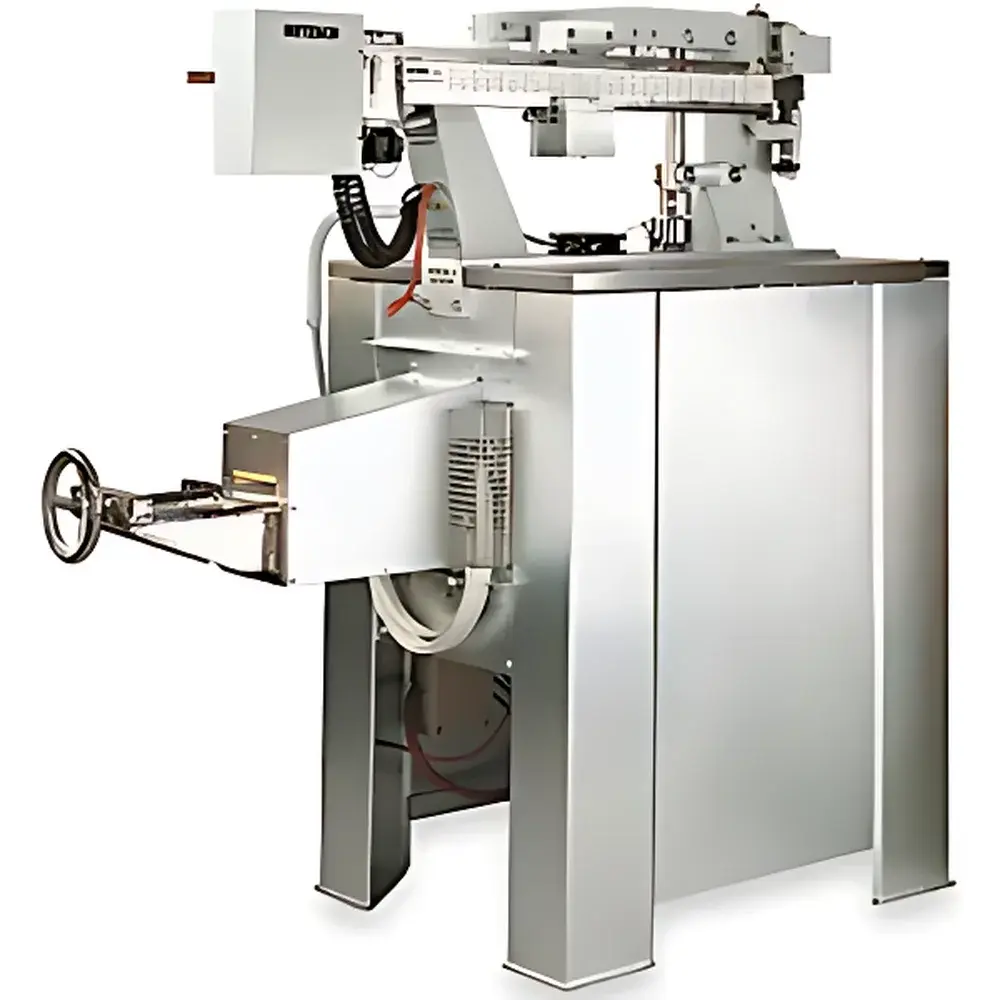
Netzsch HMOR422 Hot Modulus of Rupture Tester
| Brand | Netzsch |
|---|---|
| Origin | Germany |
| Model | HMOR422 |
| Temperature Range | RT to 1450°C (optional up to 1500°C) |
| Sample Dimensions | 125 × 25 × 25 mm (standard) |
| Load Capacity | 1 N to 5000 N |
| Loading Rate | 1.25 N/s to 125 N/s (4 selectable steps) |
| Test Atmosphere | Air |
| Feed Mechanism | Continuous feed with preheating zone |
| Bending Mode | Three-point bending (standard) |
| Deformation Measurement | Differential high-precision displacement system (compatible with RUL/CIC421 architecture) |
| Compliance | ISO 5013 |
Overview
The Netzsch HMOR422 Hot Modulus of Rupture Tester is a high-temperature mechanical testing system engineered for the quantitative determination of the hot modulus of rupture (HMOR) of refractory materials under controlled thermal and mechanical stress conditions. It operates on the principle of three-point bending deformation measurement at elevated temperatures—up to 1450°C standard, extendable to 1500°C with optional furnace configuration—while applying precisely regulated uniaxial load via an electromechanical actuator. The instrument is designed to replicate service-relevant thermo-mechanical loading scenarios encountered in industrial furnaces, kilns, and metallurgical linings. Its core function is to determine the flexural strength of ceramic and refractory specimens as a function of temperature, enabling material qualification, batch consistency verification, and comparative performance assessment across formulation variants or manufacturing processes.
Key Features
- High-temperature furnace with dual-zone design (main heating zone + preheating zone), enabling continuous sample introduction without thermal shock to the measurement zone.
- Differential displacement sensing system—derived from the proven architecture of Netzsch’s RUL/CIC421 series—ensures sub-micrometer resolution in deflection measurement, critical for accurate strain calculation during HMOR evaluation.
- Load frame with closed-loop force control (1–5000 N range) and four-step programmable loading rate (1.25–125 N/s), supporting both quasi-static and ramped-load test protocols.
- Standard three-point bending configuration with adjustable support span; optional HMOR422 E/4 variant implements four-point bending (40 mm support distance) for reduced shear influence and improved stress uniformity in small specimens (e.g., 25 × 25 × 125 mm).
- Integrated air atmosphere control with flow regulation and pressure monitoring, ensuring reproducible oxidation conditions during high-temperature testing.
- Modular furnace enclosure featuring a two-part hinged design for rapid specimen insertion and alignment—minimizing downtime between tests and enhancing operational safety.
Sample Compatibility & Compliance
The HMOR422 accommodates rectangular refractory bars conforming to international dimensional standards: standard specimens measure 125 × 25 × 25 mm; ISO 5013-compliant testing uses 150 × 25 × 25 mm bars. Specimen geometry must be free of surface defects, cracks, or density gradients that could bias fracture initiation. The system supports both dense monolithic ceramics and insulating refractories with thermal expansion coefficients ranging from 3 to 12 × 10⁻⁶ K⁻¹. All test procedures adhere to ISO 5013:2016 (“Refractory products — Determination of hot modulus of rupture”), and may be extended to support internal quality assurance protocols aligned with ASTM C583 and EN 993-7 where applicable. Data acquisition and reporting structures are compatible with GLP/GMP documentation requirements, including audit-trail-enabled test logs and user-access-controlled parameter locking.
Software & Data Management
Operation is managed via Netzsch’s proprietary ThermoSoft® platform, which provides real-time synchronization of temperature, load, displacement, and time data at configurable sampling intervals (down to 100 ms). The software enables full test sequence scripting—including multi-step temperature ramps, dwell periods, and load-rate transitions—as well as automated HMOR calculation per ISO 5013 equations. Raw data exports are available in ASCII (.txt) and universal CSV formats; metadata (operator ID, calibration timestamps, furnace thermocouple IDs) are embedded in each dataset. For regulated environments, optional 21 CFR Part 11 compliance packages include electronic signatures, role-based access control, and immutable audit trails for all method changes and result approvals.
Applications
- Quality control of alumina-silica, magnesia-carbon, and silicon carbide-based refractories used in steel ladles, cement rotary kilns, and glass tank superstructures.
- Development of next-generation low-creep, high-thermal-shock-resistant refractory formulations under simulated service temperatures.
- Failure analysis of field-failed linings by correlating laboratory HMOR degradation curves with in-service thermal cycling history.
- Validation of binder burnout profiles and sintering kinetics through sequential HMOR measurements across incremental temperature holds.
- Comparative evaluation of thermal recovery behavior—i.e., residual strength after thermal shock cycles—using post-quench HMOR retesting protocols.
FAQ
What is the maximum operating temperature of the HMOR422?
The standard configuration supports continuous operation up to 1450°C; an optional high-temperature furnace module extends this to 1500°C.
Does the system comply with ISO 5013?
Yes—the HMOR422 is explicitly configured and validated for ISO 5013:2016 conformance, including dimensional tolerances, loading geometry, and data reduction methodology.
Can the instrument perform constant strain-rate testing?
Yes—when equipped with the optional strain-rate control module, it supports constant crosshead velocity modes for elastic limit and crack propagation analysis in advanced ceramic characterization.
Is four-point bending supported natively?
The base HMOR422 performs three-point bending; the HMOR422 E/4 variant is a dedicated four-point configuration with 40 mm support span for small-specimen testing.
How is thermal homogeneity ensured across the specimen during testing?
The furnace employs axial symmetry, optimized insulation layers, and dual-zone temperature profiling to maintain ±5°C uniformity over the 100 mm central test region under steady-state conditions.



