
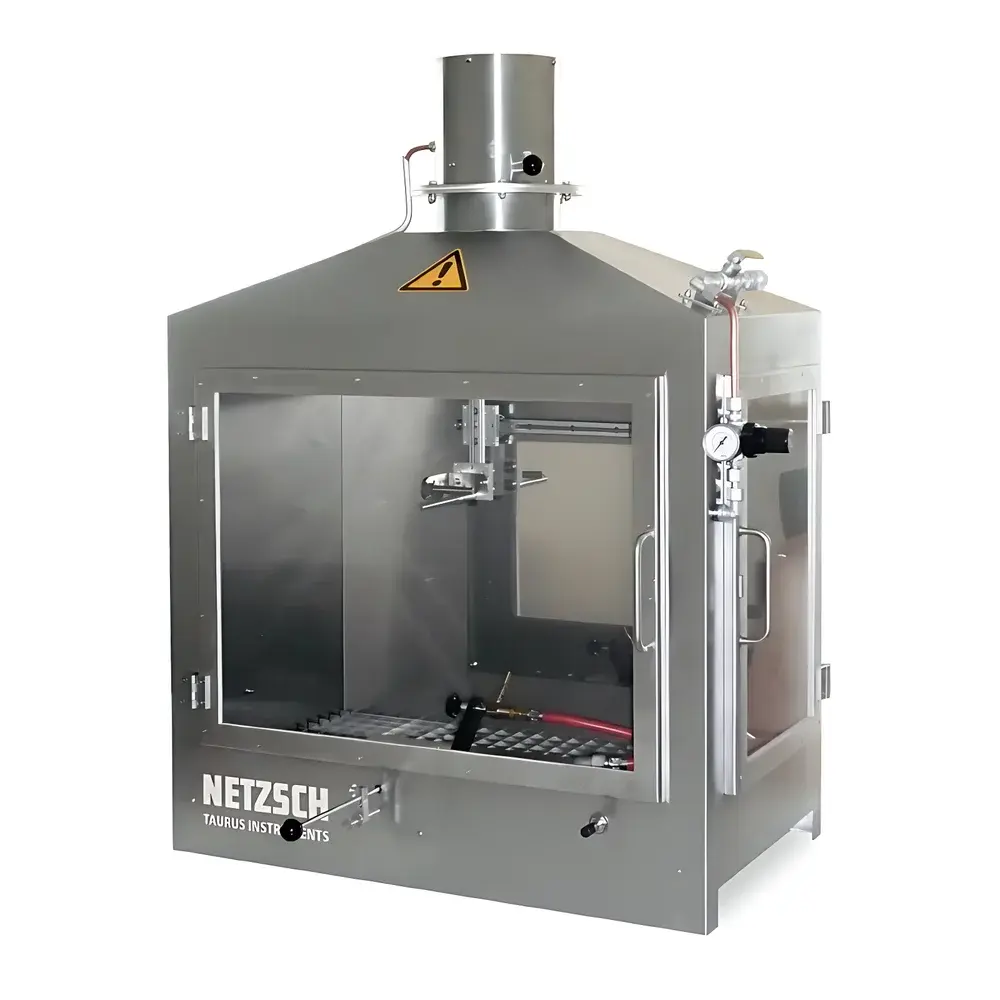
Netzsch KBK Flammability Test Chamber
| Brand | Netzsch |
|---|---|
| Origin | Germany |
| Model | KBK Flammability Test Chamber |
| Compliance | EN ISO 11925-2 |
| Sample Dimensions | 250 × 90 × ≤60 mm |
| Fuel | Propane (≥95% purity) |
| Gas Pressure | 4.0 bar |
| Airflow Velocity Accuracy | ±0.1 m/s |
| Operating Temperature | +23 ± 5 °C |
| Chamber Dimensions (W×D×H) | 700 × 400 × 980 mm |
| Construction Material | Corrosion-Resistant Stainless Steel |
| Viewing Windows | Dual Large-Sized Fire-Rated Glass Doors |
| Adjustable Sample Holder | Horizontal & Vertical Positioning |
Overview
The Netzsch KBK Flammability Test Chamber is a precision-engineered benchtop combustion test system designed for the standardized assessment of surface flammability behavior in building materials—including wall claddings, roofing membranes, floor coverings, and interior linings. It operates in strict accordance with EN ISO 11925-2 (“Reaction to fire tests — Ignitability of building products subjected to direct impingement of flame”), which defines the small-flame ignition method using a defined propane gas burner under controlled airflow conditions. The chamber’s core function is to evaluate whether a material sustains flaming combustion for more than a specified duration (typically ≥5 s) after exposure to a calibrated flame source, thereby classifying its ignitability performance for regulatory compliance and fire safety engineering applications. Its robust architecture ensures stable thermal and aerodynamic boundary conditions across repeated test cycles—critical for achieving high inter-laboratory reproducibility required by notified bodies and certification laboratories.
Key Features
- Corrosion-resistant stainless steel construction ensures long-term structural integrity and resistance to acidic combustion by-products generated during testing.
- Dual large-format fire-rated observation windows provide unobstructed visual access to the specimen during flame exposure and post-ignition monitoring—enabling real-time assessment of flame spread, charring depth, and afterglow behavior without compromising chamber integrity.
- Adjustable sample holder accommodates both horizontal and vertical mounting configurations, supporting standardized specimen orientation per EN ISO 11925-2 requirements and facilitating comparative testing across diverse product geometries.
- Integrated exhaust fan with fine-tuning adjustment allows precise control of chamber air exchange rate, maintaining consistent draft conditions critical for flame stability and repeatability of ignition response.
- Digital anemometer and thermistor-based temperature sensor deliver real-time, traceable measurements of airflow velocity (±0.1 m/s accuracy) and ambient chamber temperature (+23 ± 5 °C operating range), directly supporting audit-ready data acquisition.
- Built-in digital stopwatch enables synchronized timing of flame application duration (15 s standard), flaming time measurement, and afterflame/afterglow observation intervals—minimizing operator-dependent variability.
Sample Compatibility & Compliance
The KBK chamber accepts specimens measuring 250 mm × 90 mm × ≤60 mm (thickness variable depending on product category), conforming precisely to EN ISO 11925-2 dimensional tolerances. Specimens are mounted on a non-combustible support frame and exposed to a propane flame (≥95% purity) delivered at 4.0 bar pressure through a standardized burner tip. The test protocol mandates strict environmental controls: ambient temperature maintained at +23 ± 5 °C, relative humidity not specified but monitored per laboratory GLP practices, and airflow velocity verified prior to each test sequence. The system is fully compatible with supplementary documentation workflows required for CE marking, UKCA, and third-party certification (e.g., UL, DIBt, CSTB). While not inherently compliant with ASTM E84 or NFPA 255, its modular design permits integration with auxiliary instrumentation (e.g., radiant heat flux meters, smoke density analyzers) for extended fire performance characterization.
Software & Data Management
The KBK Flammability Test Chamber operates as a stand-alone hardware platform with analog/digital instrumentation interfaces. No proprietary software is bundled; however, all sensors (anemometer, thermometer, timer) output standard 0–10 V or 4–20 mA signals compatible with common industrial data loggers (e.g., Keysight, NI CompactDAQ, Siemens Desigo CC). Laboratories implementing electronic records management may integrate these outputs into validated LIMS or ELN systems supporting 21 CFR Part 11 compliance—including user authentication, audit trails, and electronic signatures—when paired with appropriate configuration and validation protocols. Raw test parameters and observed outcomes (e.g., “flaming time = 8.2 s”, “no sustained flaming”) are manually recorded in accordance with ISO/IEC 17025 documentation requirements.
Applications
- Classification of construction products under the EU Construction Products Regulation (CPR) and harmonized standard EN 13501-1.
- Pre-certification screening for manufacturers seeking CE marking of façade systems, insulation boards, and decorative panels.
- Quality assurance testing in production environments where batch-to-batch consistency of fire reaction properties must be verified.
- Research and development of flame-retardant additives, intumescent coatings, and low-smoke composite materials.
- Technical due diligence for architects and fire safety engineers evaluating material suitability in compartmentation strategies.
FAQ
Does the KBK chamber meet U.S. fire testing standards such as ASTM E84?
No—the KBK chamber is specifically engineered for EN ISO 11925-2. ASTM E84 requires a different apparatus (Steiner Tunnel) and test methodology; separate equipment is necessary for that standard.
Can the chamber be used for testing upholstered furniture or textiles?
Not without modification—the specimen dimensions and mounting geometry are fixed per EN ISO 11925-2 and do not accommodate flexible or draped substrates covered under ISO 6927 or NFPA 702.
Is calibration certification included with delivery?
Calibration of the digital anemometer and thermometer is performed pre-shipment against NIST-traceable references; a factory calibration report is supplied. Field recalibration is recommended annually per ISO/IEC 17025 requirements.
What electrical supply is required?
Standard single-phase 230 V AC, 50 Hz, 16 A circuit with dedicated earth grounding is sufficient for chamber operation and integrated instrumentation.
Are spare parts and consumables available globally?
Yes—Netzsch maintains an international spare parts logistics network; burner nozzles, gaskets, thermocouple probes, and replacement glass doors are stocked and dispatchable within 5 business days from regional distribution centers.



