
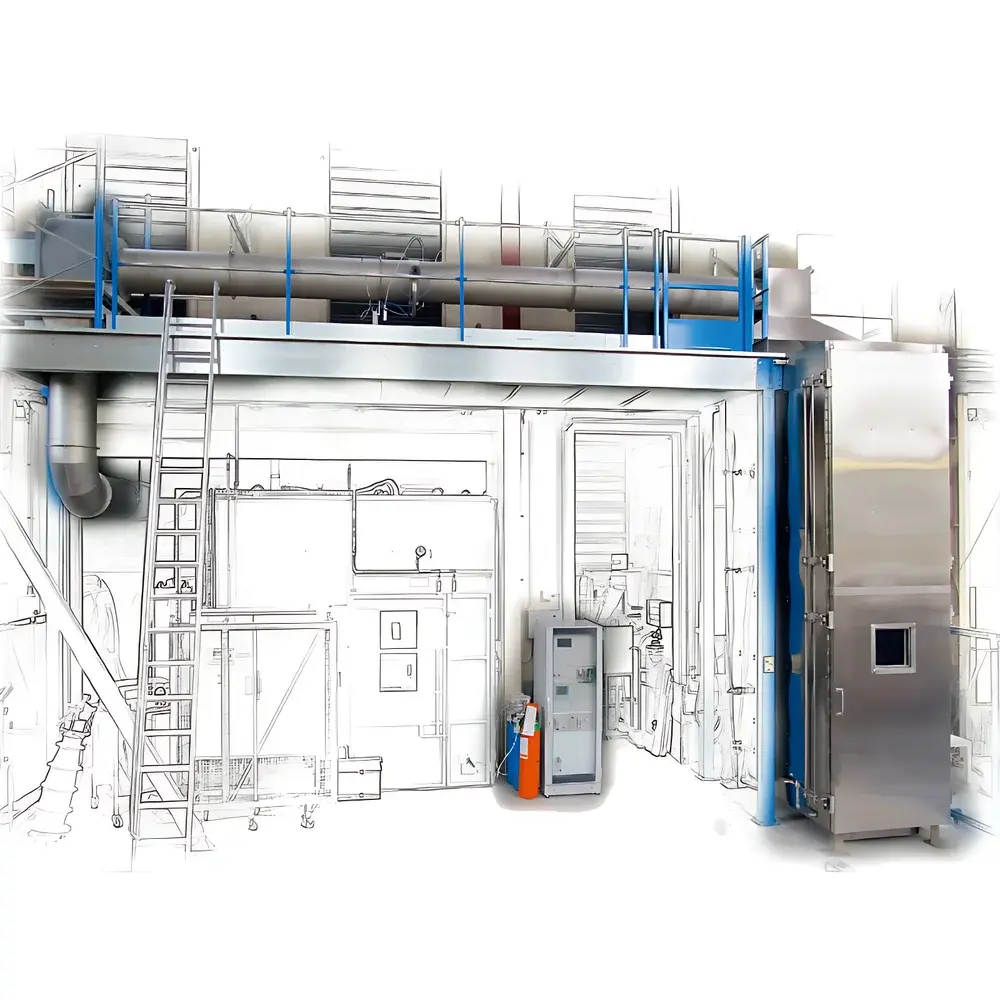
Netzsch KBT Cable Fire Testing System
| Brand | Netzsch |
|---|---|
| Origin | Germany |
| Model | KBT Cable Fire Testing System |
| Standards Compliance | EN 50399, IEC 60332-3, GB/T 31248, GB/T 18380.31, IEC 60332-3-10 |
| Chamber Dimensions (W × D × H) | 135 × 235 × 430 cm |
| Exhaust Opening (W × D) | 100 × 30 cm |
| Fume Hood Dimensions (H × W × D) | 100 × 150 × 100 cm |
| Temperature Measurement Range | −100 to 1300 °C, Resolution: 0.1 K |
| Mass Flow Controller Range | 0–1 L/min, Accuracy: ±0.3 L/min |
| Paramagnetic O₂ Analyzer | 16–21 % (v/v), Max. Resolution: 0.001 % |
| NDIR CO₂ Analyzer | 0–10 % (v/v) |
| Peltier Condenser | Min. Temp. −10 °C, Dryer-Free Operation |
| Gas Sampling Probes | High-Precision Bidirectional |
| Control System | Siemens Gas Analyzers with Auto-Calibration & Dual-Direction Data Exchange |
Overview
The Netzsch KBT Cable Fire Testing System is a fully integrated, standards-compliant fire performance evaluation platform engineered for the quantitative assessment of flame propagation, heat release, smoke generation, and toxic gas evolution during the vertical burning of insulated power and signal cables. Based on the cone calorimeter principle and aligned with the forced-flame spread methodology defined in IEC 60332-3 and EN 50399, the system subjects cable specimens to controlled radiant and convective heating under standardized airflow conditions. Its modular architecture enables precise regulation of oxygen concentration, exhaust flow dynamics, and thermal boundary conditions—critical for achieving high reproducibility in fire reaction testing. Designed for laboratories operating under ISO/IEC 17025-accredited frameworks, the KBT system supports full traceability, audit-ready data logging, and compliance with regulatory reporting requirements for cable certification in construction, rail, marine, and energy infrastructure sectors.
Key Features
- Stainless-steel combustion chamber with inert internal surface finish, optimized for low background emissions and long-term chemical stability during repeated halogenated cable testing.
- Motorized winch system with precision-guided rail assembly ensures consistent specimen positioning and vertical alignment per IEC 60332-3 Annex A requirements.
- Dual-zone ventilation architecture: laminar bottom-air supply combined with top-mounted exhaust ducting maintains stable volumetric flow (±1.5% deviation) across test durations up to 40 minutes.
- Integrated Peltier-based condensation trap operating at −10 °C eliminates reliance on desiccant cartridges, enabling continuous moisture removal from flue gases without manual intervention or calibration drift.
- Siemens-certified paramagnetic O₂ and NDIR CO₂ analyzers provide real-time, dual-direction communication with the central control unit, supporting automated zero/span calibration sequences and drift compensation algorithms.
- High-fidelity bidirectional gas sampling probes positioned at multiple axial locations within the exhaust stream allow spatially resolved analysis of combustion intermediates (e.g., CO, HCN, HCl) when coupled with optional add-on modules.
Sample Compatibility & Compliance
The KBT system accommodates single-core and multi-core cables with outer diameters ranging from 4 mm to 60 mm and total lengths up to 3.5 m. Specimens are mounted vertically in accordance with EN 50399 Clause 6.2, with lower clamping points adjustable to maintain exact 0.5 m clearance above the burner base. The system is validated for use with thermoplastic (PVC, PE), thermoset (EPR, XLPE), low-smoke zero-halogen (LSZH), and fluoropolymer-insulated cables. Full compliance includes: IEC 60332-3-10 (Category A/B/C/D), EN 50399:2013, GB/T 18380.31–2022, GB/T 31248–2014, and ASTM D6413 (with minor procedural adaptation). All measurement subsystems are factory-calibrated against NIST-traceable reference standards, and certificate-of-conformance documentation is provided with each system shipment.
Software & Data Management
The KBT operates under Netzsch’s proprietary FireTest Suite v4.2—a Windows-based application compliant with FDA 21 CFR Part 11 for electronic records and signatures. The software features role-based user access control, configurable test templates, real-time graphical overlay of temperature, O₂ depletion, CO₂ generation, and mass loss rate, and automated report generation in PDF/A-1b format. Raw data streams are stored in encrypted SQLite databases with SHA-256 hashing; audit trails log all parameter modifications, calibration events, and user actions with timestamps and operator IDs. Export options include CSV, XML, and ASTM E136-compliant ASCII formats suitable for third-party statistical analysis or submission to Notified Bodies.
Applications
- Fire classification testing for CE marking (EN 50575) and CPR compliance in building cable applications.
- Development and validation of flame-retardant polymer formulations in R&D laboratories.
- Comparative assessment of char-forming additives, metal hydroxides, and phosphorus-based synergists under realistic fire exposure profiles.
- Support for UL 1685 vertical tray flame testing correlation studies.
- Smoke density and toxicity index derivation per ISO 5659-2 and ISO 19706 methodologies using synchronized optical density and FTIR gas analysis extensions.
FAQ
Does the KBT system support automated pass/fail evaluation according to EN 50399 criteria?
Yes—the FireTest Suite applies embedded logic to calculate flame spread height, char length, and post-fire self-extinguishment time, generating immediate compliance flags against Clause 7.3 thresholds.
Can the system be upgraded for ISO 5659-2 smoke density measurements?
Yes—optional optical density module integration includes 300 mm path-length chamber, stabilized tungsten-halogen light source, and NIST-calibrated photodetector array with automatic baseline correction.
Is remote diagnostics and firmware update capability available?
Yes—via secure TLS 1.2-enabled Ethernet interface with authenticated SSH access; updates are digitally signed and verified prior to installation.
What maintenance intervals are recommended for gas analyzers?
O₂ and CO₂ sensors require annual verification using certified calibration gases; Peltier condenser performance is validated quarterly via dew point check using chilled-mirror hygrometer traceable to PTB standards.
Does the system meet GLP requirements for regulated pharmaceutical facility cable qualification?
Yes—full 21 CFR Part 11 compliance, IQ/OQ documentation packages, and GMP-aligned validation protocols are available as optional service deliverables.



