
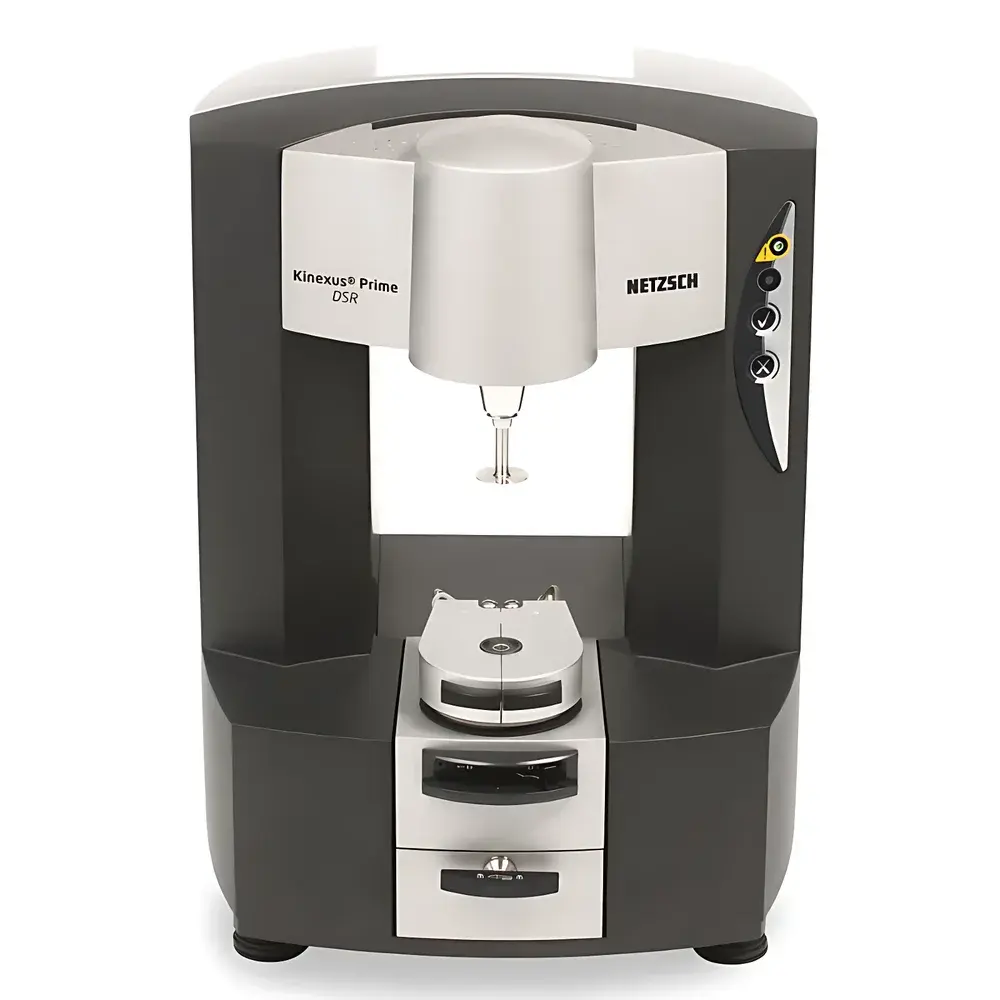
Netzsch Kinexus DSR Advanced Rotational Rheometer
| Brand | Netzsch |
|---|---|
| Origin | Germany |
| Model | Kinexus DSR |
| Instrument Type | Rotational Rheometer |
| Motor Bearing | Air Bearing |
| Minimum Angular Velocity | 10 nrad/s |
| Maximum Angular Velocity | 325 rad/s |
| Frequency Range | 1 µHz – 100 Hz |
| Maximum Torque | 200 mNm |
| Torque Resolution | 0.1 nNm |
| Normal Force Range | 0.001 N – 50 N |
| Normal Force Response Time | <10 ms |
| Vertical Travel Speed | 0.1 µm/s – 35 mm/s |
| Vertical Travel Distance | 230 mm |
| Gap Resolution | 0.1 µm |
| Motor Inertia | 12 µN·m·s² |
| Torque Range (Rate/Stress Control) | 0.01 µNm – 200 mNm |
| Torque Range (Strain/Stress Control) | 0.05 µNm – 200 mNm |
| Fixture Identification | RFID-enabled Smart Recognition |
| Environmental Control Unit | Plug-and-Play with Auto-Detection |
Overview
The Netzsch Kinexus DSR Advanced Rotational Rheometer is a high-precision, modular rheological measurement platform engineered for fundamental and applied research in complex fluid and soft solid characterization. Based on Couette and parallel-plate rotational rheometry principles, it delivers exceptional sensitivity and dynamic range across both steady-state and oscillatory deformation modes. Designed specifically for demanding applications—including asphalt binder rheology (per ASTM D7175 and AASHTO TP10), polymer melt processing, pharmaceutical suspensions, food gels, and battery electrode slurries—the Kinexus DSR enables rigorous viscoelastic quantification under controlled temperature, gap, and normal force conditions. Its air-bearing-supported motor architecture eliminates mechanical friction, ensuring ultra-low torque noise and enabling reliable measurements down to 0.01 µNm—critical for characterizing weak gel structures, dilute biopolymer solutions, and low-viscosity solvents.
Key Features
- Ultra-low-inertia air-bearing motor system (inertia: 12 µN·m·s²) with optical encoder-based position sensing for sub-nanoradian angular resolution
- High-fidelity normal force control with real-time acquisition (response time <10 ms) and full vertical motion logging (displacement, velocity, and force)
- RFID-enabled smart fixture recognition: automatic upload of geometry parameters, calibration history, and thermal expansion coefficients upon insertion
- Plug-and-play environmental control units (ECUs) with auto-detection and parameter synchronization—compatible with Peltier, liquid-circulating, and convection ovens (–40 °C to 600 °C)
- Integrated gap control with 0.1 µm resolution and automated zero-gap calibration routine, minimizing operator-induced variability
- Intuitive Kinexus software supporting both SOP-driven workflows and fully customizable experimental sequences—including multi-step amplitude sweeps, frequency sweeps, and time sweeps with adaptive feedback logic
Sample Compatibility & Compliance
The Kinexus DSR accommodates a broad spectrum of sample geometries and rheological behaviors—from Newtonian oils and shear-thinning polymer melts to thixotropic pastes and yield-stress fluids. Its modular design supports standard geometries (cone-plate, parallel-plate, concentric cylinder) as well as specialized fixtures (e.g., asphalt extensional modules, vane spindles, serrated plates). All measurement protocols comply with internationally recognized standards including ISO 6721 (plastics—determination of dynamic mechanical properties), ASTM D4402/D7175 (asphalt binder characterization), USP (rheological evaluation of semisolid dosage forms), and ISO/IEC 17025 requirements for laboratory competence. Data integrity meets FDA 21 CFR Part 11 criteria when operated with validated software configurations and audit-trail enabled.
Software & Data Management
Kinexus software provides a unified interface for instrument control, real-time data visualization, and post-acquisition analysis. It supports GLP/GMP-compliant operation through electronic signatures, user role management, and immutable audit trails for all method changes, calibration events, and raw data exports. Built-in analysis tools include Cole-Cole plot generation, time–temperature superposition (TTS), master curve construction, and linear viscoelastic region (LVER) identification via strain sweep automation. Export formats include ASCII, CSV, and universal .rhe files compatible with third-party modeling platforms (e.g., MATLAB, Python SciPy, ANSYS Polyflow). All data are timestamped, metadata-tagged, and stored in a hierarchical project structure that preserves experimental context and traceability.
Applications
- Asphalt binder grading and performance prediction (PG classification per AASHTO M320)
- Rheological fingerprinting of thermoplastic elastomers during extrusion and injection molding process development
- Yield stress and structural recovery kinetics of ceramic and Li-ion battery electrode slurries
- Temperature-dependent viscoelastic transitions in hydrogels and injectable biomaterials
- Quality control of food emulsions and dairy products under simulated processing shear profiles
- Stability assessment of colloidal dispersions and nanoparticle suspensions via amplitude sweep and creep-recovery testing
FAQ
What distinguishes the Kinexus DSR from conventional rotational rheometers?
Its combination of air-bearing torque transduction, real-time normal force feedback, and RFID-integrated fixture intelligence enables unprecedented repeatability and reduced operator dependency—particularly critical for low-torque, high-sensitivity applications.
Is the Kinexus DSR compliant with regulatory requirements for pharmaceutical or asphalt testing?
Yes—when configured with appropriate accessories and software validation packages, it supports compliance with USP , ASTM D7175, AASHTO TP10, and 21 CFR Part 11 for electronic records and signatures.
Can the instrument perform both controlled-stress and controlled-strain measurements?
Yes—the dual-mode drive electronics allow seamless switching between stress-controlled and strain-controlled modes without hardware reconfiguration.
How does the system handle thermal expansion effects during temperature sweeps?
Smart fixtures automatically load pre-measured thermal expansion coefficients; the software dynamically adjusts gap targets throughout the temperature ramp to maintain geometric fidelity.
Is remote monitoring or integration into lab automation systems possible?
The Kinexus DSR supports Ethernet-based communication (TCP/IP) and offers COM/ActiveX interfaces for integration into LIMS, MES, or custom automation frameworks.



