
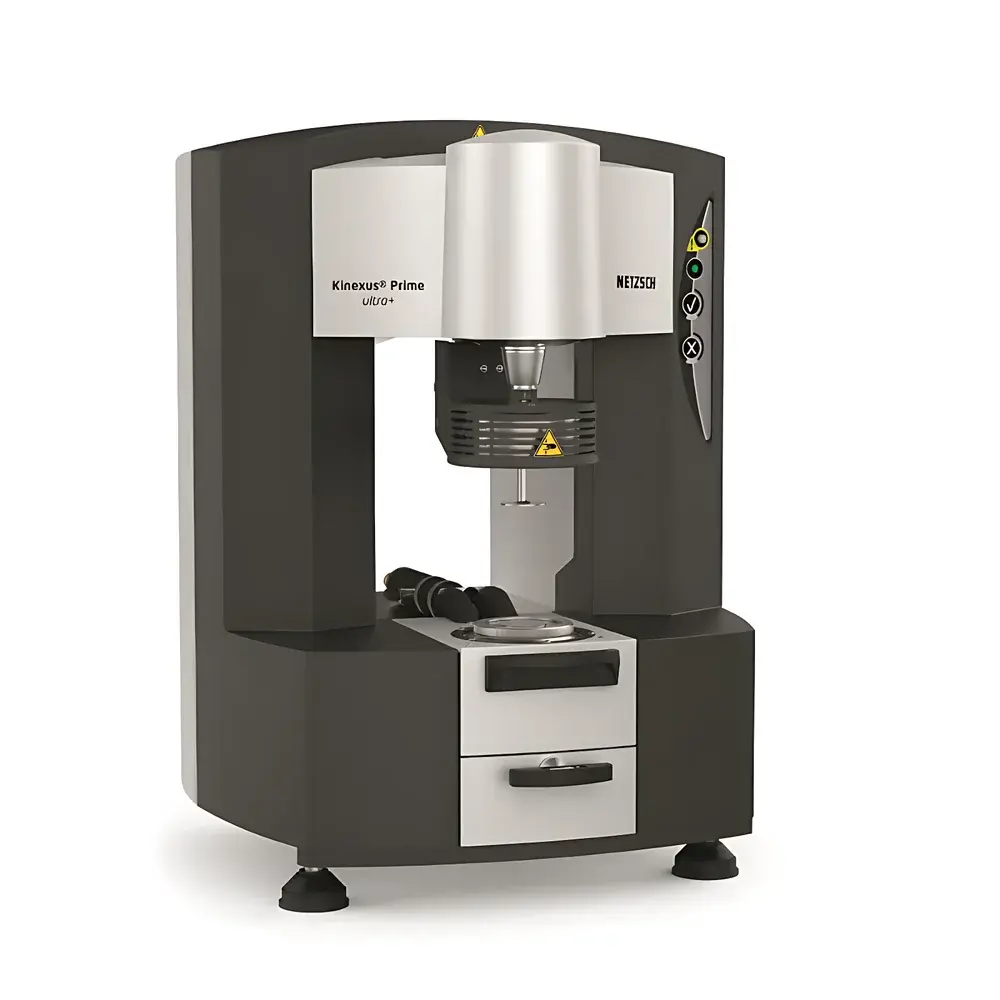
Netzsch Kinexus Prime Ultra+ Rotational Rheometer
| Brand | Netzsch |
|---|---|
| Origin | Germany |
| Model | Kinexus Prime Ultra+ |
| Instrument Type | Rotational Rheometer |
| Frequency Range | 1 µHz to 150 Hz |
| Temperature Control | Modular EasySwap™ Environmental Units |
| Normal Force Control | High-Sensitivity Electromagnetic Sensor |
| Vertical Travel & Gap Control | Precision Motorized Actuation |
| Compliance | ASTM D3835, ISO 6721-10, ISO 3219, USP <911>, FDA 21 CFR Part 11 (Software Mode), GLP/GMP Audit Trail Capable |
Overview
The Netzsch Kinexus Prime Ultra+ Rotational Rheometer is a research-grade, modular rotational rheometry platform engineered for high-fidelity characterization of complex fluids and soft solids under controlled mechanical, thermal, and environmental conditions. It operates on the fundamental principles of Couette and parallel-plate rheology—measuring torque response to imposed shear stress or oscillatory strain—and delivers quantitative viscoelastic parameters including storage modulus (G′), loss modulus (G″), complex viscosity (η*), yield stress, thixotropy, and time-dependent relaxation behavior. Designed for laboratories requiring reproducible, traceable, and standards-compliant rheological data, the system integrates advanced electromechanical actuation, real-time normal force feedback, and sub-micron gap resolution—enabling precise interrogation of low-viscosity dispersions, high-modulus polymer melts, fragile biopolymer gels, and thermosensitive formulations across wide frequency (1 µHz–150 Hz) and temperature ranges.
Key Features
- Modular EasySwap™ temperature control units—fully integrated with mechanical alignment, fluidic interfaces, power, and digital communication—enable rapid, tool-free exchange between Peltier, electric furnace, liquid nitrogen, and solvent-trap configurations.
- Ultra-precise vertical positioning system with <1 µm resolution and active gap control ensures consistent sample geometry across repeated measurements and temperature ramps.
- High-sensitivity electromagnetic normal force sensor (±0.001 mN resolution) enables accurate measurement of swelling, contraction, and interfacial slip during deformation—critical for gelation kinetics and particle network formation studies.
- True dual-control architecture supports simultaneous stress/strain-controlled steady shear, oscillatory, creep/recovery, and stress relaxation protocols within a single experiment sequence.
- Interchangeable lower plate modules—including quartz, stainless steel, sandblasted, serrated, and solvent-resistant surfaces—allow optimization for adhesion-sensitive, volatile, or abrasive samples without hardware recalibration.
- Compliance-ready software architecture with electronic signatures, user-level permissions, audit trail logging, and 21 CFR Part 11 mode supports regulated environments in pharmaceutical development, food safety QA/QC, and polymer certification workflows.
Sample Compatibility & Compliance
The Kinexus Prime Ultra+ accommodates diverse sample forms: bulk melts (e.g., polyolefins, thermoplastic elastomers), concentrated suspensions (e.g., ceramic slurries, battery electrode pastes), emulsions (e.g., mayonnaise, pharmaceutical ointments), protein solutions (e.g., whey, monoclonal antibodies), hydrogels, and highly filled adhesives. Its design conforms to key international testing standards including ASTM D3835 (polymer melt rheology), ISO 6721-10 (dynamic mechanical analysis), ISO 3219 (rheological properties of polymer solutions), and USP (rheological evaluation of semisolid dosage forms). All firmware and software modules undergo periodic validation per GLP and GMP requirements, with full documentation support for regulatory submissions.
Software & Data Management
RheoPlus™ software provides an intuitive, workflow-driven interface with drag-and-drop protocol builder, real-time parameter monitoring, and automated pass/fail criteria based on user-defined specification limits. Raw torque, strain, temperature, and normal force data are stored in vendor-neutral HDF5 format with embedded metadata (instrument ID, operator, calibration history, environmental conditions). Batch processing tools enable comparative analysis across sample sets; export options include CSV, Excel, and XML for integration with LIMS and statistical process control (SPC) platforms. Software validation packages—including IQ/OQ documentation, change control logs, and cybersecurity assessment reports—are available upon request.
Applications
- Characterization of molecular weight distribution in polymers via master curve construction and time–temperature superposition (TTS).
- Yield stress mapping and structural recovery kinetics in thixotropic coatings and printing inks.
- Thermal gelation profiling of hydrocolloids (e.g., carrageenan, gelatin) and thermoresponsive polymers (e.g., PNIPAM).
- Quality control of polymer feedstocks using melt flow index (MFI)-correlated rheograms and zero-shear viscosity extrapolation.
- Stability assessment of oil-in-water emulsions under shear-induced coalescence and creaming regimes.
- Viscoelastic fingerprinting of injectable hydrogels for biomedical device qualification under ISO 10993-5 cytotoxicity screening workflows.
FAQ
What temperature range is supported by the EasySwap™ modules?
Standard Peltier units operate from −40 °C to +200 °C; high-temperature furnace modules extend to +600 °C; cryogenic modules reach −150 °C.
Is the system compatible with third-party rheological fixtures?
Only Netzsch-certified EasySwap™ fixtures are supported to maintain calibration integrity and software recognition; non-OEM accessories void metrological traceability.
Can the Kinexus Prime Ultra+ perform extensional rheology?
No—it is a rotational rheometer optimized for shear and oscillatory deformation; extensional characterization requires dedicated filament stretching or capillary breakup instrumentation.
How is instrument calibration verified?
Factory calibration includes torque, angular displacement, normal force, and temperature sensors; users perform routine verification using NIST-traceable standard oils and certified geometry kits.
Does the system support automated sample loading?
Not natively; however, it is compatible with third-party robotic liquid handlers via TCP/IP API and LabVIEW driver libraries for unattended multi-sample sequences.



