
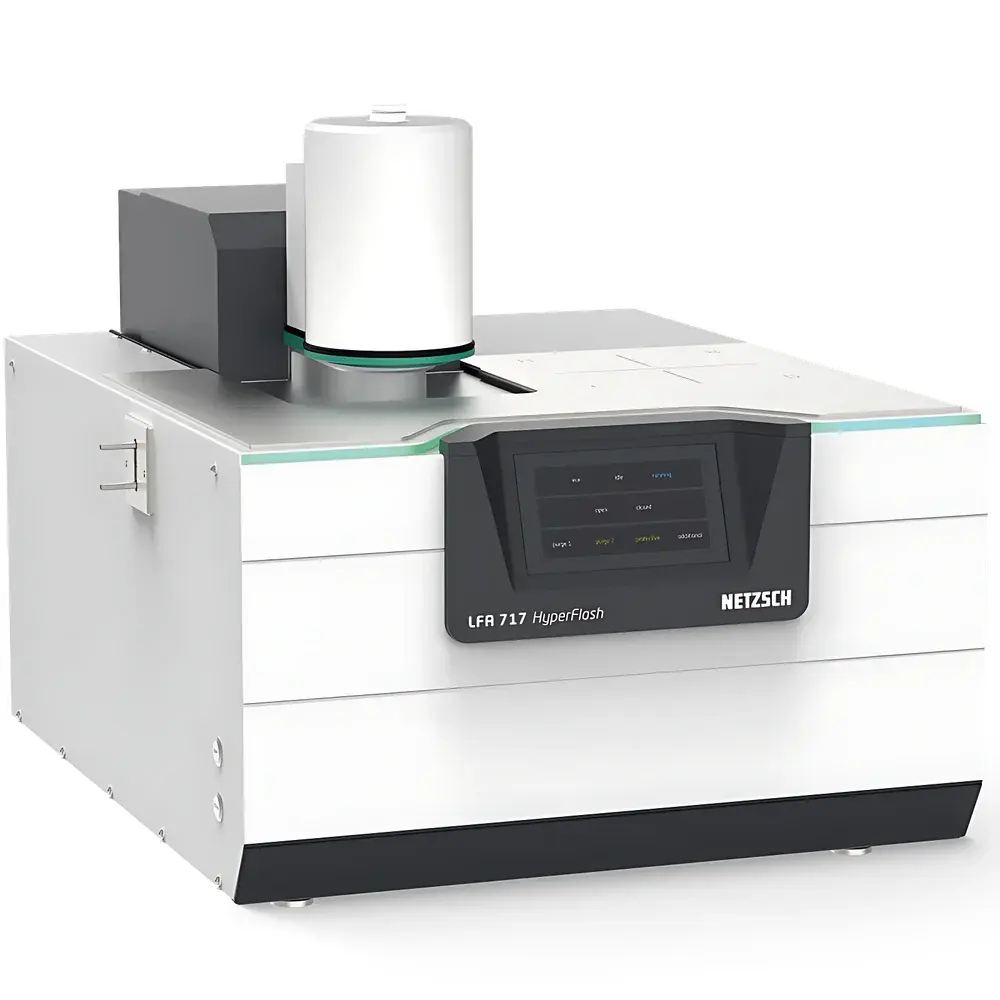
Netzsch LFA 717 HyperFlash Laser Flash Thermal Conductivity Analyzer
| Brand | Netzsch |
|---|---|
| Origin | Germany |
| Model | LFA 717 HyperFlash |
| Measurement Principle | Laser Flash Method (LFA) |
| Temperature Range | -100 °C to 500 °C |
| Thermal Conductivity Range | 0.1 – 4000 W/(m·K) |
| Accuracy | ±3% |
| Repeatability | ±2% |
| Sample Forms | Solid, Liquid, Powder, Thin Film |
| Atmosphere Options | Inert or Oxidizing |
| Sample Capacity | Up to 16 positions with automated carousel |
| Dimensions (L×W×H) | 600 mm × 500 mm × 600 mm |
| Data Acquisition Rate | 2 MHz |
| Compliance Standards | ASTM E1461, ASTM E2585, ISO 22007-4, ISO 18755, ISO 13826, DIN EN 821-2, DIN 30905, DIN EN 1159-2 |
Overview
The Netzsch LFA 717 HyperFlash is a high-performance laser flash thermal conductivity analyzer engineered for precision measurement of thermal diffusivity, specific heat capacity, and derived thermal conductivity across an exceptionally broad temperature range—from cryogenic conditions at -100 °C up to 500 °C. Based on the standardized laser flash method (ASTM E1461, ISO 22007-4), the instrument delivers traceable, reproducible results for advanced materials R&D, quality control, and regulatory compliance in aerospace, electronics, battery, and nuclear applications. Unlike conventional LFA systems requiring multiple furnace or detector configurations for extended temperature coverage, the LFA 717 integrates a single robust furnace architecture with a high-stability xenon flash lamp system—eliminating consumables and enabling long-term operational stability without lamp replacement. Its design supports both steady-state and transient thermal characterization under controlled inert or oxidizing atmospheres, making it suitable for reactive ceramics, metallic alloys, phase-change composites, and thermally sensitive polymers.
Key Features
- Single-instrument temperature coverage from -100 °C to 500 °C—no hardware swapping required for low- or high-temperature operation.
- 16-position automated sample carousel enabling unattended sequential analysis across full temperature ramps, significantly improving throughput in batch testing environments.
- Integrated liquid nitrogen auto-refill system for continuous cryogenic detector and furnace cooling—ensuring uninterrupted multi-day measurements with minimal operator intervention.
- ZoomOptics™ patented optical path optimization eliminates aperture diaphragm dependency, enhancing signal-to-noise ratio and reducing systematic error in thin-film and high-conductivity measurements.
- 2 MHz high-speed infrared detection system captures rapid surface temperature rise profiles with sub-millisecond resolution—critical for accurate thermal diffusivity calculation in films 100 mm²/s.
- Modular furnace design with dual-zone temperature control ensures uniform thermal gradients and minimizes radial heat loss during high-accuracy measurements.
Sample Compatibility & Compliance
The LFA 717 accommodates diverse physical forms—including bulk solids (discs, rods), powders (pressed or loose), liquids (in sealed quartz crucibles), and freestanding or substrate-supported thin films (down to ~5 µm). Sample diameter ranges from 6 mm to 25.4 mm; thickness is optimized per material class (e.g., 0.5–3 mm for ceramics, 0.1–1 mm for metals). All measurement protocols are fully aligned with internationally recognized standards: ASTM E1461 (standard test method for thermal diffusivity by the flash method), ASTM E2585 (practice for determining specific heat capacity), ISO 22007-4 (plastics—determination of thermal conductivity and thermal diffusivity—part 4: laser flash method), and ISO 18755 (refractory products—determination of thermal diffusivity). The system supports GLP/GMP-compliant operation through configurable audit trails, electronic signatures, and data integrity safeguards per FDA 21 CFR Part 11 requirements when integrated with Netzsch’s Proteus® software suite.
Software & Data Management
Controlled via Netzsch Proteus® 6.x software, the LFA 717 provides intuitive workflow-driven operation—from method setup and calibration to real-time thermal curve visualization and automated report generation. The software implements built-in correction algorithms for finite pulse effects, radiative losses, and heat losses through sample edges (using Parker/Cowan models). Raw time-temperature datasets are stored in vendor-neutral HDF5 format, ensuring long-term archival compatibility and third-party analysis interoperability. Batch processing tools enable statistical evaluation across multiple samples and temperatures, including uncertainty propagation based on ISO/IEC Guide 98-3 (GUM). Export options include CSV, PDF, and XML formats compliant with LIMS integration requirements.
Applications
- Thermal management material qualification for power electronics packaging (e.g., AlN, SiC, diamond composites).
- Low-k dielectric and high-κ gate oxide characterization in semiconductor process development.
- Thermal stability assessment of cathode/anode materials and solid electrolytes in next-generation Li-ion and solid-state batteries.
- High-temperature thermal property validation of turbine blade coatings (TBCs), refractories, and CMCs under simulated service conditions.
- Thermophysical benchmarking of nanocomposites, aerogels, and bio-based insulators for building envelope and cryogenic insulation applications.
- Regulatory submission support for medical device thermal safety dossiers (ISO 10993-12) and aerospace material certification (SAE AMS2750).
FAQ
What standards does the LFA 717 comply with for thermal diffusivity measurement?
ASTM E1461, ISO 22007-4, DIN EN 1159-2, and other national equivalents for flash method-based thermal diffusivity determination.
Can the instrument measure liquids and powders reliably?
Yes—liquids are measured in hermetically sealed quartz crucibles; powders are either pressed into pellets or analyzed as loose beds using calibrated reference standards.
Is the system compatible with GxP-regulated environments?
When configured with Proteus® GxP mode, it supports 21 CFR Part 11 compliance, including user access controls, electronic signatures, and immutable audit logs.
How is thermal conductivity calculated from raw LFA data?
Thermal conductivity (λ) is derived as λ = α · ρ · Cp, where α is thermal diffusivity (measured directly), ρ is density (input manually or imported from external database), and Cp is specific heat (measured separately via DSC or input from literature).
Does the system require periodic recalibration with certified reference materials?
Yes—routine verification using NIST-traceable standards (e.g., NIST SRM 735a, sapphire) is recommended per ISO/IEC 17025 guidelines to maintain measurement traceability.



