
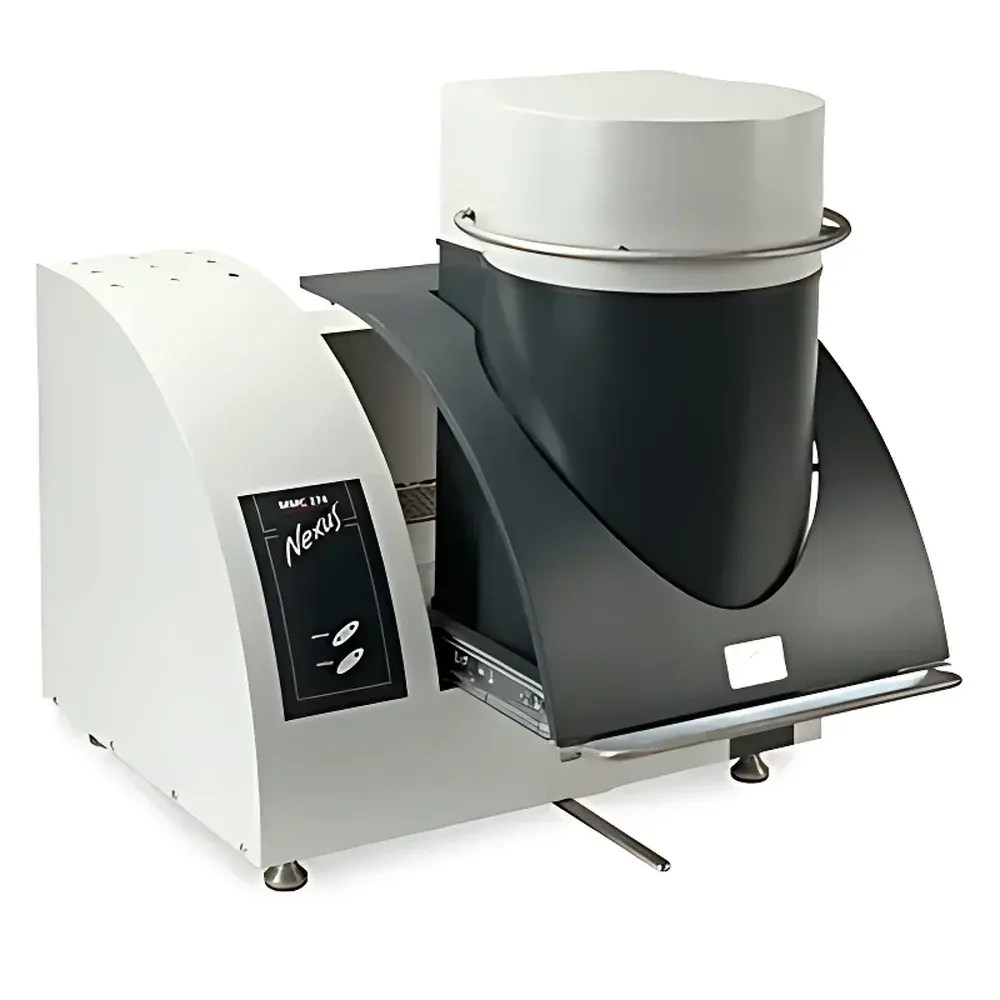
Netzsch MMC274 Nexus Modular Adiabatic Calorimeter
| Brand | Netzsch |
|---|---|
| Origin | Germany |
| Model | MMC274 Nexus |
| Instrument Type | Accelerating Rate Calorimeter (ARC) |
| Measurement Mode | Adiabatic Calorimetry |
| Temperature Range | RT to 500°C |
| Temperature Resolution | 0.01°C |
| Pressure Range | 0–100 bar |
| Heating Rate | 0–2°C/min |
| Tracking Rate | 0–50°C/min (standard) or 0–250°C/min (high-speed module) |
| Temperature Control Accuracy | ±0.01°C |
| Pressure Accuracy | ±0.01 bar |
| Sample Volume | 0.1–2.5 mL |
| Heat Flow Sensitivity | 25–250 µW/g (mode-dependent) |
| Scan Sensitivity | 0.002°C/min |
| Sample Types | Solids, Liquids, Powders |
| Optional | Custom sample vessels, button-cell test fixture, VariPhi™ thermal compensation technology |
Overview
The Netzsch MMC274 Nexus Modular Adiabatic Calorimeter is an advanced thermal safety evaluation platform engineered for high-fidelity characterization of exothermic and endothermic reactions under near-adiabatic conditions. It integrates two foundational calorimetric methodologies—accelerating rate calorimetry (ARC) and differential scanning calorimetry (DSC)—within a single, reconfigurable hardware architecture. Unlike conventional fixed-mode instruments, the MMC274 Nexus employs a patented VariPhi™ thermal compensation algorithm that dynamically adjusts heater power to maintain adiabaticity across wide temperature and reaction enthalpy ranges, minimizing heat loss and enabling precise quantification of self-heating rates, onset temperatures, time-to-maximum-rate (TMR), and pressure evolution kinetics. Designed for rigorous process safety assessment in chemical development, battery R&D, pharmaceutical stability testing, and energetic materials screening, the system complies with ASTM E698, ISO 8232, and UN Test Series 3 guidelines for thermal hazard classification.
Key Features
- Modular instrument architecture: Base unit supports interchangeable functional modules—including ARC, DSC, and dedicated button-cell test modules—enabling lab-wide method flexibility without hardware duplication.
- VariPhi™ adaptive thermal control: Real-time correction of thermal lag and heat exchange via predictive modeling ensures sustained adiabaticity (φ ≤ 1.05) over full operating range (RT to 500°C).
- Multi-parameter synchronous acquisition: Simultaneous high-resolution measurement of temperature, pressure, heat flow, and time-stamped event markers within a single experiment.
- High-speed tracking capability: Up to 250°C/min tracking rate available in optional high-dynamic module for rapid thermal runaway simulation and kinetic parameter extraction.
- Pressure-resolved calorimetry: Integrated 0–100 bar pressure transducer with ±0.01 bar accuracy enables gas evolution profiling, decomposition stoichiometry analysis, and vent sizing calculations per DIERS methodology.
- Micro-sample compatibility: Supports sample masses from 10 mg to 2 g in volumes ranging from 0.1 to 2.5 mL, accommodating viscous liquids, slurries, powders, and packaged electrochemical cells.
Sample Compatibility & Compliance
The MMC274 Nexus accommodates heterogeneous sample forms—including crystalline solids, reactive liquids, catalysts, polymer precursors, and commercial lithium-ion button cells—without requiring pre-processing or encapsulation. All standard crucibles are constructed from inert alumina or gold-plated stainless steel to prevent catalytic interference. The system meets GLP documentation requirements with full audit trail support, including user authentication, electronic signatures, and data integrity logging compliant with FDA 21 CFR Part 11. Calibration traceability follows ISO/IEC 17025 standards, with NIST-traceable reference materials used for temperature, pressure, and heat capacity verification. Applications align with regulatory expectations outlined in ICH Q1A(R2), EU GMP Annex 19, and NFPA 495 for energetic material classification.
Software & Data Management
Thermal Analysis Software (TAS) v5.2 provides intuitive experiment setup, real-time monitoring, and automated post-processing workflows. Key capabilities include automatic onset detection using multiple algorithms (tangent, intersection, derivative peak), kinetic modeling (e.g., Friedman, Ozawa-Flynn-Wall), TMRad and TMRiso prediction, and pressure-based reaction order determination. Raw data are stored in vendor-neutral HDF5 format with embedded metadata (instrument configuration, calibration history, environmental logs). Export options include CSV, Excel, and XML for integration into LIMS or enterprise risk management platforms. Audit trails record all user actions, parameter changes, and report generation events with time stamps and operator IDs.
Applications
- Chemical process safety: Determination of adiabatic temperature rise (ΔTad), self-accelerating decomposition temperature (SADT), and criticality assessment for batch reactors and storage scenarios.
- Battery safety testing: Thermal runaway propagation studies on Li-ion coin cells; quantification of exothermic onset, gas generation profiles, and internal resistance evolution during abuse conditions.
- Pharmaceutical stability: Screening of API-excipient compatibility, degradation pathway identification, and accelerated aging validation under controlled pressure environments.
- Energetic materials qualification: Classification testing per UN Manual of Tests and Criteria, Section 33.2.1, including Time–Temperature–Pressure (TTP) mapping.
- Material decomposition kinetics: Multi-step reaction modeling for polymers, peroxides, and nitro-compounds using isoconversional methods applied to adiabatic scan data.
FAQ
What distinguishes the MMC274 Nexus from conventional ARC instruments?
It combines ARC and DSC functionalities in one platform, incorporates VariPhi™ for superior adiabatic fidelity, and supports pressure-synchronized calorimetry—capabilities not found in legacy ARC-only systems.
Can the system perform isothermal aging tests?
Yes—the ARC module supports extended isothermal holds up to 1000 hours at temperatures up to 500°C, with continuous pressure and temperature logging for long-term stability assessment.
Is compliance with 21 CFR Part 11 achievable out-of-the-box?
Yes—when deployed with validated TAS software, networked authentication, and enabled audit trail settings, the system satisfies electronic record and signature requirements for regulated environments.
What sample containment options are available for volatile or corrosive substances?
Custom-engineered hermetic vessels are offered in Hastelloy C-276, titanium, and sapphire-lined configurations, qualified for pressures up to 100 bar and temperatures to 500°C.
How is calibration verified across modules?
Each module undergoes independent calibration using certified reference materials (e.g., indium, zinc, tin for temperature; benzoic acid for heat flow); calibration certificates include uncertainty budgets per ISO/IEC 17025.



