
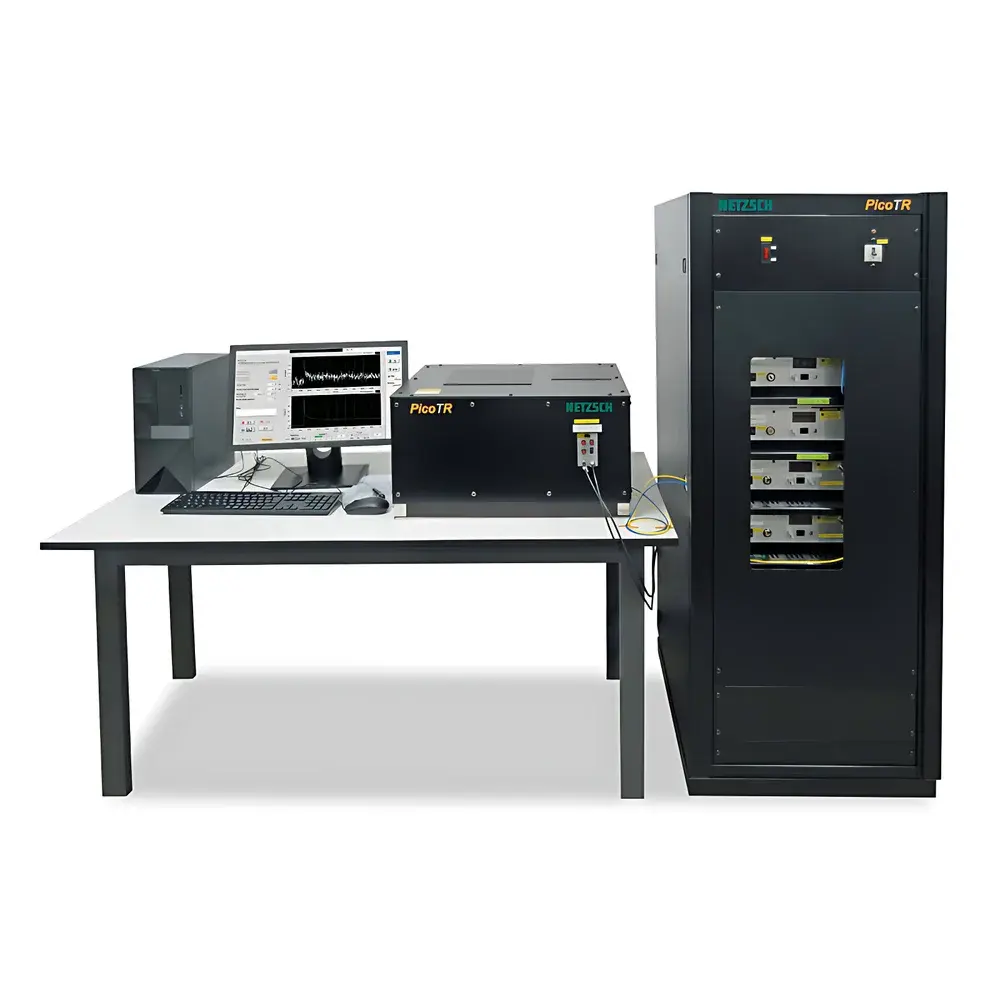
Netzsch PicoTR Thin-Film Thermal Conductivity Analyzer (Thermal Reflectance Method)
| Brand | Netzsch |
|---|---|
| Origin | Germany |
| Model | PicoTR |
| Measurement Principle | Time-Domain Thermoreflectance (TDTR) |
| Instrument Type | Thin-film thermal property analyzer |
| Dimensions (L×W×H) | 600 mm × 500 mm × 700 mm |
| Accuracy | ±5% |
| Thermal Conductivity Range | 0.1 – 2000 W/(m·K) |
| Repeatability | ±5% |
| Temperature Range | Ambient (RT) to 500 °C (optional stage) |
| Measurement Modes | RF (rear-heating/front-detection) and FF (front-heating/front-detection) |
| Sample Size | 10 mm × 10 mm to 20 mm × 20 mm |
| Film Thickness Range | 10 nm – 900 nm (material- and mode-dependent) |
| Thermal Diffusivity Range | 0.01 – 1000 mm²/s |
| Pump Laser Pulse Width | 0.5 ps |
| Probe Beam Diameter | 45 µm |
| Laser Power | 20 mW |
Overview
The Netzsch PicoTR Thin-Film Thermal Conductivity Analyzer is a high-precision, time-domain thermoreflectance (TDTR)-based instrument engineered for quantitative measurement of thermal transport properties in nanoscale thin films deposited on substrates. Unlike conventional laser flash analysis (LFA), which is optimized for bulk materials, the PicoTR employs ultrafast pump-probe optics to resolve sub-nanosecond thermal transients at interfaces—enabling direct determination of thermal diffusivity, thermal conductivity, volumetric heat capacity, and interfacial thermal resistance (Rth) with nanometer-scale spatial resolution. The system operates on the physical principle that a femtosecond-scale optical pump pulse induces localized heating in a transducer layer (e.g., Al, Ti, or Au), while a time-delayed probe beam monitors the resulting change in surface reflectivity—a signal linearly proportional to temperature rise. This non-contact, non-destructive methodology eliminates assumptions about heat loss and geometry-dependent corrections inherent in steady-state methods, making it particularly suitable for R&D laboratories focused on advanced microelectronics, thermoelectric thin films, 2D materials, and next-generation semiconductor packaging.
Key Features
- Time-domain thermoreflectance (TDTR) architecture optimized for thin-film metrology down to 10 nm thickness
- Dual operational modes: RF (rear-heating/front-detection) for opaque substrates and FF (front-heating/front-detection) for transparent or semi-transparent systems
- Integrated ultrafast laser system with 0.5 ps pump pulse width and stabilized 45 µm probe beam diameter for high lateral resolution
- Modular temperature control stage supporting ambient conditions up to 500 °C (optional), enabling thermal property mapping across operational temperature ranges
- Calibration traceable to NIST-traceable reference standards and compliant with ISO/IEC 17025–accredited laboratory practices
- Robust mechanical design with active vibration isolation and environmental shielding to ensure signal stability during long-duration acquisitions
Sample Compatibility & Compliance
The PicoTR accommodates freestanding and substrate-supported films—including metallic (Cu, Ni, Al), ceramic (SiO₂, AlN, SiC), polymeric (PI, PET, PMMA), and emerging 2D materials (graphene, MoS₂, h-BN)—on silicon, sapphire, quartz, and glass substrates. Sample dimensions range from 10 mm × 10 mm to 20 mm × 20 mm, with minimal edge effects due to precise beam positioning and automated alignment routines. All measurements adhere to ASTM E2585–22 (“Standard Guide for Thermal Property Measurements Using Time-Domain Thermoreflectance”) and support GLP-compliant documentation workflows. System software enforces audit trails, user access controls, and electronic signatures in accordance with FDA 21 CFR Part 11 requirements for regulated environments.
Software & Data Management
The PicoTR is operated via Netzsch’s proprietary TR-Analyzer software suite, built on a modular, Python-based framework compatible with Windows 10/11 (64-bit). It provides real-time oscilloscope-style visualization of thermoreflectance decay curves, automated curve fitting using multi-layer thermal diffusion models (e.g., Fourier heat conduction with interface resistance boundary conditions), and batch processing for statistical evaluation across multiple positions or temperatures. Raw data are stored in HDF5 format with embedded metadata (instrument configuration, calibration history, environmental logs), ensuring FAIR (Findable, Accessible, Interoperable, Reusable) compliance. Export options include CSV, MATLAB .mat, and ASCII formats; integration with third-party analysis platforms (e.g., MATLAB, OriginLab, Python SciPy) is supported via documented APIs.
Applications
- Characterization of thermal barrier coatings (TBCs) and interconnect metallization layers in power electronics
- Quantification of cross-plane thermal conductivity in epitaxial heterostructures for GaN-on-Si and SiC devices
- Interfacial thermal resistance (Kapitza resistance) evaluation at metal/dielectric and 2D material/substrate junctions
- Process development feedback for atomic layer deposition (ALD), sputtering, and CVD of thermally functional thin films
- Validation of molecular dynamics (MD) simulations and phonon transport modeling in low-dimensional systems
- Quality assurance testing in high-reliability aerospace and automotive electronics supply chains
FAQ
What is the fundamental difference between TDTR and conventional laser flash analysis (LFA)?
TDTR resolves thermal transport at the nanoscale using ultrafast optical pulses and interface-sensitive reflectance detection, whereas LFA measures bulk thermal diffusivity via macroscopic temperature rise on the rear surface after a single laser pulse.
Can the PicoTR measure thermal conductivity of freestanding membranes?
Yes—when configured with appropriate transducer layer deposition and vacuum-compatible sample holders, the system supports suspended membrane characterization with thickness down to ~20 nm.
Is calibration required before each measurement session?
A full system calibration is performed during installation and annually thereafter per ISO/IEC 17025 guidelines; daily verification uses certified reference samples with known thermal properties.
Does the instrument support automated temperature ramping and data acquisition?
Yes—the optional high-temperature stage enables programmable thermal ramps (0.1–5 K/min) with synchronized acquisition, generating temperature-dependent thermal property datasets.
How is data integrity ensured in regulated industries?
The software implements role-based access control, immutable audit trails, electronic signatures, and export encryption—all aligned with FDA 21 CFR Part 11 and EU Annex 11 requirements for computerized systems in GxP environments.



