
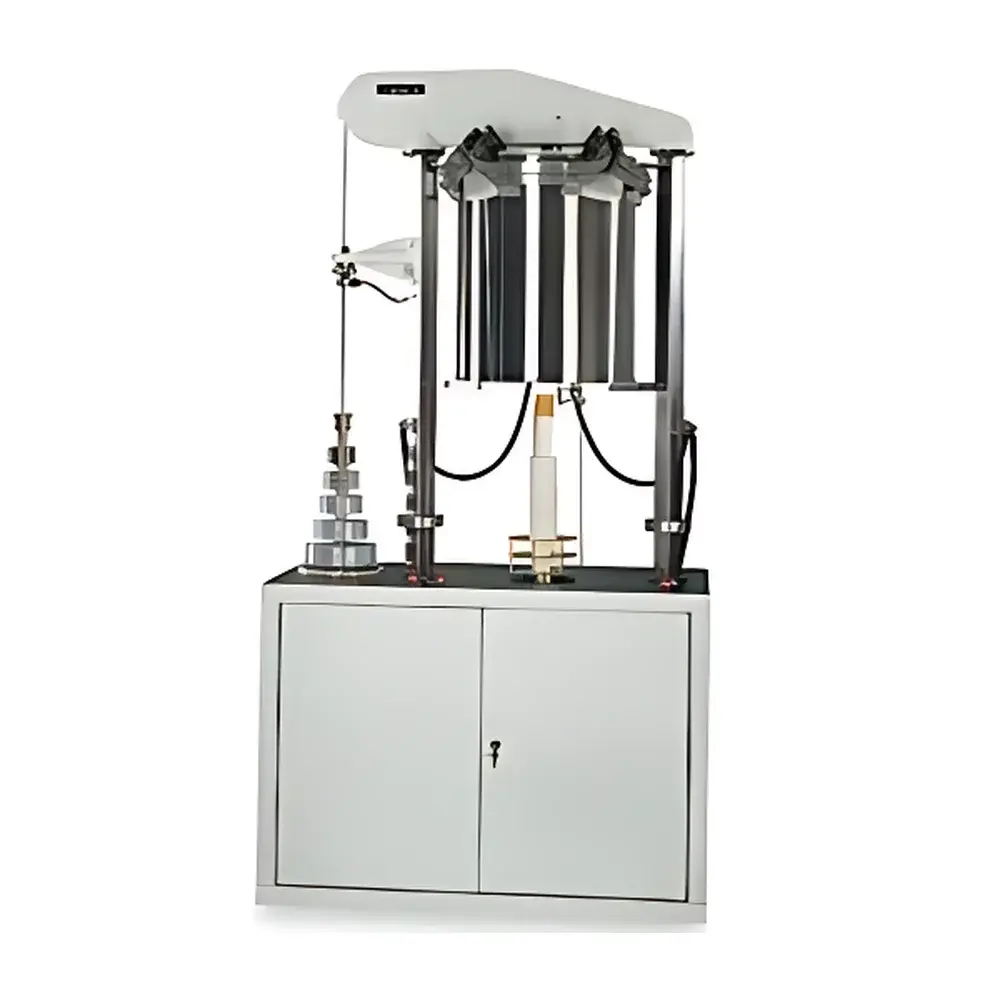
Netzsch RUL/CIC421 Refractory Testing System
| Brand | Netzsch |
|---|---|
| Origin | Germany |
| Model | RUL/CIC421 |
| Temperature Range | RT to 1600°C (standard), up to 1700°C (optional) |
| Sample Dimensions | Ø50 mm × 50 mm height |
| Deformation Measurement Range | 20 mm |
| Resolution | 5 nm |
| Load Range | 1 N to 1000 N |
| Atmosphere Options | Air or inert/protective gas (model-dependent) |
| Sample Geometry Requirement | Cylindrical specimen with coaxial 12.5 mm central bore |
| Measurement Principle | Differential displacement sensing under controlled load and temperature |
Overview
The Netzsch RUL/CIC421 Refractory Testing System is a precision-engineered, dual-mode high-temperature mechanical testing instrument designed for standardized evaluation of refractory ceramic materials under thermomechanical stress. It operates on the principle of differential displacement measurement—using high-resolution linear variable differential transformers (LVDTs) or capacitive sensors—to quantify dimensional changes in cylindrical specimens subjected to precisely controlled uniaxial compressive loads during thermal ramping (RUL mode) or extended isothermal holds (CIC mode). The system complies with internationally recognized test standards including ASTM C1322, ISO 1893, and DIN 51069 for refractoriness under load (RUL) and creep under compression (CIC). Its robust furnace architecture—featuring a counterbalanced, weight-driven loading mechanism housed within the furnace shell—ensures load stability independent of thermal expansion or sample deformation, eliminating mechanical hysteresis and enabling traceable, reproducible force application across the full temperature range.
Key Features
- Integrated dual-function design supporting both RUL (refractoriness under load) and CIC (compression creep) testing in a single platform, minimizing laboratory footprint and cross-calibration uncertainty.
- Furnace-rated operation from ambient to 1600°C as standard, with optional high-temperature configuration extending capability to 1700°C using specialized heating elements and insulation materials compliant with DIN EN 60519 safety requirements.
- High-stability mechanical loading system utilizing calibrated dead weights mounted directly on the furnace lid—eliminating servo drift, hydraulic leakage, or pneumatic fluctuation—ensuring constant nominal force throughout thermal cycling.
- Sub-5 nm displacement resolution achieved via differential sensor architecture referenced against a thermally stable internal datum, enabling detection of early-stage microstructural relaxation and sintering onset.
- Modular atmosphere control interface compatible with air, nitrogen, argon, or reducing gas mixtures; optional quartz or alumina tube liners support corrosive or reactive environments without compromising sensor integrity.
- Thermocouple integration per ASTM C71 guidelines: Type S (Pt/Pt–10%Rh) sensors positioned adjacent to specimen mid-height, with active cold-junction compensation and NIST-traceable calibration certificates available.
Sample Compatibility & Compliance
The RUL/CIC421 accepts standard cylindrical refractory specimens measuring Ø50 mm × 50 mm, featuring a mandatory coaxial 12.5 mm bore aligned perpendicular to the loading axis. This geometry ensures uniform stress distribution and enables differential measurement of axial shortening relative to a fixed reference point. The system accommodates heterogeneous compositions—including castables, bricks, monolithics, and fiber-reinforced ceramics—without requiring homogenization or sectioning. All test procedures align with GLP-compliant documentation frameworks and support 21 CFR Part 11–ready audit trails when paired with Netzsch’s ThermoSoft™ LIMS-integrated software suite. Test reports include full metadata: furnace profile, load history, ambient pressure, gas flow rates, and real-time deviation alerts—all exportable in PDF/A-1b or CSV formats for regulatory submission.
Software & Data Management
Control and analysis are executed via Netzsch ThermoSoft™ v6.x, a Windows-based platform validated for GxP environments. The software provides synchronized acquisition of displacement, temperature, load, and atmosphere parameters at user-defined sampling intervals (down to 100 ms). Automated test sequencing includes multi-step ramps, dwell periods, and conditional termination triggers (e.g., 0.6% total strain or rate-of-deformation threshold). Raw data files are stored in encrypted .tsd binary format with embedded SHA-256 checksums; processed results include derivative curves (dL/dt vs. T), inflection point detection per ASTM C1322 Annex A3, and comparative overlay of historical reference batches. Optional integration with LabVantage or STARLIMS supports automated result routing, electronic signature workflows, and long-term trend analysis across production lots.
Applications
- Quality assurance of refractory linings for steel ladles, cement kilns, and glass tank furnaces—verifying minimum softening temperatures and creep resistance at service conditions.
- R&D of next-generation oxide/non-oxide composites, where CIC data informs lifetime modeling of hot-face degradation mechanisms such as grain boundary sliding and liquid-phase migration.
- Validation of binder burnout profiles and densification kinetics during firing cycles, leveraging low-load RUL measurements to detect subtle expansion anomalies preceding structural collapse.
- Technical due diligence for refractory supplier qualification, generating data packages compliant with ISO/IEC 17025 accreditation requirements for third-party testing laboratories.
- Root-cause analysis of field failures—correlating lab-derived RUL/CIC curves with post-mortem microstructural examination (SEM-EDS, XRD) to identify phase instability or impurity-driven fluxing behavior.
FAQ
What standards does the RUL/CIC421 comply with for refractoriness under load testing?
ASTM C1322, ISO 1893, DIN 51069, and GB/T 5988 — all implemented with strict adherence to specimen geometry, heating rate, and load application protocols specified therein.
Can the system perform simultaneous RUL and CIC tests on the same specimen?
No — RUL requires continuous heating under load, while CIC mandates isothermal stabilization; however, sequential testing on identical specimens is fully supported via programmable multi-stage protocols.
Is furnace atmosphere control included as standard equipment?
Basic air-atmosphere operation is standard; inert or reducing gas capability requires optional gas manifold, mass flow controllers, and sealed furnace flange assembly — configured per customer’s process gas specifications.
How is load accuracy verified across the temperature range?
Load calibration is performed gravimetrically at ambient temperature using NIST-traceable weights; thermal drift compensation is applied algorithmically based on furnace shell expansion coefficients validated per DIN 51742.
Does the system support remote monitoring and alarm notification?
Yes — via OPC UA server interface, enabling real-time dashboard integration with plant SCADA systems and configurable SMS/email alerts for out-of-spec events (e.g., temperature deviation > ±2°C, load drop > 0.5%).



