
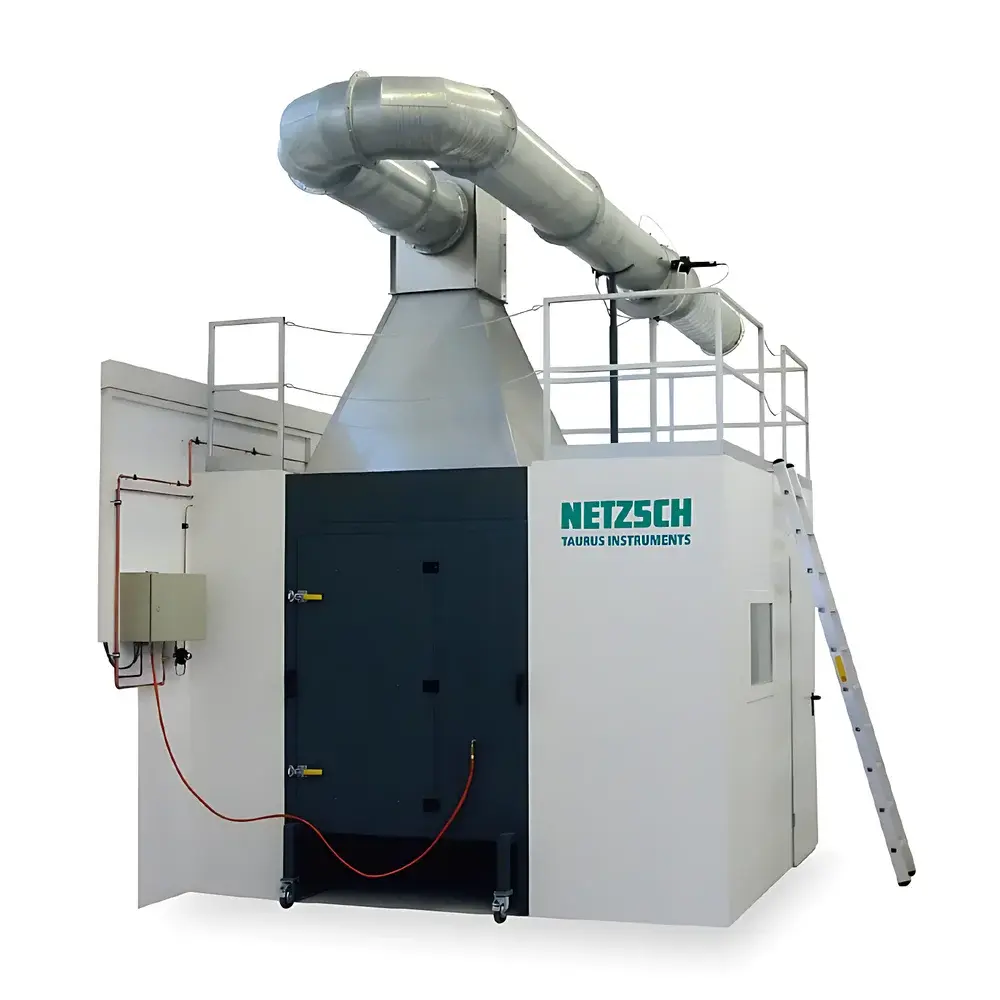
NETZSCH SBI Single Burning Item Test System
| Brand | NETZSCH |
|---|---|
| Origin | Germany |
| Model | SBI Single Burning Item Test System |
| Compliance | EN 13823, GB/T 20284, GB/T 20248 |
| Sample Configuration | Two perpendicular non-flooring building material specimens mounted on a trolley |
| Ignition Source | Sand-boxed J-type burner |
| Exhaust Duct | Ø(315 ± 5) mm |
| Mass Flow Controller Range | >0–2.1 g/s, accuracy better than ±1.5% of reading |
| Burner Switching Response Time | ≤12 s |
| Oxygen Analyzer | Paramagnetic, 16–21% (v/v), resolution 0.001% |
| CO₂ Analyzer | NDIR, 0–10% (v/v) |
| Smoke Measurement | White-light or laser-based optical density system |
| Cooling | Peltier-cooled gas conditioning unit |
| Data Acquisition | Integrated modular control and acquisition platform |
| Interface | High-resolution color touchscreen HMI |
| Gas Analysis | Siemens OEM analyzer with bidirectional communication and auto-calibration capability |
Overview
The NETZSCH SBI Single Burning Item Test System is a fully integrated, standards-compliant fire testing apparatus engineered for the quantitative assessment of the fire performance of non-flooring construction products under controlled radiant and convective exposure. Based on the principle of single-flame impingement in a defined combustion chamber, the system simulates the early growth phase of a fire involving wall claddings, insulation panels, ceiling materials, and other vertically oriented building elements. It operates in strict accordance with the internationally recognized reaction-to-fire test methodology specified in EN 13823 and its national equivalents—including GB/T 20284 and GB/T 20248—providing reproducible, auditable data on heat release rate (HRR), total heat released (THR), smoke production rate (SPR), total smoke produced (TSP), lateral flame spread, and oxygen depletion. The system’s design reflects decades of fire science research and regulatory evolution, delivering metrologically traceable outputs suitable for CE marking, CPR classification (e.g., B-s1, C-s2), and third-party certification reporting.
Key Features
- Robust stainless-steel exhaust hood and collection chamber engineered to resist corrosion from acidic combustion by-products (e.g., HCl, SO₂, NOₓ) generated during polymer or coated-material testing.
- Dual high-stability burners: primary J-type sand-boxed burner for standardized ignition and secondary auxiliary burner for thermal stabilization—both fabricated from premium-grade stainless steel for long-term dimensional and thermal integrity.
- Multi-sensor measurement train including bi-directional airflow probes, NiCr-Ni thermocouples (Class 1, ISO 4046), calibrated white-light or laser-based optical density meters, and precision-matched gas sampling manifolds.
- Integrated Peltier-cooled gas conditioning module ensures consistent sample gas temperature and dew point prior to paramagnetic O₂ and NDIR CO₂ analysis—critical for minimizing condensation-induced measurement drift.
- Siemens OEM gas analyzers featuring bidirectional Modbus TCP communication, automated zero/span calibration routines, and real-time validation of sensor health and response linearity.
- Modular PLC-based control architecture with deterministic I/O timing, enabling synchronized actuation of burner valves, damper positions, trolley movement, and data logging at 10 Hz minimum sampling rate.
- Industrial-grade 10.1″ capacitive touchscreen HMI with intuitive workflow navigation, multilingual interface support (EN/DE/FR/ZH), and configurable user access levels aligned with GLP audit requirements.
Sample Compatibility & Compliance
The SBI system accommodates rectangular specimens measuring up to 495 mm × 1,500 mm (height), mounted vertically on a motorized trolley at a 45° angle relative to horizontal. Specimens must be representative of final installed configuration—including substrate, adhesive, jointing, and surface finish—as required by EN 13823 Annex A. The system supports full compliance with EU Construction Products Regulation (CPR) Annex ZA, ASTM E2768 (for harmonized interpretation), and national adaptations such as China’s GB 8624–2012 classification framework. All critical subsystems—including mass flow controllers, thermocouple calibrations, and optical path alignment—are subject to documented annual verification per ISO/IEC 17025–compliant procedures. Traceable calibration certificates for oxygen, carbon dioxide, and smoke density channels are provided with each system delivery.
Software & Data Management
The embedded test software implements a deterministic state-machine architecture compliant with IEC 61508 SIL2 principles. It performs automatic pre-test system checks (leak integrity, gas supply pressure, thermocouple continuity), real-time validation of measurement plausibility (e.g., O₂ vs. CO₂ stoichiometric consistency), and post-test calculation of all EN 13823–defined parameters—including FIGRA (Fire Growth Rate Index), LFS (Lateral Flame Spread), and THR600s. Raw data streams (time-stamped at 100 ms intervals) are stored in HDF5 format with embedded metadata (operator ID, ambient conditions, calibration IDs). Export options include CSV, PDF test reports signed with digital certificate, and XML files structured to ETIM v9.0 for integration into enterprise LIMS or fire database platforms. Audit trail functionality records all user actions, parameter modifications, and calibration events with immutable timestamps—fully satisfying FDA 21 CFR Part 11 and ISO 17025 record-keeping requirements.
Applications
- Classification of façade systems (metal composite panels, fiber-cement boards, phenolic foams) for CPR Euroclass B–F determination.
- Development and qualification of intumescent coatings, mineral wool composites, and bio-based insulations under evolving fire safety mandates.
- Root-cause analysis of flame propagation anomalies in multi-layer assemblies subjected to corner ignition configurations.
- Supporting technical documentation for notified body submissions (e.g., UL, BRE, CNAS-accredited labs) and insurance risk assessments.
- Research into fire dynamics of emerging materials—including recycled polymers, nanocomposites, and hybrid laminates—under standardized intermediate-scale exposure.
FAQ
What specimen dimensions and mounting configurations are supported?
Standard specimens measure 495 mm wide × 1,500 mm tall, mounted at 45° on the motorized trolley; custom fixtures accommodate edge-sealed or mechanically fastened configurations per EN 13823 Annex A.
Does the system support automated calibration verification between tests?
Yes—the software initiates a full gas calibration sequence using certified reference gases prior to each test series, logging results with digital signatures and pass/fail status.
Can raw thermocouple and gas concentration data be exported for third-party reanalysis?
All time-series sensor data (including unfiltered analog inputs) is archived in open HDF5 format with SI-unit metadata, enabling independent post-processing in MATLAB, Python, or specialized fire modeling tools.
Is remote monitoring and diagnostic support available?
The system includes embedded Ethernet connectivity with optional VPN-enabled remote access for firmware updates, log retrieval, and collaborative troubleshooting via NETZSCH’s Service Cloud platform.
How is system compliance with ISO/IEC 17025 maintained over its operational lifetime?
Annual metrological verification packages—including flowmeter recalibration, thermocouple drift assessment, and optical path transmittance mapping—are offered through NETZSCH’s accredited service network with full traceability to PTB and NIST standards.



