
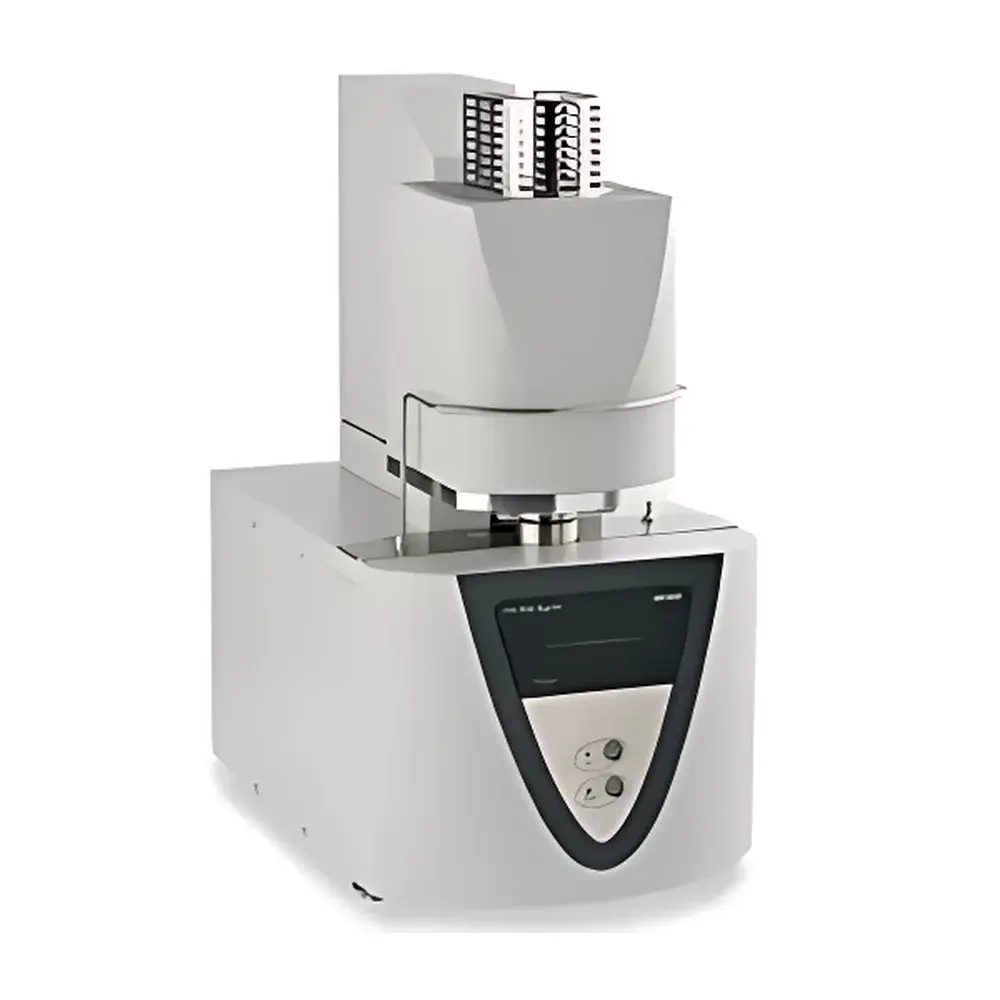
Netzsch STA 2500 Regulus Simultaneous Thermal Analyzer
| Brand | Netzsch |
|---|---|
| Origin | Germany |
| Model | STA 2500 Regulus |
| Heating Rate | 0–100 °C/min |
| Temperature Range | RT to 1100 °C (standard furnace) / RT to 1600 °C (high-temperature furnace) |
| Temperature Stability | ±0.3 K |
| Maximum Sample Mass | 250 mg |
| Atmosphere Options | Oxidizing, Reducing, Inert, Vacuum (dynamic or static) |
| Gas Control | Integrated Mass Flow Controllers (MFCs), software-regulated |
Overview
The Netzsch STA 2500 Regulus is a high-precision simultaneous thermal analyzer engineered for concurrent measurement of thermal transitions and mass changes under rigorously controlled temperature programs. Based on the principle of coupled differential scanning calorimetry (DSC) and thermogravimetric analysis (TGA), the instrument records heat flow (µW) and sample mass (µg) in real time using a single sensor platform and identical thermal history—eliminating inter-test variability inherent in sequential measurements. Its dual-signal architecture ensures strict correlation between enthalpic events (e.g., melting, crystallization, glass transition, decomposition onset) and associated mass-loss steps (e.g., dehydration, polymer degradation, carbonate decomposition), enabling unambiguous mechanistic interpretation of complex thermal behavior. Designed and manufactured in Selb, Germany, the STA 2500 Regulus adheres to ISO/IEC 17025-aligned production protocols and integrates hardware-level traceability for calibration standards (e.g., high-purity indium, nickel, and alumina).
Key Features
- Top-loading microbalance design with active buoyancy compensation and convection-dampened suspension—minimizes artifacts from gas density gradients and thermal currents during dynamic heating.
- Dual-furnace configuration: interchangeable high-stability alumina furnace (RT–1100 °C) and silicon carbide furnace (RT–1600 °C), both featuring optimized radial symmetry and rapid thermal homogeneity (<±0.5 K across 5 mm diameter zone).
- Integrated mass flow controllers (MFCs) for up to three independent gas lines (e.g., N₂, O₂, Ar, He, synthetic air), programmable via software for stepwise, ramped, or isothermal gas switching with timestamped logging compliant with 21 CFR Part 11 audit trail requirements.
- Modular coupling interface compatible with FTIR, quadrupole mass spectrometry (QMS), and GC-MS systems—enabling evolved gas analysis (EGA) with sub-second temporal resolution and spectral correlation to TGA/DSC events.
- Patented balance protection system: inert gas curtain and cold trap geometry prevent condensate deposition and particulate contamination of the microbalance head during long-duration or high-mass-loss experiments.
Sample Compatibility & Compliance
The STA 2500 Regulus accommodates solid, powdered, granular, and thin-film samples in standard ceramic, platinum, or aluminum oxide crucibles (30–100 µL volume). It supports compliance-critical workflows per ASTM E1131 (TGA), ASTM E1269 (heat capacity), ISO 11358 (polymer degradation kinetics), and USP (thermal stability of pharmaceutical excipients). All firmware and data acquisition modules are validated for GLP and GMP environments, including electronic signature support, user access levels (admin/operator/auditor), and immutable raw-data archiving. Instrument qualification documentation (IQ/OQ/PQ templates) is provided per EU Annex 15 and FDA guidance.
Software & Data Management
Proteus® Software v9.x provides full instrument control, real-time signal visualization, and advanced post-processing—including kinetic modeling (Friedman, Ozawa-Flynn-Wall), derivative thermogravimetry (DTG), peak deconvolution, and multi-curve comparison. Data export formats include ASCII, CSV, and universal .tdf (Thermal Data Format) for third-party integration with MATLAB®, Python (SciPy), or LIMS platforms. All measurement files embed metadata (operator ID, calibration certificate IDs, gas flow logs, furnace history), satisfying ALCOA+ principles (Attributable, Legible, Contemporaneous, Original, Accurate, Complete, Consistent, Enduring, Available).
Applications
- Polymers & Composites: Quantification of filler content, char yield, oxidative induction time (OIT), and multi-step degradation mechanisms in engineering thermoplastics and carbon-fiber composites.
- Pharmaceuticals: Solid-state stability screening, hydrate/solvate desolvation profiling, and compatibility assessment in drug-excipient blends per ICH Q1E guidelines.
- Ceramics & Refractories: Sintering onset, phase transformation enthalpies (e.g., α→β quartz), and binder burnout kinetics in green-body processing.
- Battery Materials: Cathode/anode thermal runaway thresholds, SEI layer formation enthalpy, and electrolyte decomposition pathways under N₂/Ar/O₂ atmospheres.
- Geochemical & Cementitious Systems: Decomposition of carbonates, clay dehydroxylation, and pozzolanic reactivity quantification in blended cements.
FAQ
What temperature calibration standards are supplied with the STA 2500 Regulus?
Certified reference materials (indium, zinc, tin, silver, nickel, and α-alumina) are included with initial delivery, each traceable to NIST or PTB standards with individual CoA.
Can the instrument operate under vacuum without external pumping equipment?
Yes—the integrated turbomolecular pump achieves base pressure <1 × 10⁻⁵ mbar; ultimate vacuum performance is verified per ISO 20482 and logged automatically during system startup.
Is remote diagnostics supported for troubleshooting?
All instruments ship with secure TLS-encrypted remote access capability (via Netzsch Remote Service Portal), authorized only upon customer-configured role-based permissions and session time limits.
How is buoyancy correction applied during high-temperature TGA runs?
Proteus® applies real-time, density-weighted buoyancy compensation using user-defined gas composition, furnace temperature profile, and crucible geometry—validated against ASTM E1970.
Does the system meet requirements for regulatory submissions (e.g., FDA, EMA)?
Yes—full 21 CFR Part 11 and Annex 11 compliance is achieved through configurable audit trails, electronic signatures, data integrity controls, and vendor-supplied validation documentation packages.



