
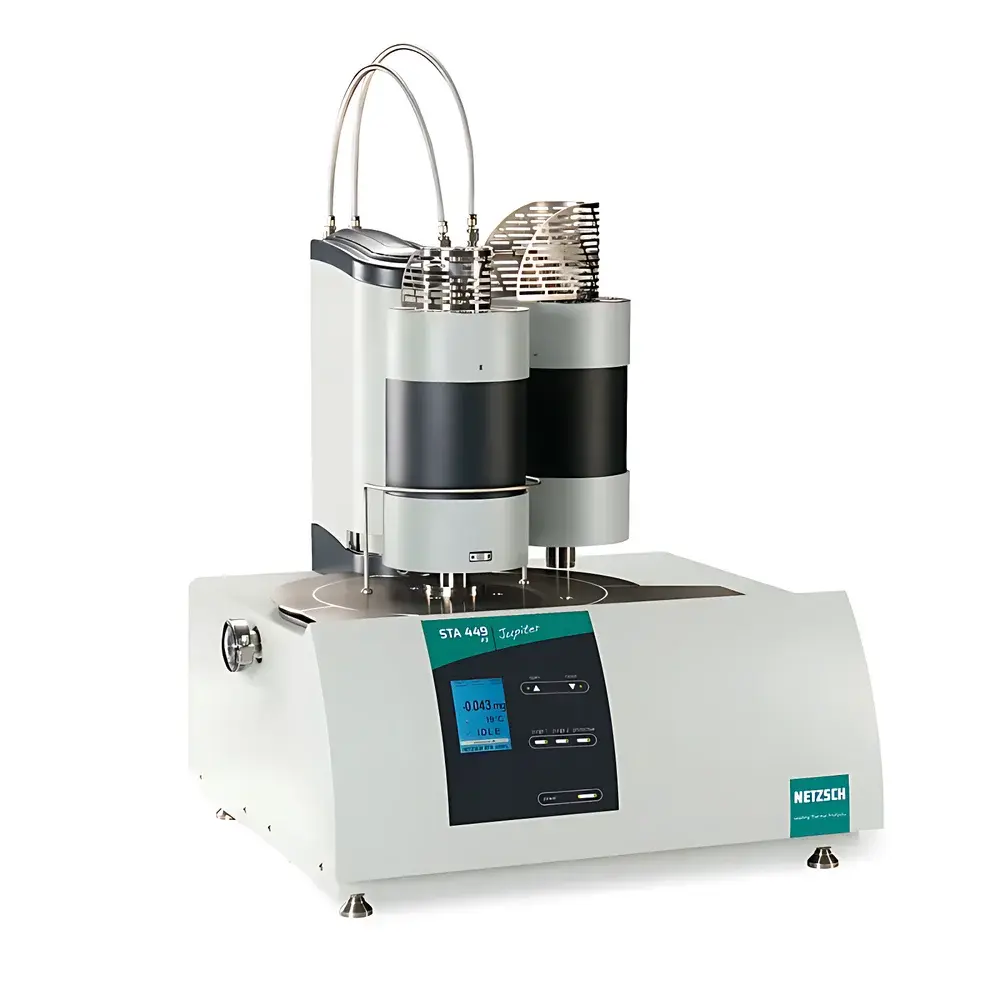
Netzsch STA 449 F3 Jupiter Simultaneous Thermal Analyzer
| Brand | Netzsch |
|---|---|
| Origin | Germany |
| Model | STA 449 F3 Jupiter |
| Temperature Range | −150 to 2400 °C |
| Heating Rate | 0–50 °C/min (standard) |
| Temperature Stability | ±0.3 K |
| Maximum Sample Mass | 35 g |
| Balance Resolution | 0.1 µg |
| Vacuum Level | 10⁻⁴ mbar |
| Atmosphere Options | Oxidizing, Reducing, Inert, Vacuum |
| Optional Modules | TMDSC, Tau-R® Cp Calibration, BeFlat® Baseline Optimization, ASC Auto-sampler (20 positions), Coupling to FTIR/MS/GC-MS, Steam Furnace, Corrosive Gas Kit |
Overview
The Netzsch STA 449 F3 Jupiter is a high-performance simultaneous thermal analyzer engineered for precision measurement of thermal transitions and mass changes under controlled atmospheric and temperature conditions. It integrates thermogravimetric analysis (TGA) and differential scanning calorimetry (DSC) or differential thermal analysis (DTA) in a single, coaxially aligned sensor system—ensuring identical thermal history and spatial positioning for both signals. This architecture eliminates inter-sensor discrepancies common in sequential or hybrid systems, delivering intrinsically correlated mass loss and heat flow data with exceptional time synchronization (<10 ms lag). Designed for research laboratories and industrial QC environments requiring traceable, reproducible thermal characterization, the STA 449 F3 operates across an industry-leading temperature range—from cryogenic conditions (−150 °C) to ultra-high temperatures (2400 °C)—enabled by interchangeable, application-optimized furnace modules including standard, fast-heating, steam, and corrosion-resistant variants.
Key Features
- Sub-microgram resolution Sartorius microbalance (0.1 µg) with active electronic temperature stabilization of the balance chamber, minimizing thermal drift and enhancing long-term baseline stability.
- Vacuum-tight, double-walled furnace design with integrated gas purging and pressure control, supporting operation under inert, oxidizing, reducing, or high-vacuum (down to 10⁻⁴ mbar) atmospheres.
- Modular furnace exchange system enabling rapid switching between up to two pre-configured furnaces—e.g., one optimized for low-T polymer characterization and another for high-T ceramic sintering—without recalibration.
- Expandable coupling interface for real-time evolved gas analysis (EGA) via FTIR, quadrupole mass spectrometry (QMS), or gas chromatography–mass spectrometry (GC-MS), facilitating mechanistic interpretation of decomposition pathways.
- Optional advanced functionality: Temperature-modulated DSC (TMDSC) for separation of reversing and non-reversing heat flows; Tau-R® calibration protocol for absolute specific heat capacity (Cp) determination; BeFlat® intelligent baseline correction for improved signal-to-noise in complex multi-step transitions.
Sample Compatibility & Compliance
The STA 449 F3 accommodates solid, powder, fiber, thin-film, and pelletized samples up to 35 g, with crucible options spanning alumina, platinum, gold, graphite, and silicon carbide—each selected for chemical compatibility, thermal inertia, and signal fidelity across defined atmosphere classes. Its hardware and firmware architecture comply with ISO 11357 (Plastics – DSC), ISO 11358 (Plastics – TGA), ASTM E1131 (Standard Test Method for Compositional Analysis by TGA), and USP for method verification. When configured with audit-trail-enabled software and electronic signature support, the system meets FDA 21 CFR Part 11 requirements for regulated environments operating under GLP or GMP frameworks.
Software & Data Management
Proteus® Software Suite provides full instrument control, real-time data acquisition, and post-processing workflows—including peak deconvolution, kinetic modeling (e.g., Friedman, Ozawa-Flynn-Wall), Cp calculation, and multi-curve comparative analysis. Raw data files are stored in vendor-neutral ASCII format with embedded metadata (timestamp, operator ID, furnace ID, gas flow rates, calibration constants), ensuring long-term archival integrity and third-party interoperability. Export modules support direct integration into LIMS platforms and statistical process control (SPC) dashboards. All software updates undergo rigorous version-controlled validation per ICH Q9/Q10 principles.
Applications
The STA 449 F3 delivers quantitative insight across diverse domains: polymer science (melting enthalpy, crystallinity, glass transition, crosslink density); pharmaceutical development (polymorph screening, desolvation kinetics, excipient compatibility); battery materials (SEI layer formation, cathode thermal runaway onset, electrolyte decomposition); metallurgy (phase transformation temperatures, eutectic behavior, oxidation kinetics); and ceramics (sintering profiles, binder burnout, thermal expansion anomalies). Its ability to resolve overlapping events—such as concurrent dehydration and polymorphic conversion—makes it indispensable for failure analysis and formulation optimization where thermal event attribution is critical.
FAQ
What furnace configurations are available for the STA 449 F3 Jupiter?
Standard, fast-heating (0–1000 °C/min), steam, and corrosion-resistant furnaces are offered, each certified for specified temperature ranges and atmosphere compatibility.
Can the system perform absolute specific heat capacity (Cp) measurements?
Yes—when equipped with the optional Tau-R® calibration module and appropriate reference standards (e.g., sapphire), the system achieves traceable Cp determination per ISO 11357-4.
Is automated sample handling supported?
An ASC auto-sampler with 20-position capacity is available, enabling unattended overnight runs with programmable crucible selection and purge gas sequencing.
How is data integrity ensured during regulatory audits?
Proteus® supports role-based access control, electronic signatures, full audit trails (including parameter changes and manual interventions), and 21 CFR Part 11-compliant electronic records when deployed with validated IT infrastructure.
What evolved gas analysis interfaces are compatible?
Dedicated transfer lines and pressure-matched coupling kits are provided for seamless integration with FTIR, QMS, and GC-MS systems from major vendors, including real-time spectral correlation to mass loss steps.



