
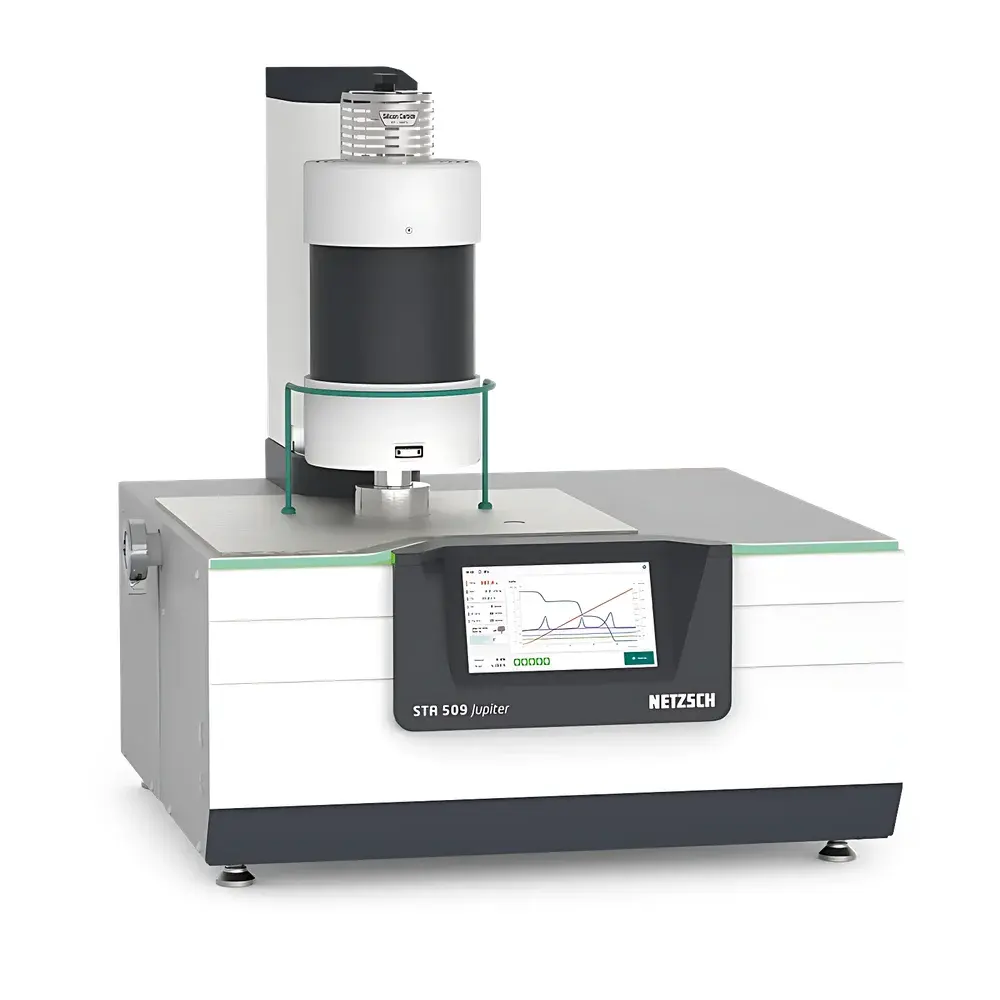
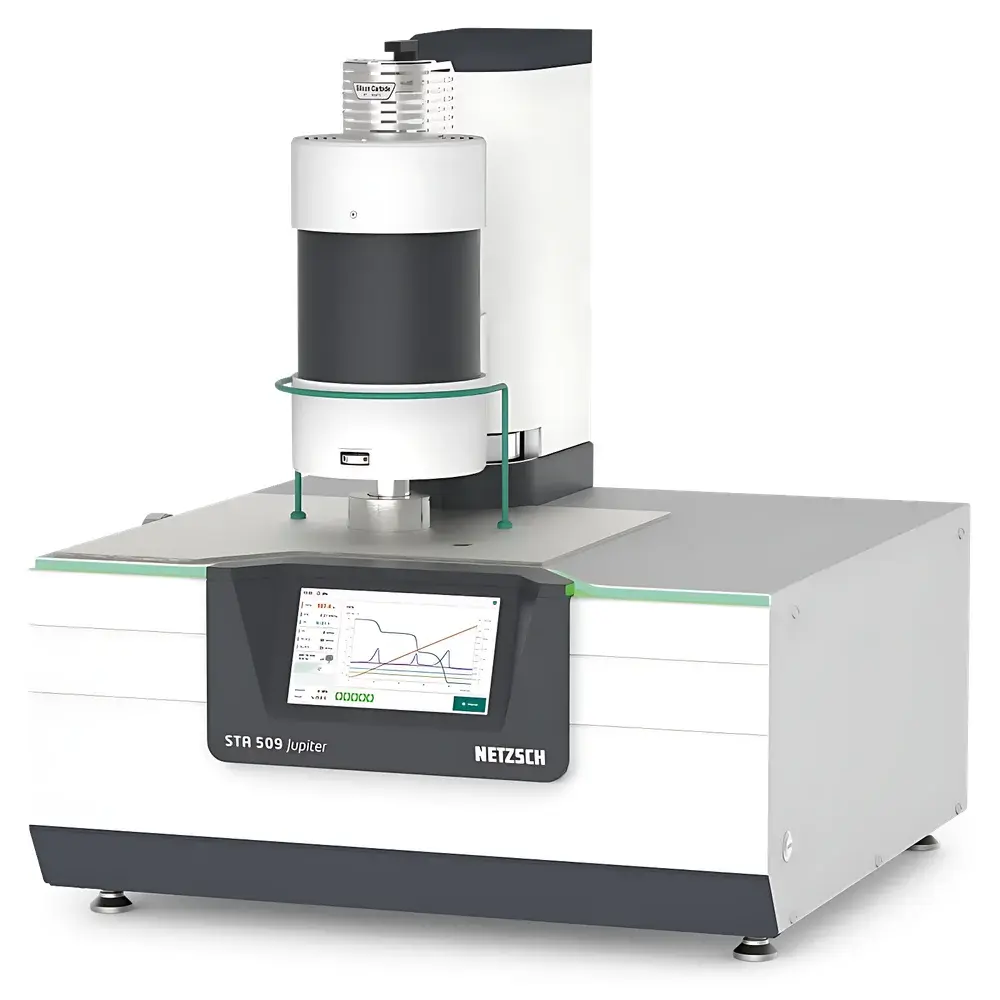
Netzsch STA 509 Jupiter Classic Simultaneous Thermal Analyzer
| Brand | Netzsch |
|---|---|
| Origin | Germany |
| Model | STA 509 Jupiter Classic |
| Temperature Range | RT to 1600 °C |
| Heating Rate | 0.001–50 °C/min |
| Max Sample Mass | 35 g |
| Atmosphere Options | Inert, Oxidizing, Static, Dynamic, Vacuum, Corrosive (optional) |
Overview
The Netzsch STA 509 Jupiter Classic is a high-precision simultaneous thermal analyzer engineered for concurrent thermogravimetric analysis (TGA) and differential scanning calorimetry (DSC) or differential thermal analysis (DTA). Based on the proven dual-sensor microbalance and symmetric furnace architecture, it delivers exceptional mass resolution (<0.1 µg) and thermal sensitivity under controlled atmospheric conditions—from ambient to 1600 °C. Its modular design supports rigorous compliance with ISO 11358, ASTM E1131, ASTM E1269, and USP for quantitative thermal characterization in R&D, quality control, and regulatory submissions. The instrument operates on the principle of measuring real-time mass change (TGA) alongside heat flow differences (DSC/DTA) within a single sample run—enabling direct correlation of decomposition events, phase transitions, oxidation onset, and enthalpic effects without inter-run variability.
Key Features
- Symmetric dual-furnace geometry ensuring high thermal homogeneity and baseline stability across the full temperature range (RT to 1600 °C)
- High-resolution microbalance with active buoyancy correction and automatic zero-point calibration
- Programmable heating rates from 0.001 to 50 °C/min, supporting both conventional and modulated temperature protocols
- Integrated c_DTA® functionality enabling simultaneous DTA signal acquisition during TGA measurement for precise temperature calibration and exo/endothermic event identification
- Super-Res® algorithm for automated deconvolution of overlapping mass-loss steps and dynamic rate control to enhance resolution of closely spaced decomposition events
- BeFlat® software module (optional) for intelligent DSC baseline optimization using multi-point curvature correction
- TM-DSC (Temperature-Modulated DSC) capability (optional) for separation of reversing and non-reversing heat flow components in complex transitions such as glass relaxation or cold crystallization
Sample Compatibility & Compliance
The STA 509 Jupiter Classic accommodates diverse sample forms—including powders, fibers, films, granules, and bulk solids—within a maximum capacity of 35 g. A comprehensive crucible portfolio (Al, Pt, Al2O3, ZrO2, graphite, stainless steel, Au, Ag, Cu) ensures chemical compatibility with aggressive, reducing, or corrosive matrices. Optional corrosion-resistant gas handling modules—including isolated mass-flow controllers, chemically inert sample carriers, and protected thermocouple configurations—enable safe operation under H2, HCl, SO2, or NH3 atmospheres. For radiological or air-sensitive samples, integration with gloveboxes or hot cells is supported via extended feedthroughs and remote electronics housing. All configurations adhere to IEC 61000-6-3 (EMC) and CE safety directives; data integrity meets FDA 21 CFR Part 11 requirements when used with certified TA-Control software and audit-trail-enabled workflows.
Software & Data Management
Control and analysis are performed via NETZSCH’s proprietary Proteus® software suite, compliant with GLP/GMP environments. Proteus provides full instrument control, real-time visualization, and post-run evaluation including automatic peak detection (onset, peak, endset), enthalpy integration with customizable baselines (tangent, linear, spline), residual mass quantification, DTG curve generation, and derivative analysis. Advanced modules support ASTM-compliant crystallinity calculation (e.g., for polymeric systems), specific heat capacity determination (with optional calibration kit), and kinetic modeling (e.g., Friedman, Ozawa-Flynn-Wall). Data export formats include ASCII, CSV, and universal .tdms for third-party statistical or AI-driven analytics platforms. Audit trails, user access levels, electronic signatures, and secure database archiving are fully configurable.
Applications
- Decomposition kinetics and thermal stability assessment of ceramics, battery cathode materials, and refractory composites
- Quantification of filler content, polymer degradation pathways, and moisture/volatile loss in pharmaceutical excipients
- Glass transition (Tg) and cold crystallization analysis in amorphous APIs and biopolymers
- Oxidation onset temperature (OOT) and activation energy determination for metal alloys and catalysts
- Char yield prediction and ash composition profiling in coal, biomass, and waste-derived fuels
- Reaction enthalpy validation for curing processes in thermosetting resins and adhesives
FAQ
What atmosphere options are supported without hardware modification?
Standard configurations support inert (N2, Ar), oxidizing (air, O2), static, and dynamic gas modes. Vacuum operation requires optional vacuum pump interface.
Is the STA 509 compatible with regulated pharmaceutical development?
Yes—when deployed with Proteus® in validated mode, it supports 21 CFR Part 11 compliance, including role-based access, electronic signatures, and immutable audit trails for GMP documentation.
Can the system perform quantitative residue analysis after high-temperature ashing?
Yes—the integrated microbalance enables precise residual mass reporting in % or mg, traceable to NIST-certified reference standards.
What is the minimum detectable mass change under standard conditions?
Typical mass resolution is ≤0.1 µg at ambient conditions, degrading predictably with temperature due to convection effects; actual performance depends on crucible type, purge gas flow, and thermal history.
Are there accessories available for humidity-controlled thermal analysis?
While the base system does not include humidity control, custom water vapor generators and sealed humidity chambers can be integrated via third-party OEM partnerships and require mechanical and software co-validation.



