
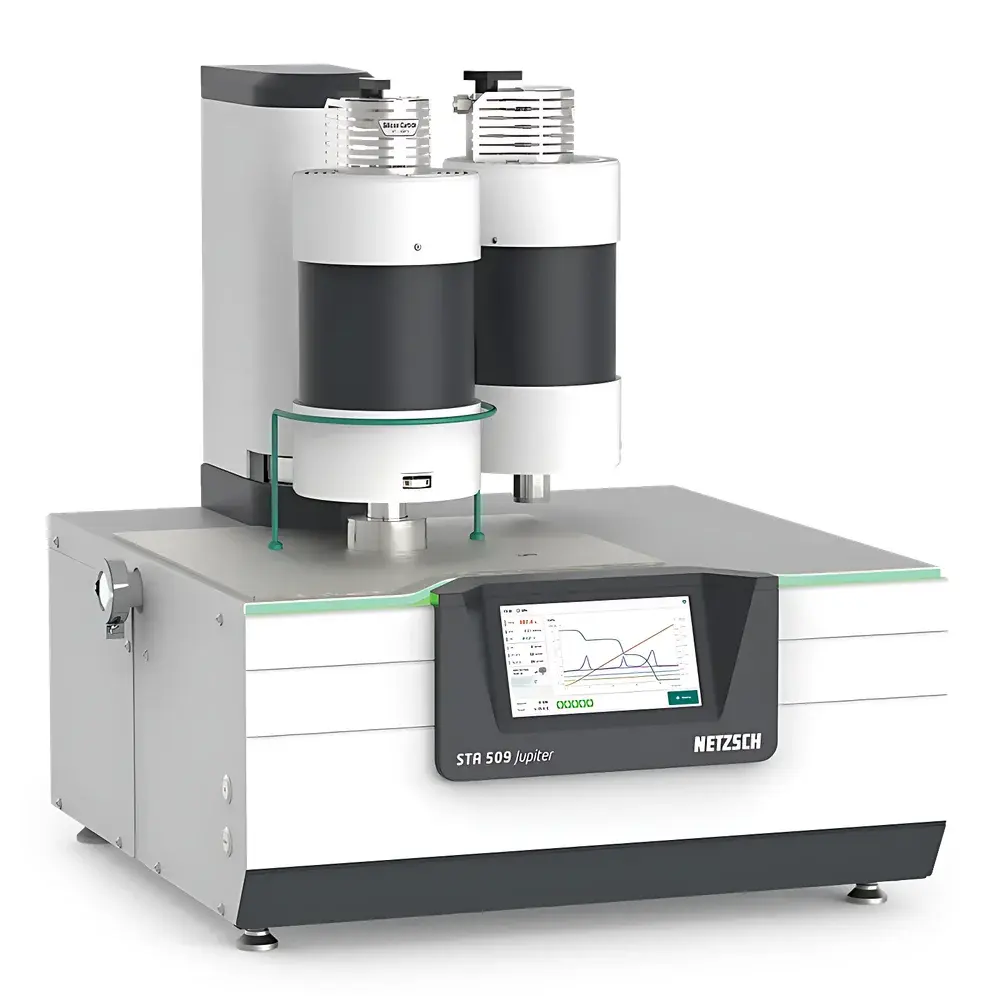
Netzsch STA 509 Jupiter Supreme Simultaneous Thermal Analyzer
| Brand | Netzsch |
|---|---|
| Origin | Germany |
| Model | STA 509 Jupiter Supreme |
| Temperature Range | –150 °C to 2000 °C |
| Maximum Sample Mass | 5 g |
| Atmosphere Options | Inert, Oxidizing, Static, Dynamic, Vacuum, Corrosive (optional) |
Overview
The Netzsch STA 509 Jupiter Supreme is a high-performance simultaneous thermal analyzer engineered for precision-coupled measurement of mass change (thermogravimetry, TGA) and heat flow (differential scanning calorimetry, DSC or differential thermal analysis, DTA) under controlled atmospheric conditions. Based on the principle of concurrent microbalance and thermocouple-based heat flux detection within a single furnace chamber, the instrument delivers synchronized, high-fidelity thermal data across an exceptional temperature range—from cryogenic –150 °C up to ultra-high 2000 °C—enabling comprehensive characterization of decomposition kinetics, phase transitions, oxidative stability, and compositional evolution in advanced materials. Its modular architecture supports application-specific configurations including high-vacuum operation, corrosive gas handling, and oxygen-trapped environments, making it suitable for R&D laboratories and quality control facilities operating under ISO/IEC 17025, ASTM E1131, ASTM E1641, and USP thermal analysis guidelines.
Key Features
- Simultaneous acquisition of TGA and DSC/DTA signals with sub-milligram mass resolution and ±0.1 °C temperature accuracy
- Expandable temperature range via interchangeable furnace modules: low-temperature cryo-furnace (–150 °C), standard quartz furnace (up to 1100 °C), high-temperature SiC furnace (up to 1600 °C), and ultra-high-temperature graphite furnace (up to 2000 °C)
- Integrated c_DTA® functionality enabling real-time DTA signal generation during TGA runs for independent temperature calibration and anomaly detection
- Super-Res® algorithm for automated separation of overlapping weight-loss steps and dynamic rate control during thermal decomposition
- BeFlat® baseline optimization software module for enhanced DSC baseline stability and reproducibility across extended temperature ramps
- TM-DSC (Temperature-Modulated DSC) and advanced DSC calibration packages (including enthalpy and temperature standards traceable to NIST) available as factory-installed options
- Corrosion-resistant gas handling system with external gas box, chemically inert sample holder, and shielded thermocouples for operation in H₂, H₂S, Cl₂, HF, or other aggressive atmospheres
Sample Compatibility & Compliance
The STA 509 Jupiter Supreme accommodates diverse sample forms—including powders, fibers, films, granules, and bulk solids—within a maximum mass limit of 5 g. A broad portfolio of crucibles (Al, Ag, Au, Cu, Pt, Al₂O₃, ZrO₂, graphite, stainless steel) ensures compatibility with reactive, volatile, or high-temperature-stable materials. Optional OTS™ (Oxygen Trap System) minimizes ambient oxygen ingress during high-temperature oxidation studies, while glovebox- and hot-cell-integrated configurations support radiological or air-sensitive sample handling. The system complies with GLP and GMP documentation requirements when paired with NETZSCH Proteus® Software equipped with 21 CFR Part 11-compliant audit trail, electronic signatures, and user-access-level management.
Software & Data Management
Proteus® Software serves as the unified platform for instrument control, real-time data acquisition, and post-run evaluation. It provides automated peak identification (onset, peak, inflection, endset), multi-baseline selection for enthalpy integration, partial area analysis, glass transition quantification (Tg, ΔCp, step height), and crystallinity calculation via melting enthalpy normalization. Data export supports ASTM E1461-compliant formats (.txt, .csv, .xls) and proprietary .ASC files for long-term archival. Batch processing, report templating, and customizable metadata tagging streamline compliance with internal SOPs and external regulatory submissions.
Applications
- Thermal stability and decomposition mechanism analysis of polymers, composites, and battery cathode/anode materials
- Quantification of filler content, moisture, solvent residue, and volatiles in pharmaceutical excipients and APIs
- Oxidation onset temperature (OOT) and kinetic modeling (e.g., Kissinger, Ozawa-Flynn-Wall) for aerospace alloys and refractory ceramics
- Hydration/dehydration behavior of zeolites, MOFs, and cementitious systems
- Phase diagram validation and eutectic point determination in metallurgical and geochemical samples
- Reaction enthalpy and stoichiometry assessment in catalytic and solid-state synthesis processes
FAQ
What is the maximum operating temperature with standard configuration?
The base system includes a quartz furnace rated to 1100 °C; higher ranges require optional furnace modules (SiC: 1600 °C; graphite: 2000 °C).
Can the STA 509 perform isothermal TGA or DSC holds?
Yes—Proteus® supports multi-step temperature programs including isothermal segments with user-defined duration and stabilization criteria.
Is vacuum operation supported out-of-the-box?
Vacuum capability (down to 10–5 mbar) is standard; optional turbomolecular pump integration enables high-vacuum applications.
How is calibration traceability maintained?
All calibration kits (In, Zn, Sn, Al, Cu, Ni, KCl) are NIST-traceable; factory calibration certificates include uncertainty budgets per ISO/IEC 17025.
Does the system support automated sample loading?
Yes—the ASC (Automatic Sample Changer) option enables unattended sequential analysis of up to 24 samples with integrated purge gas switching and thermal equilibration logic.



