
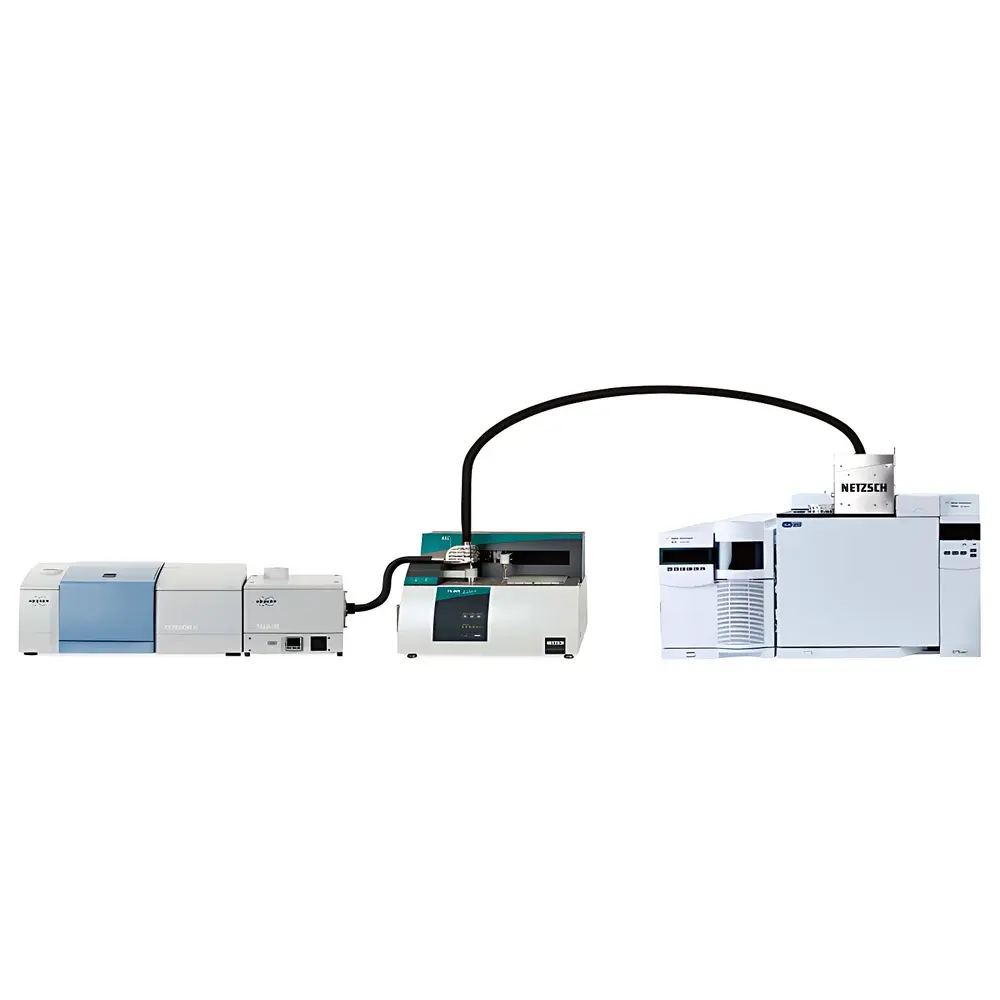
Netzsch STA/TG-FTIR-GC-MS Hyphenated Thermal Analysis System
| Brand | Netzsch |
|---|---|
| Origin | Germany |
| Model | STA/TG-FTIR-GC-MS |
| Operating Temperature Range | RT to 350 °C |
| Gas Transfer Path | Heated (up to 350 °C) |
| Coupling Architecture | Parallel FTIR and GC-MS interfaces |
| Sample Introduction | Top-loading vertical TGA configuration |
| Trigger Mode | Event-driven hardware synchronization |
| Software | Fully integrated, real-time synchronized control platform |
| Compliance Support | ASTM E1131, ISO 11358, USP <621>, GLP-compliant audit trail capability |
Overview
The Netzsch STA/TG-FTIR-GC-MS Hyphenated Thermal Analysis System is an advanced multi-modal analytical platform engineered for comprehensive evolved gas analysis (EGA) during thermal decomposition, oxidation, reduction, and pyrolysis processes. It integrates a simultaneous thermal analyzer (STA), Fourier-transform infrared spectrometer (FTIR), and gas chromatography–mass spectrometry (GC-MS) in a parallel hyphenated architecture—enabling concurrent, time-resolved identification and quantification of volatile and semi-volatile species released from solid or liquid samples under controlled thermal programs. Unlike serial coupling approaches, this system employs independent, thermally insulated gas pathways to FTIR and GC-MS detectors, eliminating cross-interference and preserving spectral fidelity and chromatographic resolution. The vertical top-loading thermobalance design minimizes gas residence time and prevents condensation-induced analyte loss, while the fully heated transfer line (up to 350 °C) ensures quantitative transport of high-boiling-point compounds—including aldehydes, lactones, siloxanes, and organometallic fragments—without wall adsorption or phase separation.
Key Features
- Parallel hyphenation architecture: Simultaneous, non-interfering coupling of STA with both FTIR and GC-MS—each receiving undiluted, temperature-stabilized effluent via dedicated heated capillaries.
- Top-loading vertical TGA module: Eliminates gravitational sample displacement and ensures reproducible gas evolution kinetics; optimized for powders, polymers, composites, catalysts, and pharmaceutical formulations.
- Heated gas transfer path (RT–350 °C): Maintains effluent in vapor phase throughout transit—critical for accurate detection of polar, thermally labile, or high-molecular-weight volatiles.
- Event-driven hardware synchronization: Precise trigger logic coordinates thermal ramp initiation, gas valve actuation, detector acquisition start, and data timestamp alignment across all subsystems—enabling sub-second temporal correlation between mass loss events and spectral/chromatographic peaks.
- Fully integrated software suite: Single GUI for method definition, real-time monitoring, automated peak deconvolution, library matching (NIST, SDBS, polymer additive databases), and multi-instrument report generation compliant with 21 CFR Part 11 requirements.
- Modular flexibility: FTIR and GC-MS units operate independently for routine screening; full hyphenation is activated only when required—maximizing instrument uptime and operational efficiency.
Sample Compatibility & Compliance
The system accommodates diverse sample forms including pellets, films, fibers, granules, and slurries (with appropriate crucible selection). It supports standard crucible materials (alumina, platinum, gold-plated) and optional reactive atmospheres (N₂, O₂, Ar, synthetic air, CO/CO₂ mixtures) with flow control down to ±0.1 mL/min. Method development adheres to ASTM E1131 (standard test method for determining composition by thermogravimetric analysis), ISO 11358 (polymer thermal degradation characterization), and USP <621> (chromatography validation principles). Data integrity is maintained through electronic signatures, user-level access controls, and audit-trail-enabled software meeting GLP and GMP documentation standards.
Software & Data Management
The proprietary Proteus® software provides unified control, real-time overlay of TG/DTA, FTIR absorbance spectra (4000–400 cm⁻¹, 4 cm⁻¹ resolution), and GC-MS total ion chromatograms (TIC) with extracted ion traces. Advanced algorithms perform dynamic background subtraction, atmospheric compensation, and spectral unmixing for overlapping gas-phase bands. All raw and processed data are stored in vendor-neutral HDF5 format, supporting third-party import into MATLAB, Python (SciPy/Pandas), or LIMS environments. Automated report templates include ISO/IEC 17025-compliant metadata fields—sample ID, operator, calibration history, uncertainty estimates, and instrument verification logs.
Applications
- Decomposition mechanism elucidation in battery cathode precursors (e.g., LiNi₀.₈Co₀.₁₅Al₀.₀₅O₂) under inert and oxidative conditions.
- Quantification of residual solvents (DMF, NMP, THF) in API intermediates per ICH Q3C guidelines.
- Identification of combustion byproducts from flame-retardant polymers (e.g., brominated epoxy resins) for regulatory toxicology assessment.
- In-situ monitoring of metal-organic framework (MOF) ligand cleavage and framework collapse temperatures.
- Gas-phase reaction intermediates in catalytic cracking studies using supported zeolites or transition metal oxides.
- Thermal stability profiling of biodegradable packaging films (PLA, PHA) under simulated composting conditions.
FAQ
What is the maximum recommended operating temperature for the gas transfer line?
The heated transfer line is rated for continuous operation up to 350 °C, ensuring complete volatilization of compounds with boiling points below 300 °C.
Can the FTIR and GC-MS modules be used independently of the thermal analyzer?
Yes—both instruments retain full standalone functionality with native vendor software; hyphenation is activated only during coupled experiments.
Is the system compatible with regulated environments requiring 21 CFR Part 11 compliance?
Yes—the Proteus® software includes electronic signature workflows, role-based permissions, and immutable audit trails validated for pharmaceutical and contract research laboratory use.
How is baseline drift minimized during long-duration EGA experiments?
Real-time reference beam correction in FTIR, combined with dynamic background subtraction synchronized to mass-loss rate (dm/dt), suppresses thermal-emission artifacts and flow-induced fluctuations.
What sample throughput can be expected in routine evolved gas screening mode?
Typical cycle time—including 10 °C/min ramp to 600 °C, 30-min isothermal hold, and full-spectrum FTIR/GC-MS acquisition—is approximately 90 minutes per sample, scalable via autosampler integration.



