
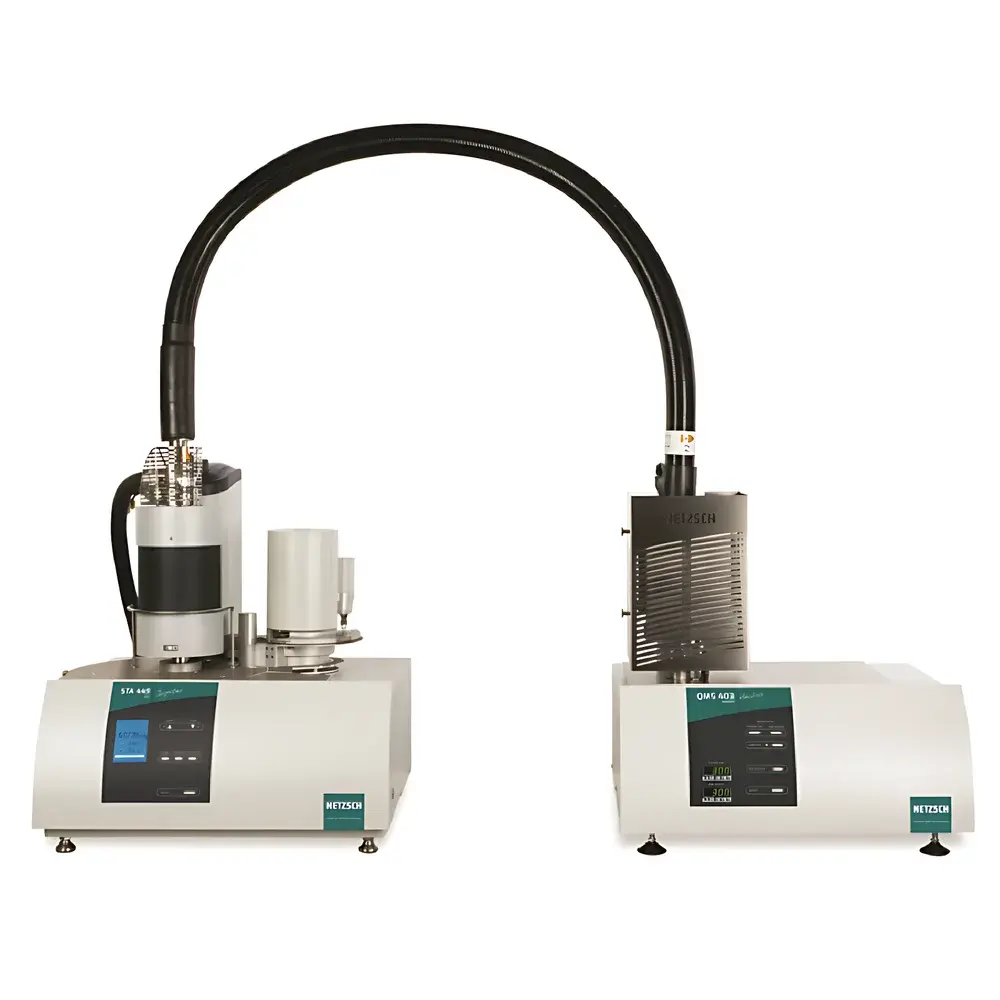
Netzsch STA/TG-MS Thermal Analysis–Mass Spectrometry Coupling System
| Brand | Netzsch |
|---|---|
| Origin | Germany |
| Model | STA/TG-MS |
| Mass Range | 1–300 amu (capillary interface) / 1–1024 amu (SKIMMER® interface) |
| Interface Temperature Range | RT–350 °C (capillary) / RT–2000 °C (SKIMMER®) |
| Sample Introduction | Top-loading vertical TGA configuration |
| Gas Transfer | Heated capillary or SKIMMER® transfer line, fully temperature-controlled |
| Data Synchronization | Hardware-triggered real-time coupling with dual acquisition control |
| Software Architecture | Fully integrated native-core platform with synchronized thermal and MS data acquisition |
Overview
The Netzsch STA/TG-MS Thermal Analysis–Mass Spectrometry Coupling System is an engineered solution for simultaneous, time-resolved identification and quantification of evolved gases during thermal decomposition, oxidation, reduction, or desorption processes. Based on the principle of hyphenated analytical instrumentation, it integrates a high-stability simultaneous thermal analyzer (STA)—combining thermogravimetric analysis (TGA) and differential scanning calorimetry (DSC)—with a quadrupole mass spectrometer (QMS) via a dedicated, temperature-regulated transfer interface. This architecture enables direct correlation between mass loss events (e.g., dehydration, decomposition, volatilization) and molecular-species evolution (e.g., H₂O, CO₂, NH₃, organic fragments, residual solvents), supporting mechanistic interpretation of solid-state reactions under controlled atmospheres (inert, oxidative, or reactive gas environments). The system is designed for laboratories requiring structural insight into thermal stability, reaction pathways, and off-gas composition—particularly in advanced materials development, pharmaceutical formulation, catalysis research, and energy storage material characterization.
Key Features
- Top-loading vertical TGA furnace design minimizes gravitational sample displacement and ensures quantitative, loss-free transfer of evolved gases from the crucible to the interface.
- Dual-interface capability: Selectable heated capillary (RT–350 °C) or high-temperature SKIMMER® transfer (RT–2000 °C), enabling robust transmission of thermally labile or high-boiling compounds without condensation or surface adsorption artifacts.
- Real-time hardware synchronization between thermal and mass spectral acquisition, eliminating time-lag drift and ensuring sub-second temporal alignment of mass loss steps and ion signal onset.
- Quantitative evolved gas analysis enabled by calibrated ion current response, supported by optional reference gas dosing and internal standard protocols compliant with ISO 11358-2 and ASTM E2550 practices.
- 3D visualization module correlating m/z intensity, temperature, and time—or mass loss rate—facilitating multivariate pattern recognition across complex decomposition profiles.
- Fully native-core software architecture with embedded instrument control, method automation, and post-acquisition deconvolution tools—including library matching (NIST/EPA/NIH), peak integration, and background subtraction algorithms.
Sample Compatibility & Compliance
The STA/TG-MS accommodates solid, powdered, or pelletized samples up to 500 mg in standard ceramic or platinum crucibles. It supports inert (N₂, Ar), oxidative (air, O₂), and reactive (H₂, CO, NH₃) atmospheres with flow control down to ±0.1 mL/min. All thermal modules comply with ISO 11357 (DSC), ISO 11358 (TGA), and ASTM E1131 (TGA) standards. The mass spectrometer meets IEC 61000-4 electromagnetic compatibility requirements. For regulated environments, the software platform supports audit trail logging, electronic signatures, and 21 CFR Part 11 compliance packages upon configuration—enabling use in GLP and GMP settings for pharmaceutical stability studies or polymer degradation validation.
Software & Data Management
NETZSCH Proteus® software serves as the unified control and evaluation environment. It provides synchronized method setup for both STA and QMS, including ramp-rate programming, step-isothermal holds, and MS scan parameter definition (dwell time, m/z range, cycle time). Raw data are stored in vendor-neutral HDF5 format with embedded metadata (instrument ID, calibration timestamps, operator credentials). Batch processing workflows support automated baseline correction, derivative calculation (DTG), and multi-peak fitting using Marquardt–Levenberg algorithms. Export options include CSV, ASCII, and XML formats compatible with third-party chemometric platforms (e.g., MATLAB, Python pandas, SIMCA).
Applications
- Decomposition mechanism elucidation in metal–organic frameworks (MOFs) and coordination polymers.
- Residual solvent quantification and desorption kinetics in API intermediates per ICH Q5C guidelines.
- Oxidative stability assessment of lithium-ion battery cathode materials under air/O₂ sweeps.
- Pyrolysis product profiling of biomass-derived chars and carbon precursors.
- Identification of volatile impurities in silicone elastomers and medical-grade polymers.
- In-situ monitoring of precursor-to-oxide conversion in sol–gel synthesis (e.g., Ti(OiPr)₄ → TiO₂).
FAQ
Can the STA/TG-MS operate in standalone mode?
Yes—the thermal analyzer and mass spectrometer can be operated independently, allowing routine TGA/DSC or QMS analysis without coupling.
Is SKIMMER® interface required for all applications?
No; the capillary interface suffices for low-to-medium volatility species (e.g., H₂O, CO₂, CH₄). SKIMMER® is recommended for heavy organics, oligomers, or metal carbonyls prone to condensation below 350 °C.
How is calibration performed for quantitative MS signal?
Calibration employs certified gas mixtures (e.g., NIST-traceable CO₂/N₂ blends) and/or dynamic vapor generation systems; sensitivity factors are stored per m/z channel and applied during post-processing.
Does the system support reactive gas atmospheres during MS detection?
Yes—gas switching is programmable within Proteus®, and the heated transfer path maintains integrity during transitions between inert and reactive gases.
What data security features are available for regulated labs?
Optional 21 CFR Part 11 add-on includes role-based access control, immutable audit trails, electronic signature capture, and encrypted database backups—validated per internal IQ/OQ protocols.



