
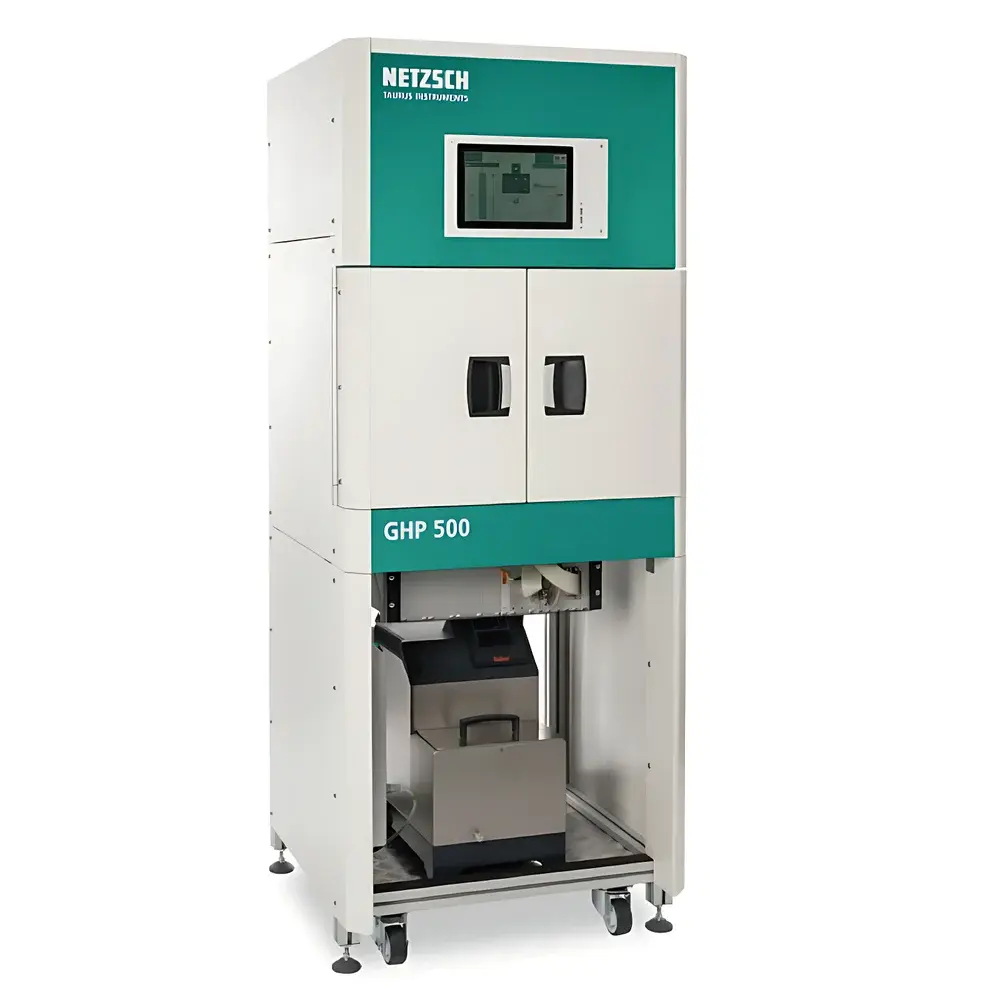
Netzsch TAURUS GHP 500 Guarded Hot Plate Thermal Conductivity Analyzer
| Brand | Netzsch |
|---|---|
| Origin | Germany |
| Model | TAURUS GHP 500 |
| Measurement Principle | Guarded Hot Plate (GHP) |
| Standard Compliance | ISO 8302, ASTM C177, EN 12664, EN 12667, EN 12939, EN 1946-2 |
| Thermal Conductivity Range | 0.005 – 2.0 W/(m·K) |
| Accuracy | ±1.0% |
| Repeatability | ±0.5% |
| Sample Thickness (Single-Sided) | 15 – 200 mm |
| Sample Thickness (Double-Sided) | 2 × 15 – 100 mm |
| Sample Area | 100 × 100 – 300 × 300 mm (optional 500 × 500 mm) |
| Hot Plate Temperature Range | −5 to 70 °C |
| Cold Plate Temperature Range | −15 to 60 °C |
| Enclosure Dimensions (H × W × D) | 186 × 75 × 75 cm |
Overview
The Netzsch TAURUS GHP 500 is a high-precision guarded hot plate (GHP) thermal conductivity analyzer engineered for absolute, steady-state measurement of thermal transport properties in low-to-moderate conductivity solid materials. Based on the fundamental principle of one-dimensional Fourier heat conduction under controlled temperature gradient and zero lateral heat loss, the GHP method delivers primary-standard-level accuracy—making it the reference technique for certification labs, building material R&D centers, and national metrology institutes. Unlike transient or comparative methods, the TAURUS GHP 500 establishes true thermal equilibrium across the sample, enabling direct determination of thermal conductivity (λ) and thermal resistance (R-value) without calibration against reference standards. Its design adheres strictly to ISO 8302 and ASTM C177, ensuring traceable, auditable results suitable for regulatory submissions, product certification (e.g., CE marking under EN 12664), and inter-laboratory round-robin studies.
Key Features
- Full-guarded enclosure architecture minimizing parasitic edge losses and ensuring <1% lateral heat flux deviation—critical for accurate λ calculation in heterogeneous or anisotropic insulators.
- Modular dual-plate and single-plate configurations: supports both symmetric double-sample (2×15–100 mm) and asymmetric single-sample (15–200 mm) testing, accommodating thick VIPs, aerogel composites, and structural boards.
- Adjustable heating area from 100 × 100 mm to 300 × 300 mm (500 × 500 mm optional), enabling representative bulk-property evaluation of large-format construction panels without edge-effect bias.
- Independent active temperature control of hot and cold plates (−5 to 70 °C / −15 to 60 °C), with high-stability PID loops maintaining ΔT stability better than ±0.02 K over 24 h—essential for low-conductivity measurements (<0.02 W/(m·K)).
- Front-access sample chamber with tool-free clamping and alignment guides, reducing setup time and operator-induced compression variability—particularly vital for compressible fibrous or foamed specimens.
- Integrated 7-inch capacitive touchscreen HMI with context-sensitive workflow guidance, real-time thermal gradient visualization, and automated pass/fail checks per ISO-defined stabilization criteria.
Sample Compatibility & Compliance
The TAURUS GHP 500 is validated for rigid, semi-rigid, and flexible low-density insulating materials including mineral wool, glass fiber batts, polyurethane (PUR) and phenolic foams, expanded/extruded polystyrene (EPS/XPS), polyimide aerogels, vacuum insulated panels (VIPs), multilayer reflective insulation systems, gypsum board, oriented strand board (OSB), and fired clay bricks. It accommodates non-planar surfaces up to ±1.5 mm flatness deviation and tolerates moderate thermal expansion anisotropy. All operational protocols align with GLP requirements: full audit trail logging, electronic signatures per FDA 21 CFR Part 11, and certificate-of-conformance generation compliant with ISO/IEC 17025 reporting templates. Test reports include uncertainty budgets calculated per GUM (JCGM 100:2008) and reference to NIST-traceable temperature sensors.
Software & Data Management
Control and analysis are performed via NETZSCH’s ThermoConcept GHP software (v5.x), a Windows-based platform supporting IQ/OQ/PQ documentation packages. The software implements automatic stabilization detection using dynamic slope-threshold algorithms, iterative λ calculation with iterative correction for contact resistance, and multi-point thermal gradient mapping across the guard gap. Raw data—including thermocouple voltages, power input, and time-stamped plate temperatures—is stored in HDF5 format with embedded metadata (sample ID, operator, ambient conditions, calibration certificates). Export options include CSV, PDF test reports with digital signature, and XML for LIMS integration. Optional network licensing enables centralized instrument fleet monitoring and remote diagnostic access under ITAR-compliant secure tunneling.
Applications
This system serves as the definitive benchmark for thermal performance validation in building envelope R&D (EN 1946-2), industrial insulation qualification (ASTM C618), aerospace composite certification (SAE AMS 3719), cryogenic packaging development, and green building compliance (LEED, Passivhaus). It is routinely deployed in third-party certification bodies (e.g., TÜV, UL, BRE) for Type IV testing of novel bio-based insulators, phase-change material (PCM)-integrated boards, and fire-retardant treated wood products. Its capability to resolve λ-values down to 0.005 W/(m·K) makes it indispensable for next-generation vacuum insulation and nanoscale porous silica characterization.
FAQ
What distinguishes guarded hot plate from heat flow meter methods?
The GHP method eliminates edge losses via active guarding and measures absolute thermal resistance under true steady state; HFM relies on comparative calibration and assumes linear heat flow, limiting accuracy for highly insulating or anisotropic materials.
Can the TAURUS GHP 500 measure anisotropic materials like wood or fiberboard?
Yes—its uniform pressure distribution system (adjustable up to 5 kPa) and large-area plates minimize directional bias; orientation-specific testing (radial vs. tangential) is supported via sample mounting fixtures.
Is temperature calibration traceable to national standards?
All Pt100 sensors are factory-calibrated against NIST SRM 1750 and accompanied by individual calibration certificates valid for 12 months; in-house verification routines follow EURAMET cg-18 guidelines.
How is contact resistance between sample and plates addressed?
The software applies an iterative correction model based on measured interfacial thermocouple gradients and known plate emissivity; users may also perform blank-run subtraction per ASTM C177 Annex A3.
Does the system support automated long-term drift monitoring?
Yes—the thermal drift monitor mode logs baseline heat flux at zero ΔT for 72 h, quantifying environmental influence and enabling predictive maintenance scheduling.



