
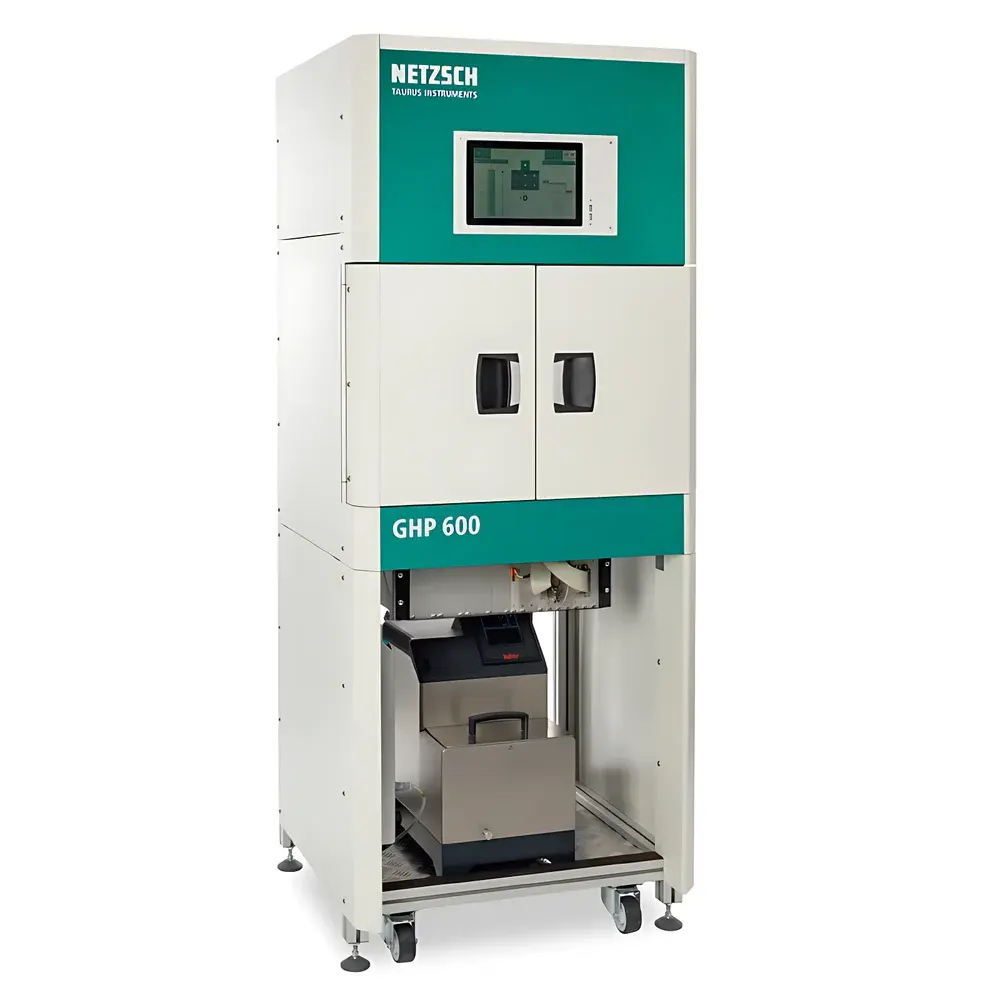
Netzsch TAURUS GHP 600 Guarded Hot Plate Thermal Conductivity Analyzer
| Brand | Netzsch |
|---|---|
| Origin | Germany |
| Model | TAURUS GHP 600 |
| Measurement Principle | Guarded Hot Plate Method |
| Sample Capacity | Multiple sequential tests |
| Operating Environment | Ambient temperature |
| Dimensions (H×W×D) | 186 × 85 × 85 cm |
| Accuracy | ±1.0% |
| Thermal Conductivity Range | 0.005 – 2.0 W/(m·K) |
| Repeatability | ±0.5% |
| Compliant Standards | ISO 8302, ASTM C177, EN 1946-2, EN 12664, EN 12667, EN 12939 |
| Sample Thickness | 15–200 mm (single-plate), 15–100 mm per plate (double-plate) |
| Sample Area | 100×100 – 300×300 mm² (standard), up to 600×600 mm² (optional) |
| Hot Plate Temperature Range | –5 to 70 °C |
| Cold Plate Temperature Range | –15 to 60 °C |
Overview
The Netzsch TAURUS GHP 600 is a high-precision guarded hot plate (GHP) thermal conductivity analyzer engineered for absolute, steady-state measurement of thermal transport properties in low-to-moderate conductivity solid materials. Based on the fundamental principle of Fourier’s law under controlled one-dimensional heat flow, the instrument establishes a stable thermal gradient across a flat, homogeneous sample sandwiched between two parallel plates — a centrally heated hot plate and a thermally symmetric cold plate — while actively suppressing lateral heat loss via a precisely regulated guard ring system. This architecture ensures minimal edge effects and enables traceable, primary-standard-level determination of thermal conductivity (λ, in W/(m·K)) and thermal resistance (R-value), without reliance on calibration transfer or empirical correlation. Designed and manufactured in Selb, Germany, the TAURUS GHP 600 meets the stringent metrological requirements of national and international standards laboratories, building physics research centers, and industrial R&D facilities engaged in insulation material development and regulatory compliance testing.
Key Features
- Full-guarded hot plate configuration with independently controlled guard ring, delivering true boundary-condition isolation and eliminating parasitic lateral conduction errors
- Modular plate design supporting both single-plate (15–200 mm thickness) and double-plate (2 × 15–100 mm) configurations for enhanced flexibility in specimen geometry and thermal resistance range
- Adjustable heating area from 100 × 100 mm² to 300 × 300 mm² (600 × 600 mm² available as optional configuration), accommodating standard and non-standard test specimens including large-format boards and layered composites
- Thermally optimized, fully insulated test chamber with vacuum-insulated walls and low-emissivity internal surfaces, minimizing environmental heat exchange and ensuring long-term thermal stability
- Intuitive 10.1-inch touchscreen interface with guided workflow navigation, real-time thermal profile visualization, and built-in diagnostic checks for heater uniformity, sensor drift, and guard-ring effectiveness
- Integrated precision temperature control system with PID-regulated hot and cold plates, capable of maintaining setpoints within ±0.02 °C over extended equilibration periods
Sample Compatibility & Compliance
The TAURUS GHP 600 is validated for rigid, semi-rigid, and flexible low-conductivity solids exhibiting isotropic or near-isotropic behavior. Compatible specimen categories include mineral wool, glass fiber batts and blankets, ceramic fiber modules, polyurethane (PUR), expanded (EPS) and extruded (XPS) polystyrene foams, polyimide aerogels, vacuum insulation panels (VIPs), gypsum board, oriented strand board (OSB), plywood, cellular concrete, and multi-layer architectural assemblies. All measurements are performed in accordance with ISO 8302 (1991), ASTM C177-22 (Standard Test Method for Steady-State Heat Flux Measurements), EN 1946-2 (Building Physics – Thermal Performance), EN 12664 (Lightweight Building Components), EN 12667 (High-Conductivity Materials), and EN 12939 (Vacuum Insulation Panels). The system supports full GLP documentation and audit-ready reporting for regulatory submissions requiring ISO/IEC 17025 traceability.
Software & Data Management
Operation and data acquisition are managed via Netzsch’s proprietary TaurusControl software, running on an embedded industrial PC. The software implements automated equilibrium detection based on temporal stability thresholds (e.g., <0.01 K/h drift in ΔT and Q), calculates λ and R-values using standardized correction algorithms for contact resistance and finite-edge effects, and exports results in CSV, PDF, and XML formats compliant with LIMS integration protocols. Full 21 CFR Part 11 functionality is available upon request, including electronic signatures, user role-based access control, and immutable audit trails for all measurement parameters, calibration events, and operator interventions. Raw thermocouple voltages, power inputs, and time-stamped thermal profiles are retained for retrospective analysis and uncertainty budgeting per GUM (JCGM 100:2008).
Applications
The TAURUS GHP 600 serves as a reference-grade instrument in national metrology institutes (NMIs), university thermal physics laboratories, and third-party certification bodies validating thermal performance claims for construction products under CE marking, ENERGY STAR, Passivhaus Institut criteria, and ASHRAE Standard 90.1. It is routinely deployed for: qualification of next-generation aerogel composites; verification of VIP core integrity after aging or mechanical compression; benchmarking of bio-based insulators (hempcrete, cork, mycelium); thermal characterization of fire-rated assemblies per ASTM E119; and generation of certified reference data for computational fluid dynamics (CFD) and building energy simulation tools such as EnergyPlus and TRNSYS. Its ability to measure thick, heterogeneous, or anisotropic samples—without assumptions about homogeneity—makes it indispensable for real-world material validation beyond idealized lab conditions.
FAQ
What standards does the TAURUS GHP 600 comply with?
ISO 8302, ASTM C177, EN 1946-2, EN 12664, EN 12667, and EN 12939.
Can it measure vacuum insulation panels (VIPs)?
Yes — the system accommodates VIPs up to 200 mm thick and includes pressure-compensated thermal interface protocols to minimize edge leakage errors common in ultra-low-λ materials.
Is dual-plate operation required for all tests?
No — single-plate mode is used for high-R-value materials (e.g., thick mineral wool), while double-plate mode improves accuracy for medium-conductivity specimens (e.g., XPS foam) by halving the required temperature differential.
How is thermal contact resistance addressed during measurement?
The software applies iterative correction based on interfacial thermocouple readings and empirically derived contact conductance models aligned with ISO 10456 Annex B.
Does the system support automated calibration verification?
Yes — integrated NIST-traceable reference standards (e.g., SRM 1450c Fibrous Glass Board) can be loaded for routine performance checks with auto-generated calibration certificates.



