
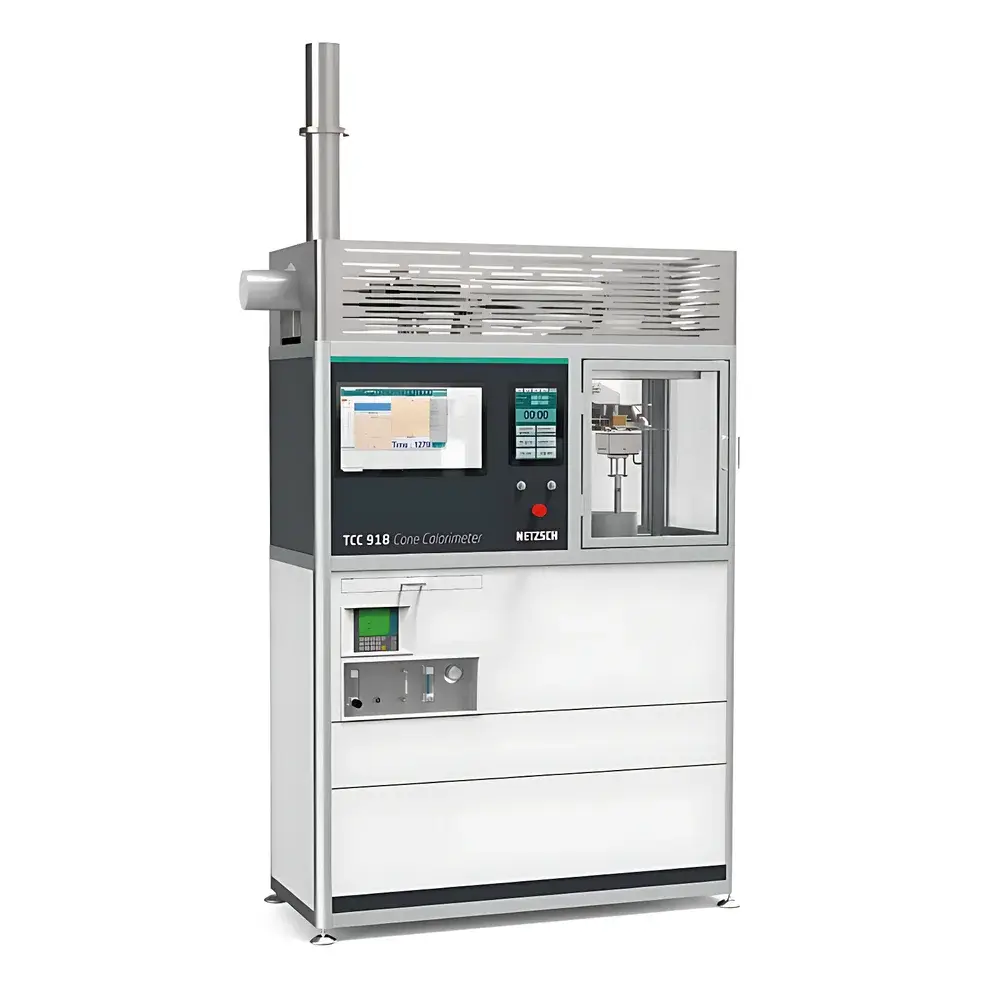
Netzsch TCC918 Cone Calorimeter
| Brand | Netzsch |
|---|---|
| Origin | Germany |
| Model | TCC918 Cone Calorimeter |
| Cone Heater | 220 V, 5 kW, adjustable heat flux 0–100 kW/m² |
| Thermocouple Accuracy | ±0.5 °C, tolerance 0.004 |
| Specimen Holder | 100 × 100 × 50 mm (expandable for vertical drip testing) |
| Load Cell | 8.2 kg max capacity, resolution 0.01 g, linearity ±0.02 g |
| Heat Flux Meter | fully automated control, accuracy ±2%, repeatability ±0.5% |
| O₂ Analyzer | paramagnetic, 0–25% vol, accuracy 0.001%, noise & drift <100 ppm |
| CO₂ Analyzer | NDIR, 0–10% vol, accuracy 0.001% |
| CO Analyzer | NDIR, 0–1% vol, accuracy 0.001% |
| C-factor Range | 0.036–0.044, calibration deviation ≤5% |
| Peltier Cooling | down to −10 °C |
Overview
The Netzsch TCC918 Cone Calorimeter is a high-precision, research-grade instrument engineered for quantitative fire reaction testing in accordance with ISO 5660-1, ASTM E1354, and other internationally recognized standards. It operates on the principle of oxygen consumption calorimetry—measuring heat release rate (HRR), total heat released (THR), mass loss rate (MLR), smoke production rate (SPR), and toxic gas yields (CO, CO₂, O₂) during controlled radiant exposure of solid materials. The TCC918 delivers traceable, reproducible fire performance data essential for regulatory compliance, material development, and fire modeling. Its design prioritizes measurement integrity: thermal stability is ensured via a massive granite test bench that isolates the specimen from mechanical vibrations induced by exhaust fans or environmental fluctuations; this directly enhances the sensitivity and fidelity of microgram-level mass loss detection.
Key Features
- Integrated Peltier cooling system capable of maintaining detector and sensor housings at −10 °C—eliminating reliance on cryogenic gases or desiccants while improving long-term signal stability and reducing operational overhead.
- Motorized vertical adjustment of the conical heater enables dynamic compensation for specimen expansion or charring during combustion, preserving consistent incident heat flux across evolving sample geometry.
- Granite-based combustion test platform provides exceptional rigidity, thermal inertia, and chemical resistance—facilitating rapid post-test cleaning and minimizing mechanical coupling between exhaust flow and mass measurement subsystems.
- Optimized laser alignment system ensures precise collimation and beam path integrity for the oxygen depletion measurement loop, supporting robust operation under prolonged thermal stress and particulate-laden exhaust conditions.
- Full automation architecture with synchronized acquisition of >20 real-time channels—including thermocouple arrays, load cell outputs, gas concentration signals, and airflow metrics—enabling strict temporal correlation required for fire dynamics analysis and model validation.
- Comprehensive safety interlock suite including automatic power cutoff upon flame extinction, overtemperature detection, and flow interruption safeguards—fully compliant with laboratory safety protocols and GLP audit requirements.
Sample Compatibility & Compliance
The TCC918 accommodates standard specimens measuring 100 mm × 100 mm × up to 50 mm thick, with optional fixtures enabling vertical orientation for drip behavior assessment per ISO 9772 and UL 94 extensions. It supports both non-intumescent and intumescent formulations—including polymer composites, fiber-reinforced laminates, foams, coatings, and construction boards. All measurement subsystems are calibrated traceably to national metrology institutes (e.g., PTB, NIST), and data reporting conforms to ISO/IEC 17025 documentation practices. The instrument meets functional requirements for ASTM E1354 Annex A1 (heat release rate), ISO 5660-1 Annex B (smoke obscuration), and EN 13823 (SBI pre-screening correlation). Optional audit-ready software modules support 21 CFR Part 11-compliant electronic signatures and full ALCOA+ data integrity frameworks.
Software & Data Management
The TCC918 is operated via Netzsch’s proprietary FireSoft™ platform—a Windows-based application delivering intuitive test setup, live parameter monitoring, and post-acquisition analysis. Raw data streams are stored in HDF5 format with embedded metadata (operator ID, calibration timestamps, environmental logs). Built-in tools enable calculation of peak HRR, time-to-ignition (TTI), effective heat of combustion (EHC), CO yield, and smoke specific optical density (Ds). Export options include CSV, XML, and PDF reports formatted to match internal QA templates or external regulatory submissions. Version-controlled firmware updates and secure remote diagnostics are supported through encrypted TLS channels, ensuring continuity in GMP-regulated environments.
Applications
- Fire safety qualification of automotive interior materials (FMVSS 302, ISO 3795)
- Development and certification of flame-retardant polymers for electronics enclosures and cable sheathing
- Performance benchmarking of intumescent coatings and firestop systems in building applications
- Validation of computational fluid dynamics (CFD) fire models using experimentally derived HRR curves
- Regulatory submission support for EU Construction Products Regulation (CPR) classification (Euroclasses B–F)
- Comparative evaluation of bio-based vs. petroleum-derived composites under identical radiant exposure conditions
FAQ
What standards does the TCC918 comply with for heat release rate measurement?
The TCC918 is fully compliant with ISO 5660-1, ASTM E1354, and DIN 53436 for oxygen consumption calorimetry-based HRR determination.
Can the instrument be used for vertical drip testing?
Yes—the specimen holder is configurable for vertical orientation, and optional drip collection trays and ignition source positioning kits are available for extended testing per ISO 9772 and UL 94.
How is calibration traceability maintained?
All critical sensors—including the heat flux meter, paramagnetic O₂ analyzer, and load cell—are calibrated using reference standards certified by accredited laboratories (e.g., DAkkS, UKAS), with calibration certificates archived within FireSoft™.
Is the system compatible with LIMS integration?
FireSoft™ supports OPC UA and RESTful API interfaces for bidirectional data exchange with laboratory information management systems, enabling automated result ingestion and audit trail synchronization.
What maintenance intervals are recommended for gas analyzers?
NDIR CO/CO₂ cells require annual zero/span verification; the paramagnetic O₂ sensor is specified for recalibration every 6 months under continuous operation, with built-in diagnostics logging drift trends.



