
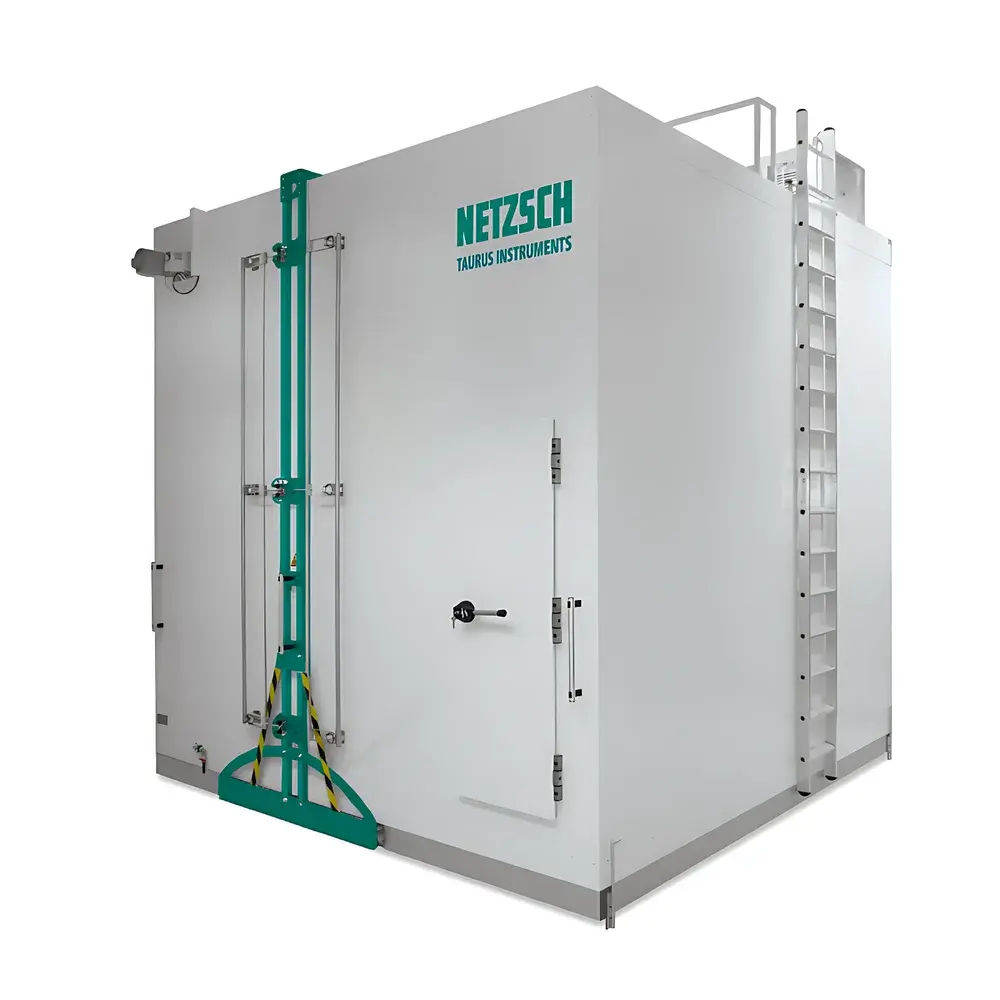
Netzsch TDW 4140 Guarded Hot Box System
| Brand | Netzsch |
|---|---|
| Origin | Germany |
| Model | TDW 4140 |
| Measurement Principle | Guarded Hot Box (Steady-State Heat Flow Method) |
| Compliance Standards | DIN EN ISO 8990, DIN EN 1946-4, DIN EN ISO 12567, DIN EN 12412-2, ASTM C1363 |
| Test Chamber Dimensions (Closed) | 400 × 400 × 405 cm (H×W×D) |
| Test Chamber Dimensions (Open) | 400 × 610 × 405 cm (H×W×D) |
| Sample Capacity (Windows) | up to 2180 × 1480 mm (H×W) |
| Sample Capacity (Doors) | up to 2180 × 2000 mm (H×W) |
| Maximum Sample Thickness | 340 mm |
| Thermal Resistance Range (R-value) | 0.10 – 8.00 m²·K/W |
| Thermal Transmittance Range (U-value) | 0.12 – 3.70 W/m²·K |
| Temperature Control Range (Hot Side) | 10 – 40 °C |
| Temperature Control Range (Cold Side) | −10 – 40 °C |
| Accuracy | ±3.0% |
| Repeatability | ±1.0% |
| Cooling System | Water-cooled recirculating chiller |
| Software | HotBox v5.x (Single License) |
| Weight | 4260 kg |
| Sample Handling | Motorized roller base with fork-lift access ports |
| Insulation Configuration | Fully guarded hot box with calibrated heat flux sensors and precision temperature mapping |
Overview
The Netzsch TDW 4140 Guarded Hot Box System is a high-precision, steady-state thermal transmittance measurement platform engineered for the quantitative characterization of full-scale building components under controlled environmental conditions. Based on the guarded hot box principle defined in ISO 8990 and ASTM C1363, the system establishes a stable thermal gradient across the test specimen while actively suppressing lateral heat losses through dynamic guard zone temperature control and high-performance insulation. This architecture ensures metrological traceability to national standards and enables reliable determination of both thermal resistance (R-value) and thermal transmittance (U-value) for heterogeneous, multi-layered assemblies—including windows, doors, façade panels, vaulted ceilings, masonry walls, and structural insulated panels (SIPs). The TDW 4140 is designed for laboratory-based certification testing, R&D validation, and compliance verification in accordance with EU Construction Products Regulation (CPR), Energy Performance of Buildings Directive (EPBD), and national energy code requirements.
Key Features
- Full-size guarded hot box configuration with independently controlled hot and cold chambers, each equipped with high-resolution PT100 sensor arrays (±0.05 °C accuracy) and active air circulation for uniform boundary conditions.
- Motorized roller base integrated into the insulated test frame, enabling safe, repeatable insertion and alignment of specimens up to 2180 mm in height and 2000 mm in width using standard forklift equipment—eliminating manual handling risks and positional variability.
- Water-cooled recirculating chiller system with dual independent loops, maintaining stable thermal setpoints across the full operating range (hot side: 10–40 °C; cold side: −10–40 °C) with drift < ±0.1 K/h during steady-state acquisition.
- Calibrated heat flux transducers (HFTs) embedded in chamber walls and specimen mounting frames, traceable to PTB (Physikalisch-Technische Bundesanstalt) reference standards, supporting uncertainty budgets compliant with ISO/IEC 17025.
- Modular insulation design featuring vacuum-insulated panels (VIPs) and multi-layer reflective barriers, minimizing parasitic heat transfer and ensuring guard zone effectiveness > 98% per ISO 8990 Annex B.
- Integrated environmental monitoring suite including relative humidity, ambient pressure, and air velocity sensors—automatically logged and correlated with thermal data for comprehensive uncertainty analysis.
Sample Compatibility & Compliance
The TDW 4140 accommodates architectural elements with complex geometries and variable thicknesses up to 340 mm, including double- and triple-glazed windows, thermally broken aluminum or timber-framed doors, prefabricated wall units, and curved or segmented assemblies such as domes and barrel vaults. Its mechanical interface supports both vertical and horizontal mounting orientations, with adjustable clamping mechanisms that preserve edge sealing integrity without compressing gasket materials. All operational protocols and calibration procedures adhere strictly to DIN EN ISO 8990 (hot box method), DIN EN 1946-4 (ventilation and thermal performance), DIN EN ISO 12567 (wood-based panels), DIN EN 12412-2 (window U-value determination), and ASTM C1363 (thermal performance of building assemblies). Data reporting includes full audit trails, instrument calibration certificates, and uncertainty statements aligned with EURAMET cg-18 guidelines.
Software & Data Management
HotBox software v5.x serves as the unified control, acquisition, and analysis environment for the TDW 4140. It implements automated test sequencing—from initial chamber conditioning and thermal equilibration to steady-state detection (based on ISO 8990 criteria: ΔT < 0.1 K/h over ≥4 h), real-time flux integration, and final R/U calculation. The software enforces GLP-compliant workflows, including electronic signatures, role-based user permissions, and 21 CFR Part 11–ready audit logs with immutable timestamps and operator attribution. Raw sensor data (temperature, heat flux, humidity, pressure) are stored in HDF5 format with embedded metadata, supporting post-hoc reprocessing and third-party interoperability via API export (JSON/XML). Calibration parameters, environmental corrections, and material property databases are centrally managed and version-controlled within the application.
Applications
- Third-party certification testing for CE marking and EPBD compliance (e.g., U-value declarations for window systems under EN 14351-1).
- Development and validation of low-emissivity coatings, vacuum glazing, aerogel-integrated spacers, and phase-change material (PCM)-enhanced façades.
- Comparative evaluation of thermal bridging effects at frame-sash junctions, anchoring points, and perimeter seals in curtain wall systems.
- Verification of declared thermal performance for prefabricated building modules prior to site installation.
- Research into moisture-coupled heat transfer in hygroscopic materials (e.g., cross-laminated timber, hempcrete) under controlled RH gradients.
- Support for national building energy codes requiring in-situ or lab-measured U-values for compliance documentation (e.g., German EnEV, UK SAP, French RT 2012).
FAQ
What standards does the TDW 4140 comply with for thermal transmittance measurement?
The system fully conforms to DIN EN ISO 8990, DIN EN 1946-4, DIN EN ISO 12567, DIN EN 12412-2, and ASTM C1363, with documented traceability to PTB and NIST reference methods.
Can the TDW 4140 measure specimens with non-rectangular geometries?
Yes—its open-frame architecture and programmable sensor grid allow accurate R/U determination for curved, arched, or segmented assemblies, provided thermal symmetry and boundary condition control are maintained per ISO 8990 Annex D.
Is the HotBox software validated for regulated environments?
Yes—HotBox v5.x includes 21 CFR Part 11 compliance features (electronic signatures, audit trail, data integrity controls) and has been deployed in ISO/IEC 17025-accredited laboratories for accredited testing.
What is the typical stabilization time for a full-size door test?
Under standard conditions (ΔT = 20 K), stabilization typically requires 8–12 hours; the software automatically detects steady state using configurable convergence thresholds and duration criteria.
Does the system support custom environmental profiles (e.g., cyclic temperature or humidity ramps)?
While primarily optimized for steady-state operation, optional add-on modules enable controlled transient profiling for advanced research applications, subject to hardware cooling capacity and sensor response limitations.
Related Products



