
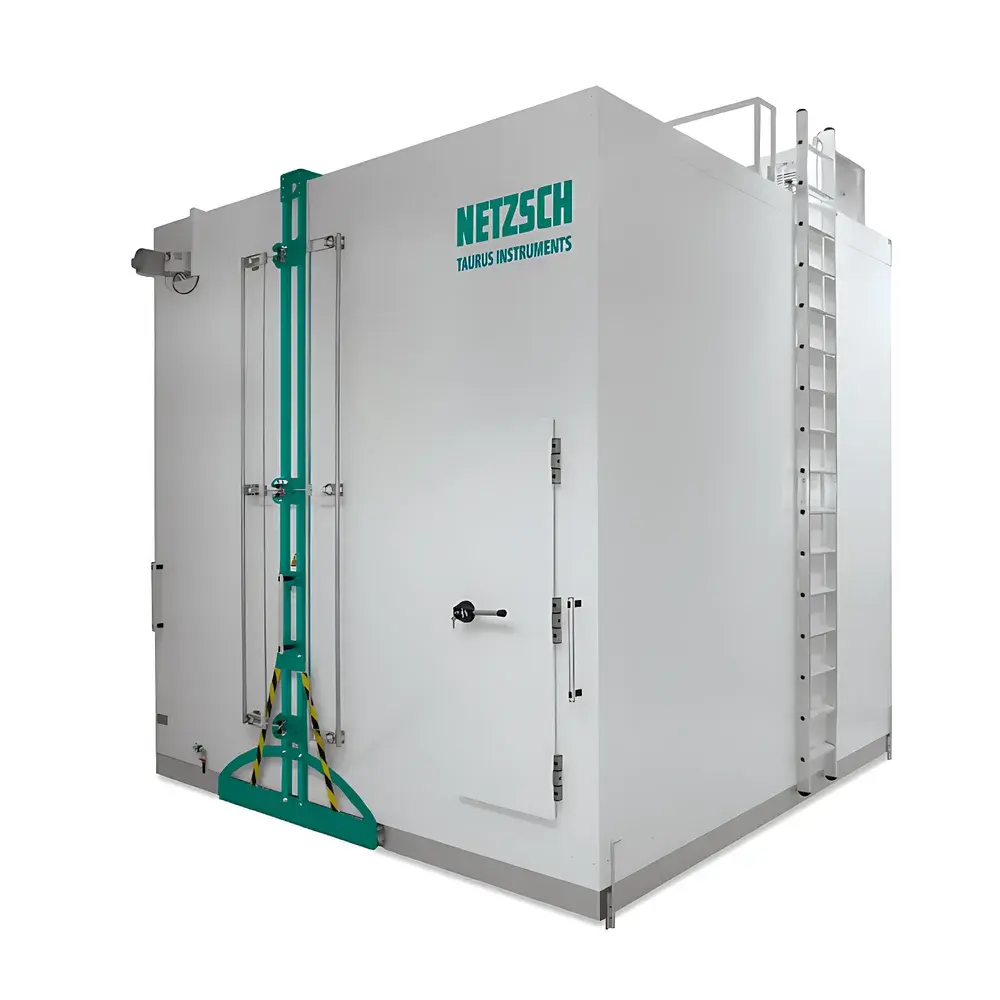
Netzsch TDW 4240 Guarded Hot Box System
| Brand | Netzsch |
|---|---|
| Origin | Germany |
| Model | TDW 4240 |
| Measurement Principle | Guarded Hot Box (Steady-State Heat Flow Method) |
| Compliance Standards | DIN EN ISO 8990, DIN EN 1946-4, DIN EN ISO 12567, DIN EN 12412-2, ASTM C1363 |
| Thermal Resistance Range (R-value) | 0.10 – 8.00 m²·K/W |
| Thermal Transmittance Range (U-value) | 0.12 – 3.70 W/m²·K |
| Sample Height (Windows) | up to 2180 mm |
| Sample Width (Windows) | up to 1480 mm |
| Sample Height (Doors) | up to 2180 mm |
| Sample Width (Doors) | up to 2000 mm |
| Maximum Sample Thickness | 560 mm |
| Cold Chamber Temperature Range | −15 °C to +40 °C |
| Hot Chamber Temperature Range | +10 °C to +60 °C |
| Enclosure Dimensions (Closed) | 400 × 400 × 405 cm (H × W × D) |
| Enclosure Dimensions (Open) | 400 × 610 × 405 cm (H × W × D) |
| System Weight | 4680 kg |
| Accuracy | ±3.0% |
| Repeatability | ±1.0% |
| Cooling System | Water-cooled recirculating chiller |
| Sensor Configuration | Two guarded heat flux meters with protective plates |
| Test Frame | Insulated test frame with roller base and opening for forklift-assisted sample loading |
| Software | HotBox™ v5.x (single-user license) |
| Power Supply | 400 V, 3-phase, 50/60 Hz |
Overview
The Netzsch TDW 4240 Guarded Hot Box System is a precision-engineered, fully compliant steady-state thermal transmittance (U-value) and thermal resistance (R-value) measurement platform designed for large-scale building components under controlled environmental conditions. Based on the guarded hot box principle defined in ISO 8990 and ASTM C1363, the system establishes a stable thermal gradient across the specimen while actively suppressing lateral heat losses through dynamic guard zone temperature control. This architecture ensures metrologically traceable results for heterogeneous, non-uniform assemblies—such as insulated doors, multi-pane windows, curtain wall systems, masonry panels, and prefabricated façade elements—where conventional transient or comparative methods fail to resolve spatially varying thermal bridging effects. The TDW 4240 operates in accordance with national and international regulatory frameworks governing energy performance certification, including EN 1946-4 for window testing and EN 12412-2 for door classification, making it an essential tool for accredited laboratories pursuing ISO/IEC 17025 accreditation.
Key Features
- Guarded hot box configuration with independently controlled hot and cold chambers, each equipped with high-stability PID-regulated heating/cooling circuits and water-cooled recirculating chillers for precise thermal boundary condition maintenance.
- Insulated test frame with integrated roller base and front-access opening, enabling safe, forklift-assisted loading of oversized specimens up to 2180 mm in height and 2000 mm in width without disassembly.
- Two calibrated, guarded heat flux meters (with stainless steel protective plates) mounted on the cold-side interior surface, providing redundant, spatially resolved heat flow quantification with traceable NIST-equivalent calibration certificates.
- HotBox™ v5.x software suite supporting full test sequence automation, real-time thermal gradient monitoring, automatic equilibrium detection per EN ISO 8990 Annex B, and built-in uncertainty propagation analysis per GUM (JCGM 100:2008).
- Rigid structural enclosure fabricated from 50 mm polyurethane-insulated steel panels with triple-glazed viewing windows, minimizing parasitic heat exchange and ensuring long-term thermal stability during extended 72+ hour steady-state measurements.
- Integrated environmental data logging (temperature, humidity, air velocity) at 16 spatially distributed points across both chambers, synchronized with heat flux acquisition at 1 Hz sampling rate for comprehensive thermal mapping.
Sample Compatibility & Compliance
The TDW 4240 accommodates architectural specimens conforming to standardized dimensional classes A and B per EN ISO 12567: windows (1480 × 1230 mm and 2180 × 1480 mm), doors (2180 × 1230 mm and 2180 × 2000 mm), and planar building elements up to 560 mm thick. Its modular sealing interface supports gasketed, bolted, and vacuum-assisted mounting configurations to ensure air-tight boundary conditions required by EN 1946-4. All measurement protocols are pre-configured to enforce compliance with mandatory reporting formats for CE marking documentation, EPBD (Energy Performance of Buildings Directive) declarations, and U.S. NFRC 100–2022 certification submissions. The system meets ISO/IEC 17025 clause 6.4.10 requirements for equipment suitability verification and includes factory-verified thermal drift compensation algorithms validated against reference standards traceable to PTB (Physikalisch-Technische Bundesanstalt).
Software & Data Management
HotBox™ v5.x provides a validated, audit-ready environment aligned with FDA 21 CFR Part 11 and EU Annex 11 principles. It features role-based user access control, electronic signatures, full audit trail logging (including parameter changes, calibration events, and report generation), and automatic backup to network-attached storage. Raw sensor data—including thermocouple arrays, heat flux integrals, and chamber power consumption—is stored in HDF5 format with embedded metadata (timestamp, operator ID, calibration expiry, environmental conditions). Export modules generate EN-compliant PDF reports with uncertainty budgets, graphical R/U-value convergence plots, and annotated thermal images. Optional integration with LIMS platforms via RESTful API enables automated result ingestion into enterprise quality management systems operating under GLP or GMP frameworks.
Applications
- Determination of U-values and R-values for certified energy labeling of windows, doors, skylights, and façade systems under EN 1279-2 and ISO 10291.
- Thermal bridging analysis of complex junctions (e.g., window-to-wall interfaces, lintel penetrations) using localized heat flux mapping.
- Validation of computational fluid dynamics (CFD) and finite element method (FEM) thermal models per ISO 10211.
- Performance verification of vacuum insulation panels (VIPs), aerogel composites, and phase-change material (PCM)-integrated building envelopes.
- Third-party conformity assessment for CE marking, Passive House Institute (PHI) certification, and U.S. ENERGY STAR® qualification testing.
- Research-grade characterization of novel insulating materials, including bio-based foams and recycled aggregate concretes, under realistic boundary conditions.
FAQ
What standards does the TDW 4240 comply with for building component testing?
The system is fully compliant with DIN EN ISO 8990, DIN EN 1946-4, DIN EN ISO 12567, DIN EN 12412-2, and ASTM C1363 for steady-state thermal transmittance measurement.
Can the TDW 4240 test curved or non-planar specimens such as domes or vaulted glazing?
Yes—the open-frame architecture and adjustable mounting fixtures support convex, concave, and segmented geometries up to 560 mm thickness, provided thermal contact uniformity is maintained via custom gasketing.
Is HotBox™ software qualified for regulated environments requiring 21 CFR Part 11 compliance?
Yes—version 5.x includes electronic signature workflows, audit trail retention for ≥10 years, and configurable user roles meeting FDA and EMA validation requirements.
What is the typical measurement duration for achieving steady-state equilibrium?
Per EN ISO 8990 Annex B, equilibrium is confirmed after three consecutive 30-minute intervals where temperature differentials and heat flux rates vary by ≤0.1%; typical duration ranges from 48 to 96 hours depending on specimen thermal mass and R-value.
Does the system support external calibration verification using reference panels?
Yes—calibration verification kits with NIST-traceable reference specimens (R = 1.0, 2.5, and 5.0 m²·K/W) are available, and the software includes dedicated verification protocol templates with pass/fail criteria per ISO/IEC 17025.



