
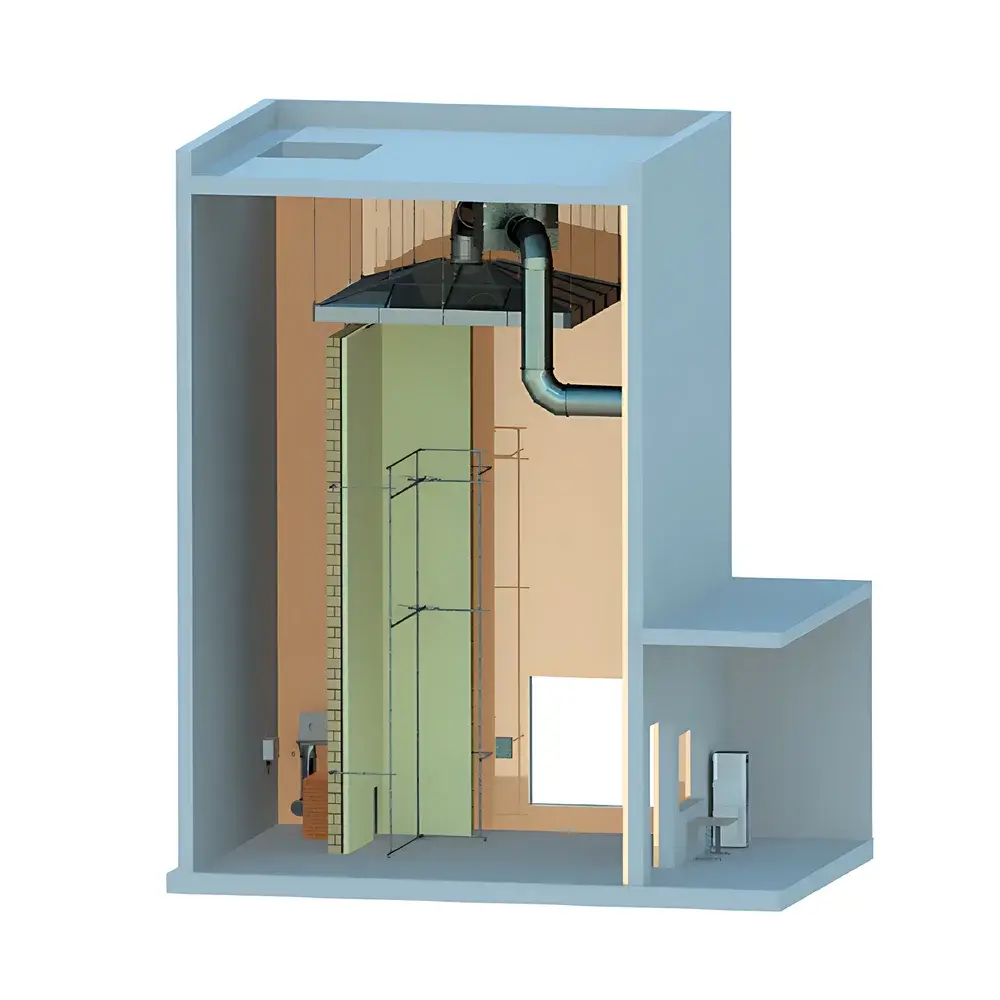
Netzsch TFP External Cladding Fire Test System
| Brand | Netzsch |
|---|---|
| Origin | Germany |
| Model | TFP External Cladding Fire Test System |
| Standards Compliance | DIN 4102-20, ONORM B3800-5, BS 8414-1 |
| Combustion Chamber Base | Stainless steel roller bed with gravel fill, non-return valve, ignition system, and flame detection sensor |
| Exhaust System | Radial exhaust fan with mass-flow control (0–200 L/min), stainless steel exhaust hood and collector |
| Cooling | Peltier cooler (down to −10 °C) |
| Gas Analysis | Siemens paramagnetic O₂ analyzer (16–21% v/v, resolution 0.001%), NDIR CO₂ analyzer (0–10% v/v) |
| Temperature Measurement | −100 °C to 1300 °C, resolution 0.1 K, cold-junction compensation |
| Pressure Differential Sensor | 0–20 Pa, accuracy ±1% |
| Propane Mass Flow Controller | 0–0.5 kg/min |
| Measurement Tube | Stainless steel, Ø600 mm |
| Control Unit | Integrated single-board computer with 10.1″ color touchscreen interface for real-time monitoring and automated reporting |
Overview
The Netzsch TFP External Cladding Fire Test System is a rigorously engineered bench-scale fire testing apparatus designed to evaluate the fire performance of external wall cladding systems under realistic, large-scale exposure conditions. It operates on the principle of controlled radiant and convective heat flux application—simulating the vertical flame spread behavior of façade assemblies when subjected to external fire sources such as dumpster fires or adjacent building fires. Unlike small-scale flammability screening methods (e.g., cone calorimetry or LOI), the TFP system replicates full-system interaction between insulation, cladding, cavity, and substrate under standardized fire exposure protocols defined in DIN 4102-20 (Germany), ONORM B3800-5 (Austria), and BS 8414-1 (UK). Its design adheres to the fundamental requirements of large-scale reaction-to-fire testing: stable thermal input, reproducible airflow management, precise gas composition monitoring, and traceable thermometric calibration—all essential for regulatory submission and third-party certification.
Key Features
- Stainless steel roller-bed combustion base with calibrated gravel layer, integrated non-return valve, programmable propane ignition system, and optical flame detection for automatic test initiation and safety interlock.
- Radial exhaust fan with closed-loop mass-flow control ensures constant volumetric exhaust rate (0–200 L/min), critical for maintaining prescribed draft conditions per BS 8414-1 Annex A and DIN 4102-20 Section 6.3.
- Corrosion-resistant stainless steel exhaust hood and condensate collector accommodate acidic combustion by-products (e.g., HCl, SO₂) generated during polymeric cladding decomposition.
- Peltier-based active cooling module maintains detector and sampling line temperatures below dew point (down to −10 °C), preventing condensation-induced measurement drift in gas analyzers.
- Siemens-certified paramagnetic oxygen analyzer (16–21% v/v, resolution 0.001%) and NDIR carbon dioxide analyzer (0–10% v/v) enable stoichiometric combustion efficiency calculation and smoke production quantification in accordance with ISO 13943 and ASTM E1354.
- Integrated single-board control unit with real-time 10.1″ capacitive touchscreen interface supports synchronized acquisition of 16+ analog channels—including thermocouple arrays (Type K, −100 °C to 1300 °C, 0.1 K resolution with cold-junction compensation), differential pressure sensors (0–20 Pa, ±1% accuracy), and mass flow controllers (propane: 0–0.5 kg/min).
Sample Compatibility & Compliance
The TFP system accommodates façade mock-ups up to 3.0 m height × 1.5 m width, supporting multi-layer configurations including metal composite panels (MCPs), fiber-cement boards, aluminum curtain walls, mineral wool or phenolic foam insulation, air gaps, and structural substrates (concrete, steel framing). All hardware and software workflows are aligned with GLP-compliant audit trails and meet data integrity requirements under FDA 21 CFR Part 11 when configured with electronic signature modules. Test reports automatically embed metadata compliant with EN 13501-1 classification logic, facilitating direct integration into European Technical Assessments (ETAs) and UK Building Regulations Approved Document B submissions.
Software & Data Management
The embedded TFP Control Suite runs on a deterministic real-time OS and provides synchronized acquisition at 10 Hz across all sensor inputs. Raw data is stored in HDF5 format with embedded calibration certificates, instrument IDs, and operator metadata. Reporting templates conform to DIN SPEC 91379 and BS 8414-1 Annex D, generating PDF/CSV outputs with traceable uncertainty budgets per GUM (JCGM 100:2008). Optional add-ons include remote diagnostics via TLS-encrypted MQTT, automated calibration logging with NIST-traceable reference gases, and interoperability with LIMS platforms through ASTM E1461-compliant API endpoints.
Applications
- Regulatory fire testing of external cladding systems for high-rise residential and commercial buildings.
- Development and validation of fire-retardant coatings, intumescent barriers, and cavity fire stop solutions.
- Root-cause analysis of façade fire incidents (e.g., post-Grenfell forensic investigations).
- Comparative assessment of combustible vs. non-combustible insulation integration strategies.
- Supporting CE marking under Construction Products Regulation (CPR) Annex ZA and UKCA marking pathways.
FAQ
Which international standards does the TFP system fully support?
DIN 4102-20 (Germany), ONORM B3800-5 (Austria), and BS 8414-1 (United Kingdom) — including all mandatory instrumentation, procedural controls, and reporting requirements.
Can the system be upgraded to comply with upcoming revisions of BS 8414?
Yes — the modular architecture allows firmware updates, sensor recalibration, and protocol expansion via certified software releases validated against draft CEN/TS 13823 amendments.
Is third-party verification of calibration included?
Each delivery includes factory calibration certificates traceable to PTB (Physikalisch-Technische Bundesanstalt) for temperature, flow, and gas sensors, with optional on-site verification by accredited metrology partners.
What level of technical support is available post-installation?
Netzsch provides 24/7 remote diagnostics, annual preventive maintenance contracts, and on-demand application engineering support for method development and regulatory documentation.



