
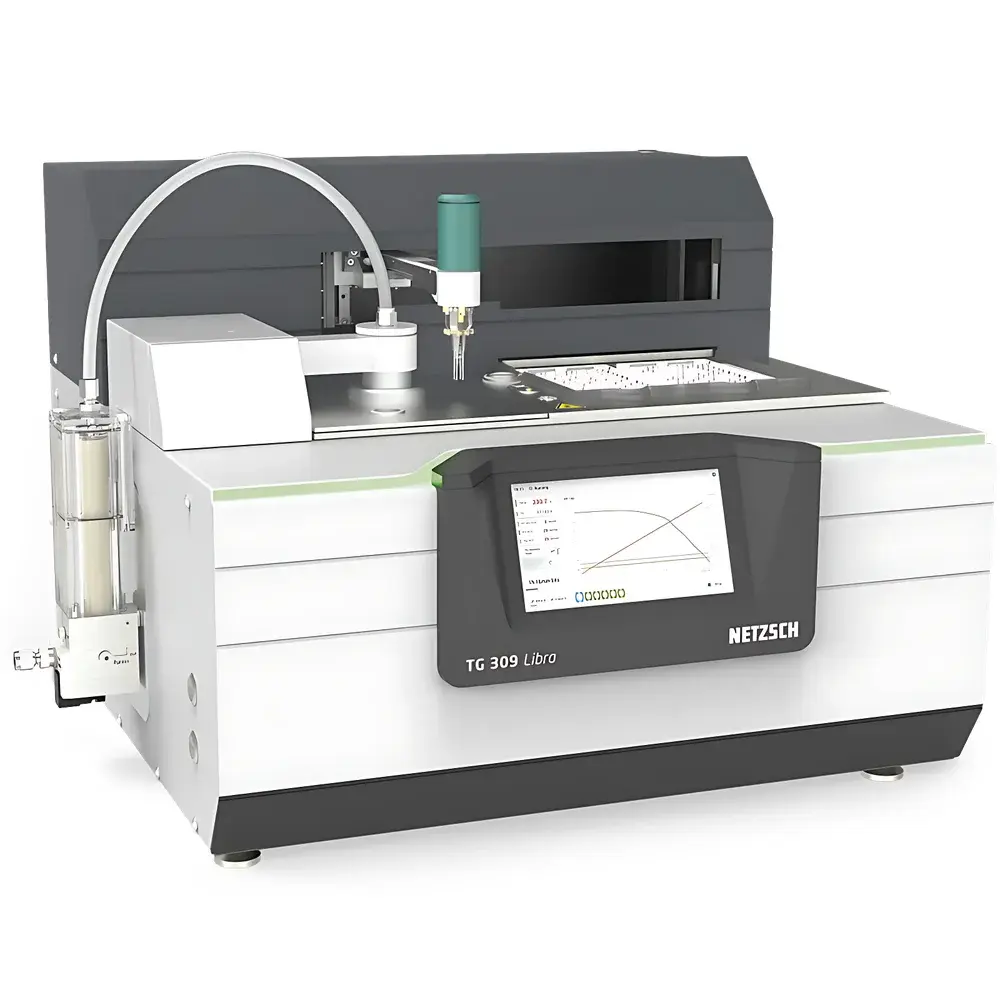
Netzsch TG 309 Libra Select Thermogravimetric Analyzer
| Brand | Netzsch |
|---|---|
| Origin | Germany |
| Model | TG 309 Libra Select |
| Temperature Range | 10 °C to 1025/1100 °C |
| Temperature Accuracy | ±0.15 K |
| Heating/Cooling Rate | 0–200 K/min |
Overview
The Netzsch TG 309 Libra Select is a high-precision, modular thermogravimetric analyzer engineered for rigorous thermal stability, decomposition kinetics, and compositional analysis of solid and powdered materials under controlled atmospheric conditions. Operating on the fundamental principle of continuous mass measurement as a function of temperature or time in a defined gas environment, the instrument employs a high-resolution microbalance (capable of sub-microgram resolution) coupled with a precisely regulated horizontal furnace. Its core architecture integrates a patented counterbalanced suspension system and active buoyancy compensation to minimize convection-induced artifacts and ensure exceptional baseline stability—even during rapid heating or extended isothermal holds. Designed for both R&D laboratories and quality control environments, the TG 309 Libra Select delivers reproducible, traceable mass-loss data aligned with international thermal analysis standards including ASTM E1131, ISO 11358, and CEI-IEC 60695-2-10.
Key Features
- Ultra-stable microbalance platform with active drift compensation and real-time buoyancy correction
- Programmable heating/cooling rates from 0 to 200 K/min, enabling kinetic studies across wide thermal regimes
- Temperature accuracy of ±0.15 K, validated using certified reference materials traceable to NIST and PTB standards
- Integrated c_DTA® option: simultaneous differential thermal analysis (DTA) signal acquisition synchronized with TGA, supporting precise temperature calibration and detection of endo-/exothermic events coincident with mass change
- Super-Res® mode: intelligent rate modulation that dynamically adjusts heating rate near overlapping decomposition steps to enhance resolution of adjacent mass-loss events
- Modulated TGA (MTGA) capability (optional): application of sinusoidal temperature perturbations to decouple kinetic and diffusion-controlled processes
- Dual-zone temperature-controlled enclosure: includes integrated recirculating chiller unit for stable ambient conditioning of the balance compartment—critical for minimizing thermal drift during long-duration runs and enabling sub-ambient start temperatures down to 10 °C
- Vacuum-compatible design with optional turbomolecular pump integration for inert, oxidative, or reducing atmospheres at pressures down to 10⁻⁵ mbar
Sample Compatibility & Compliance
The TG 309 Libra Select accommodates diverse sample types—including polymers, pharmaceuticals, catalysts, ceramics, composites, and battery materials—via interchangeable crucible systems: standard alumina, high-purity platinum-rhodium (for corrosive or high-temperature applications), quartz, graphite, and aluminum pans. Optional corrosion-resistant sample holders extend usability for halogen-rich or acidic samples. All crucibles are pre-characterized for thermal mass contribution and calibrated against certified reference substances (e.g., Ni, Cu, Al₂O₃, CaC₂O₄·H₂O) covering the full operational range (10–1100 °C). The system supports compliance with GLP/GMP workflows through audit-trail-enabled software, electronic signatures, and 21 CFR Part 11–compliant data integrity controls when configured with appropriate security modules.
Software & Data Management
Operating via NETZSCH Proteus® Software, the instrument provides comprehensive data acquisition, real-time visualization, and post-processing tools. Functions include automatic step detection and annotation (mass loss onset, offset, residual mass), DTG (first derivative) and D²TG (second derivative) curve generation with peak identification, baseline subtraction algorithms (linear, polynomial, or adaptive), and extrapolated onset/endpoint calculation per ASTM E1641. Data export is supported in ASCII, CSV, and universal .tdms formats; batch processing and report templates comply with internal SOPs and external regulatory submissions. Proteus® also enables remote monitoring, scheduled shutdowns, and integration with LIMS platforms via OPC UA or SQL database connectors.
Applications
- Quantitative determination of moisture, volatiles, filler content, and ash residue in polymer formulations and composites
- Thermal degradation profiling and kinetic modeling (e.g., Flynn-Wall-Ozawa, Kissinger) for pharmaceutical excipients and APIs
- Oxidative induction time (OIT) and oxidative onset temperature (OOT) assessment per ASTM D3895 and ISO 11357-6
- Catalyst deactivation studies under simulated process conditions
- Char yield evaluation in flame-retardant materials per UL 94 and IEC 60695 standards
- Decomposition pathway analysis of metal-organic frameworks (MOFs) and battery cathode precursors
FAQ
What is the maximum recommended operating temperature for routine use?
The standard configuration supports continuous operation up to 1025 °C; the 1100 °C variant requires optional high-temperature furnace and sensor upgrades.
Can the TG 309 Libra Select perform simultaneous TGA-DSC measurements?
No—this model does not integrate DSC functionality. However, the c_DTA® option provides a qualitative DTA-like signal synchronized with mass change, primarily intended for temperature calibration and event correlation.
Is automatic baseline correction available during data acquisition?
Yes—Proteus® software applies real-time adaptive baseline modeling, and post-acquisition correction algorithms support linear, polynomial, or user-defined reference segment fitting.
How is system calibration maintained over time?
Calibration is performed using certified reference materials supplied by NETZSCH; temperature calibration covers 10–1100 °C, while mass calibration uses certified weights traceable to national metrology institutes.
Does the ASC (Automatic Sample Changer) support unattended weekend operation?
Yes—the ASC-2000 module enables fully automated sequential analysis of up to 20 samples, including purge gas switching, temperature ramp programming, and error recovery protocols compliant with 24/7 QC laboratory requirements.



